

Promoting Proteaceae: Prospects & Provisos
June 2023

Trees and plants always look like the
—Zora Neale Hurston 1
people they live with, somehow.
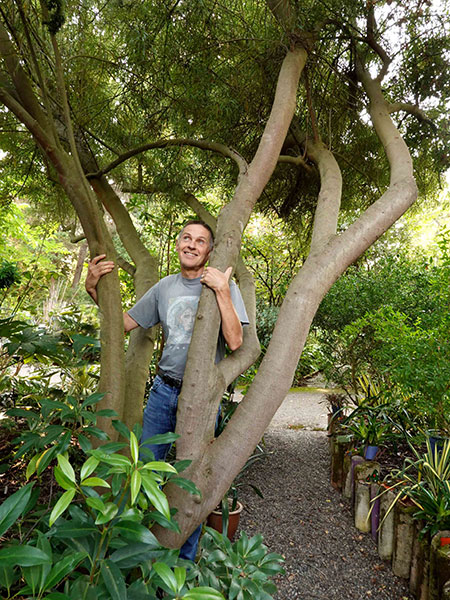
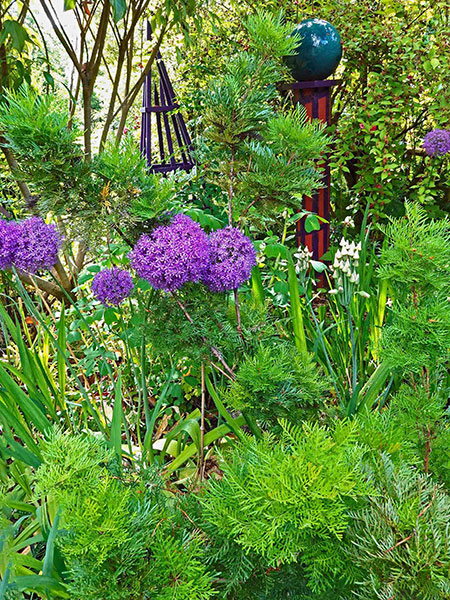
Of the 100 or so trees I’ve plopped into the garden over the last third of a century, one that against all odds has wormed its way endearingly into my heart is Lomatia myricoides, a native of southeastern Australia and the largest member of the protea family we can grow in the maritime Pacific Northwest. My sprawling specimen, profiled last fall in the HY segment “If Trees Could Talk,” airily embraces neighbors with its 30-foot wingspan. Already budding up, next month it will be covered in fragrant, ivory-toned blossoms that captivate bees and hummingbirds alike. Two other species in the genus can be grown here, the easier of which, L. tinctoria, also an Aussie, is a compact shrub with attractive, tightly packed, minutely dissected foliage 2. The third, L. ferruginea, a native of Patagonian Chile and Argentina that boasts exquisitely bipinnate, ferny foliage and alluring pinkish orange flowers, is occasionally offered by specialty growers in our region, although I’ve failed to keep one alive in my garden.

Straddling the intersection of weird, wacky and wonderful, proteaceous plants are instantly identifiable by the elaborate curlicues, pincushions or whirligigs of their complex inflorescences. The botanical family Proteaceae —which comprises only around 80 genera— was among the earliest group of flowering plants to emerge. They did so in nutrient-poor soils of the erstwhile southern-hemisphere supercontinent of Gondwanaland, which explains the family’s roughly 1600 species’ concentration in South Africa and Australia, with prominent members also found in the southern cone of South America. Closer to home, the climate of California’s Bay Area is exceptionally well suited for this family, with dazzling collections on view in the botanical gardens of UC Santa Cruz, UC Berkeley and San Francisco’s Strybing Arboretum. In our chillier region we can only grow a few of the Australian and South American Proteaceae species in the genera Embothrium (covered in the last segment of HY), Gevuina, Grevillea, Hakea, Lomatia, and Telopea.
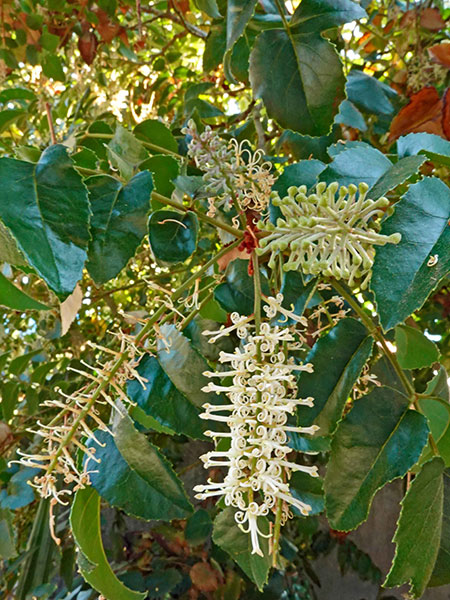
Let’s take an alphabetical look at the four genera we haven’t yet discussed. Gevuina: The only species in its genus, G. avellana (commonly called Chilean hazelnut) is oddly absent in our gardens, although Tacoma’s Point Defiance Zoo boasts a healthy, 16-year-old specimen (see photo) that sports gorgeous white bottlebrush flowers. According to chief horticulturalist Bryon Jones, it has yet to produce the hallmark edible nuts. (Sidenote: the tastiest “protean” tidbits are the nuts of the decidedly delicious Macadamia integrifolia, an Australian native we often associate with Hawaii.)
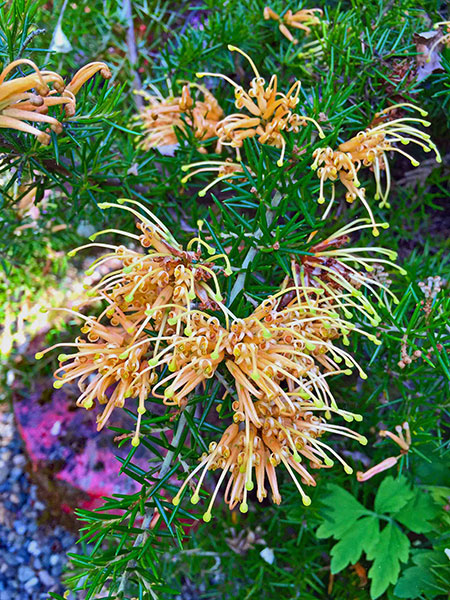
As for Grevillea, I’ve inadvertently killed about a dozen cultivars over the decades. Of all I’ve tried, only two remain, but these are fat and sassy. This prolific genus (one for every day of the year) hails almost exclusively from Australia; only a wee handful are suitable for the PNW. The most robust is G. victoriae, which grows gangbusters and pushes out spidery, rusty-orange flowers (beloved by hummingbirds) for much of the year. Giving this “royal grevillea” a run for its money is G. rosmarinifolia, a denser and more elegant shrub whose similarly spidery, cherry-pink flowers seem even more attractive to birds and bees. For 12 years I successfully grew the prostrate G. juniperina ‘Molonglo’, whose apricot-yellow flowers illuminated the spring garden. It fizzled out only because the sunny spot in which I planted it morphed over time into deep shade. More adept PNW gardeners than I report success with G. rivularis and the curious groundcover G. × gaudichaudii with its distinctly toothbrushy flowers. Both died in short order under my inept care.
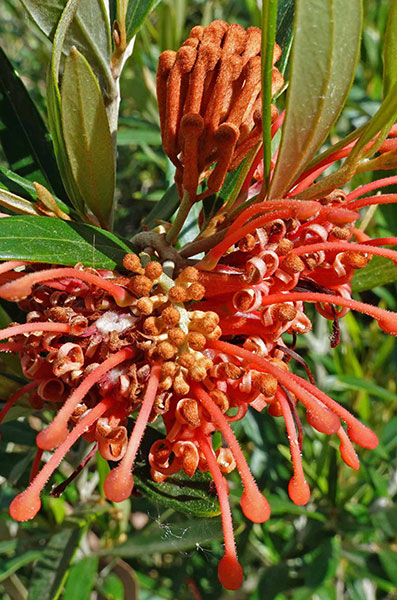

Now for the remaining duo. The only Hakea (an Australian genus encompassing 150 species) I’ve seen offered locally is H. macrocarpa. Mine, which I procured at Heronswood in 2005, is now a gangly 10-foot-tall, contorted and prickly multi-trunked phantasmagoria of a shrub that resembles the misbegotten love child of a pine tree and a giant squid —mesmerizing, but if you rub it the wrong way, you’ll live to regret it. (Dan Hinkley says of Hakea: “There has never been a meaner shrub invented.”)
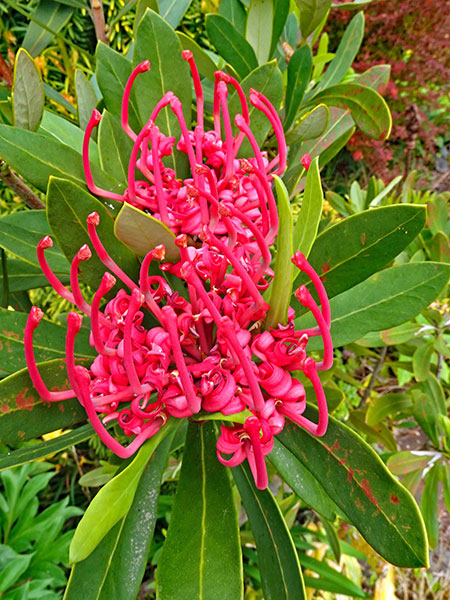
As for Telopea, we’ve saved the showiest for last. Its botanical name is telling: Telopea is Greek for “seen from a distance,” a reference to the eye-popping incarnadine beauty of its large and bewitching pincushion inflorescence. Dan H. says of his, “Mine has sailed through and thrilled me to death for now close to 20 years. I’m pleasantly surprised each year that it’s not dead. I won’t be surprised when it jumps the fence, but as with a beloved dog, I’ll miss it when it does.” My friend Ciscoe grows two in his North Seattle garden, the Tasmanian native T. truncata, which flowers liberally in May and June, and the coarser T. oreades that is disinclined to bloom at all. Given the beauty and relative ease of growing T. truncata, I’m baffled it’s not more widely available here. I’m chomping at the bit to procure one.

The title of today’s episode promises provisos, so here they are: 1. As phosphorus is fatal to proteaceous plants, DO NOT FERTILIZE! 2. Younger plants are more frost sensitive, so plant early in the season or keep in containers for a couple of years before planting out. 3. Water liberally just after planting, but sparingly thereafter. 4. Although it’s counterintuitive, do NOT water in hot weather. (This promotes root rot.) 5. Prune grevilleas in summer to control height and sprawl. (Tall grevilleas are top-heavy and may tip over with winter winds or when weighed down by snow. This happened to mine.)
On that note, we’ll wrap up the third season of this column in anticipation of a restorative summer of further adventures in the garden. See you in September.
Horticulturally yours,
Daniel
- From Hurston’s 1948 novel Seraph on the Suwanee, republished in 2008 by HarperPerennial.
- My 13-year-old L. tinctoria doesn’t bloom, although Loree Bohl’s in Portland regularly does. (See here.)
