

If Trees Could Talk
October 2022
I speak for the trees, for the trees have no tongues.
—The Lorax1

Last year marked the 50th anniversary of the publication of Dr. Seuss’ ecological fable that starkly outlined the peril awaiting hapless humanity in a rapacious world where trees are valued solely as a commodity to be harvested. While the Lorax was spot on in arboreal advocacy, we are increasingly aware that trees are in fact far from being passive victims and are much more active than they appear to our limited vision. Botanist Jack C. Schulz faced skepticism when in 1983 he stated that “plants are just very slow animals”. However, a dozen years later acclaimed naturalist and filmmaker David Attenborough flatly asserted that “Plants can see. They can count and communicate with one another.”2 Really? Like most hortheads, I habitually talk to my plants, and I would dearly love to hear them reply. Wouldn’t you?
Inspired in part by the Lorax, when I began gardening in earnest 30 years ago, I found myself plugging more and more life-enhancing shrubs and trees into a shrinking suburban lawn that eventually vanished. At last count I’ve planted around 100 on our 1/3-acre plot, of which more than 50 now measure at least 10 feet tall. Particularly prominent is a cosmopolitan quintet of virtuous veterans, each exceeding 20 feet in height, that encircle a raised fishpond in our front garden. In flights of fancy I ponder what they might “think” of me, and of their leafy neighbors. Here’s a set of imaginary soliloquies (with “nickname” and year of planting):
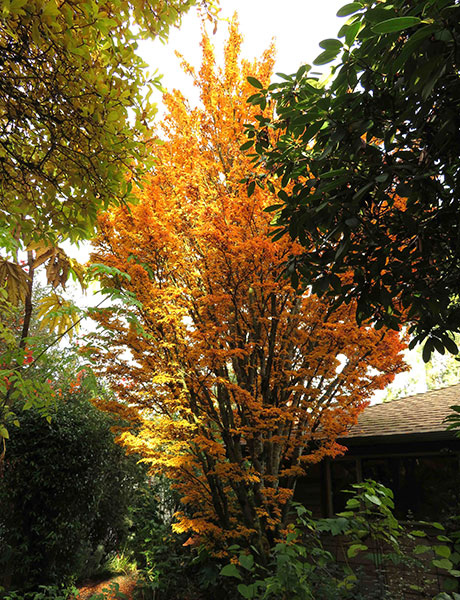
Acer palmatum ‘Shishigashira’ “Shishi” (1995) — Welcome. Don’t be cowed by my regal, upright stature and leonine elegance. Even though my name means “lion’s head” in Japanese, I pose no threat to well-wishers. A couple years after anchoring “Palma” close to the pond, Daniel and Jeff chose me to guard the nearby path to the front door of their house. I’ve risen to the occasion and now (approaching 30 feet) am among the tallest examples of my maple cultivar. Moreover, my tidy, crisp foliage that turns a brilliant orange in autumn graces three seasons. My fallen leaves, light and airy, make a fine mulch, and my noble framework forms a striking silhouette in winter.
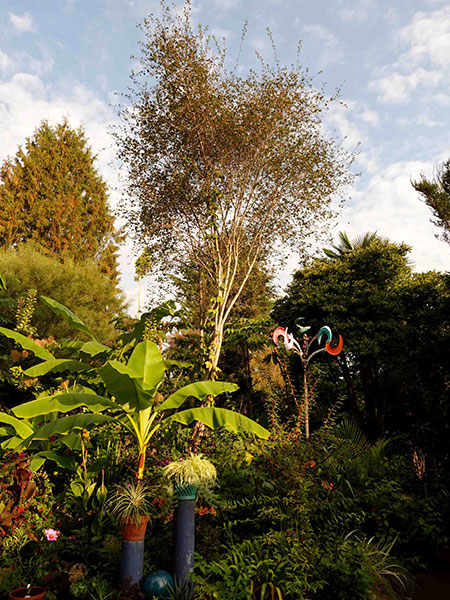
Acer sempervirens “Sempy” (2004) — Surprised you all, didn’t I? Despite my name (sempervirens means “always green” in Latin) everyone underestimated me. You assumed I was just another shrubby, dumpy, deciduous maple; didn’t think I had it in me to grow into a lanky giraffe of a tree and thrust myself above the gang of fiber bananas (Musa basjoo) that tried to keep me down for years. Guess I showed them last winter when they turned to mush. But Dan Hinkley saw my potential, collecting my seed in Turkey’s Pontic Alps about 25 years ago. Although his Heronswood catalog offered me only once, in 2002, that was enough to catch Daniel’s eye. I know he’s proud of me and my compact, glossy leaves now that I’ve reached a towering 30 feet.
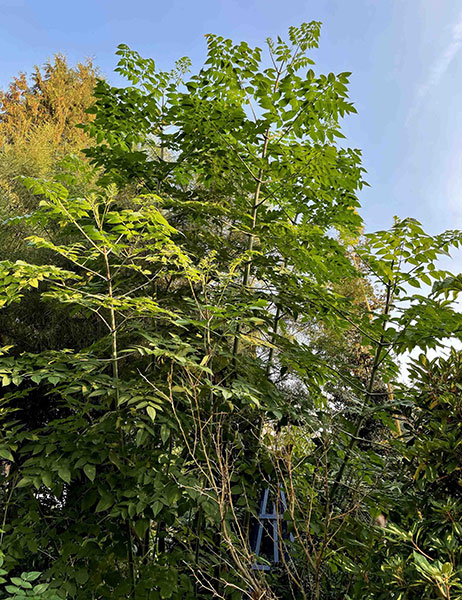
Dahlia imperialis “Dolly” (1996) — I know what y’all are thinking about me: aloof, haughty, fragile. The hardy woodies also call me imposter or intruder, unwelcome in their group due to my frost sensitivity. I may behave like a giant, herbaceous perennial, but “tree dahlia” is my common name, so there! Yes, my voluptuous buds don’t emerge until late November, twenty feet in the air at that, and most years freeze before they can fully open, but that only enhances my allure. Even though wintry blasts cut me to the ground, I rise like the phoenix come May and lift my new canes skyward with astonishing speed. Don’t hate me because I’m beautiful! Click here to see how Daniel dotes on me.

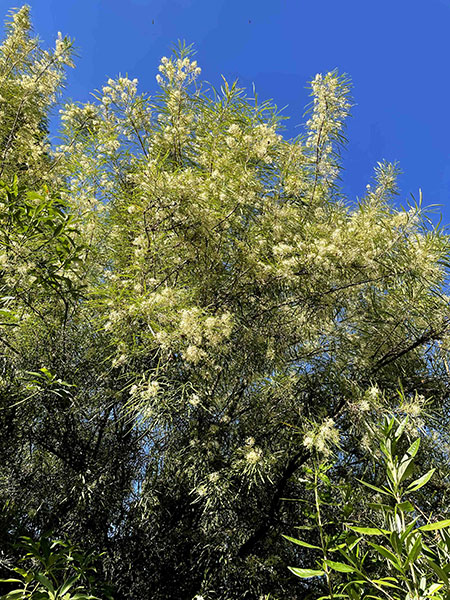
Lomatia myricoides “Lomy” (2002) — G’day, mates! I’m a hardy evergreen tree in the protea family. Can you tell I’m an Aussie from the outback? How about a hug? I love to get ‘em. If you’re a tree hugger, I’m the one for you: My multiple sturdy trunks have just the right texture for rubbing up against –neither too smooth nor too rough. I like to give ‘em too, by embracing my neighbors with dozens of long arms lined with lacy, evergreen foliage, although they don’t always appreciate it. Guess I’m too enthusiastic, kinda like the golden retriever of the woody plant world. Daniel keeps me in check by pruning my lower branches when I unintentionally start to smother others. Like “Sempy”, I’m also underestimated. Most authorities describe me as a small shrub, but Daniel’s tough love (no fertilizer ever, little water, fast drainage) has nurtured me into a sprawling (but handsome!) tree. Have I mentioned the frilly, fragrant ivory flowers I sport every July? The bees just can’t get enough of ‘em. Bet you couldn’t either if you gave me a try.
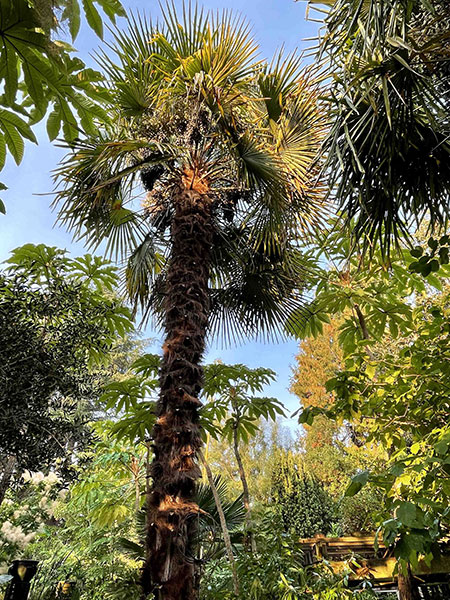
Trachycarpus fortunei “Palma” (1993) — How fitting that I should have the last word, I who have served as botanical den-mother to you younger sprouts. I’ve endured a lot these last three decades: howling windstorms, torrential rain, heavy snow, hail stones, arctic blasts and heat domes, yet I stand more than 30 feet tall, undeterred by inclement weather, by far the most suitable palm for this part of the world. I’m a single mom, too, with twin eight-year-olds and a tiny two-year-old seedling nestled around my base. Does this startle you? Yes, we Trachycarpus palms (which means “rough fruit” in Greek) are dioecious, with female and male flowers on separate plants, but we females sometimes produce a few male blossoms to self-pollinate. Unlike “Lomy”, my fibrous trunk may be too rough to hug, but I know Daniel and Jeff love me. They chose me before any of you.
On that note, let’s wrap this up. We’ll meet again just before Halloween.
Horticulturally yours,
Daniel
- The Lorax, by Theodor Seuss Geissel, aka Dr. Seuss (New York: Random House, 1971).
- From the introduction to Attenborough’s The Private Life of Plants (Princeton University Press, 1995), published to accompany a six-part TV series of the same name by the BBC.