

Scarlet Shapeshifter: Embothrium coccineum
May 2023

Some say the world will end in fire,
—Robert Frost 1
Some say in ice.
I went to the end of the world once, and I saw fire and ice —together— in the same technicolor eyeful. Unlike the poet’s verse cited above, my experience was not apocalyptic, but an enlightening excursion 20 years ago to Los Glaciares National Park in Argentine Patagonia near the southern extremity of the South American landmass. The eponymous ice was the vast expanse of Perito Moreno Glacier, while the fire consisted of the incandescent inflorescence of Embothrium coccineum sprawling in a shoulder-high tangle along the edge of a precipice that separated my footpath from the shimmering surface of Lago Argentino and the looming walls of the cerulean-tinted icefield oozing into it.
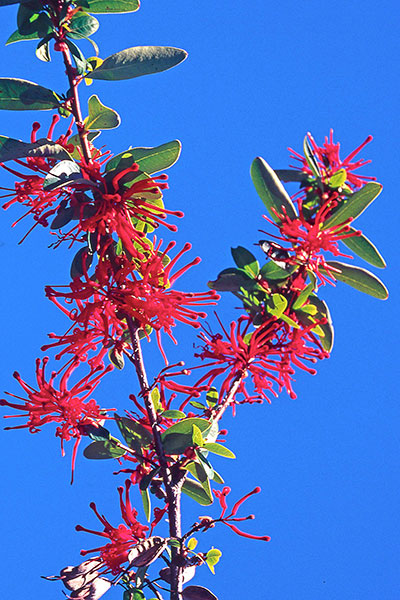

In the moment, I didn’t recognize the dazzling floral fireworks as Embothrium. Its brilliant coloring was of a neon red rather than the orange hue I was accustomed to. Moreover, all the forms I had seen around Seattle were solitary trees, not prostrate bushes. Returning home, I consulted my books and learned that this highly variable, solitary genus in the Protea family was once thought to be several separate species. It may present as a suckering shrub or a 50-foot tree. Some forms are deciduous, others evergreen. They may sport long, lanceolate leaves or shorter, obovate foliage. And despite its common name (Chilean fire bush), Embothrium is also endemic to Argentina, as we have seen. Away from its home turf, it can be successfully nurtured in maritime climates such as our Pacific Northwest, the British Isles and New Zealand.

My first venture in growing Embothrium came in 1997. It flamed out and was dead within months. Three years later I tried again: It withered away. After my 2003 Argentine encounter persuaded me that winter cold wasn’t the culprit (the Patagonian patch I saw is buried by seasonal snow), I tried once more in 2006 with a Dan Hinkley collection from Heronswood. Result? It, too, went belly up. This puzzled me, as I took pains to avoid fertilizing it or its neighbors, since phosphorus (the middle component of N-P-K formulation) is fatal to proteaceous plants. Having struck out, I concluded that the Goddess Flora deemed me unworthy of stewarding such a divine thing. I resolved to relinquish my obviously unrequited love for this protean diva.
Fast forward to a fine August afternoon in 2015: While visiting one of our region’s premier plant purveyors, I ogled a small wisp of an Embothrium on a sales table while chatting with the affable owner. Lamenting my triple set of prior failures with the species, I pondered aloud whether I should bite the proverbial bullet and tempt fate with a fourth foray. Knowing that it was my birthday, the generous proprietor snatched up one of the small pots, thrust it in my arms and admonished me, “Try again. This one’s on the house.”
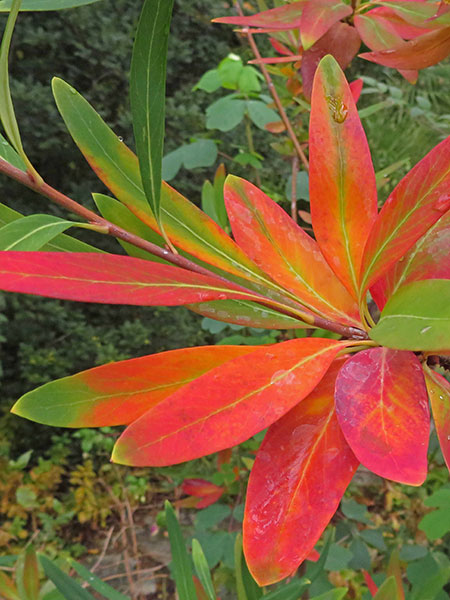
Somehow this broke the curse; eight years later my little slip of a seedling has grown to about 15 feet. It’s still almost painfully thin, and as it’s a deciduous clone, its spare skeleton in winter makes me wince. Only this year has it begun to bloom in earnest, albeit sparsely, with flower clusters much thinner and more widely spaced than those in friends’ gardens or in the UW Arboretum. However, my gangly adolescent of an Embothrium makes me a proud papa in a way I hadn’t anticipated: Before its leaves drop in late autumn, the foliage exits the stage in flamboyantly brilliant hues –befitting of a diva, I suppose.

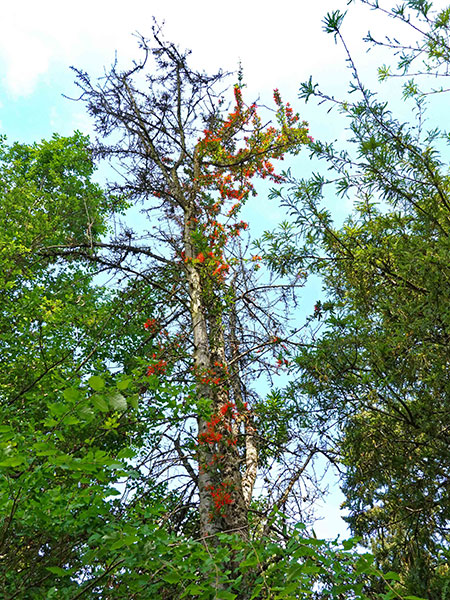
Mid to late May is usually prime time for Embothrium viewing in our Salish Sea area. Last week I went to see my friend Ciscoe in hopes of snagging a photo of his towering specimen that in years past has been cloaked with a floor-length spangled gown of scarlet flowers. Although he had warned me that this year’s display was not up to usual standards, and that a couple of major lower branches had died, I was nonetheless saddened to see the ravages of age on his glorious tree, which he planted in the mid-90s. In fact, authoritative sources state that 25 years of showy splendor is about all one should expect of this species.

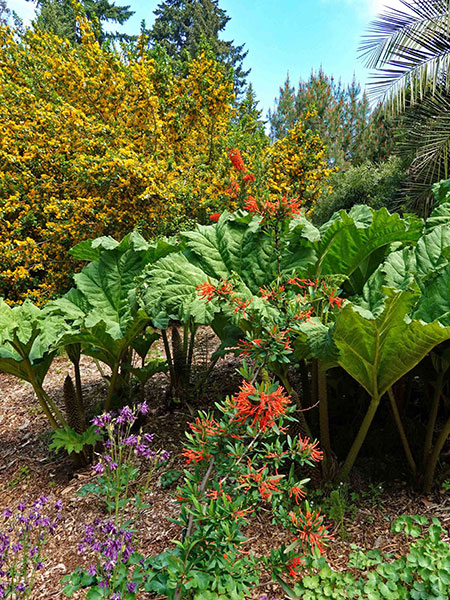
Wending my way back home, I stopped in at the UW’s Washington Park Arboretum to check on their population of Embothrium, perhaps the largest in the PNW. Although their online Living Collections database lists 32 specimens, I could only find half a dozen, all of which were in boisterous bloom, even young, knee-high saplings. What’s their secret? I must admit being bowled over by a couple of über-Chilean vignettes in the Pacific Connections section: The first featured our beloved Embothrium paired with Fuchsia magellanica and Araucaria araucana (the “monkey puzzle” tree), the second flanked the diva with an honor guard of spiky Gunnera and a golden phalanx of Azara. Unhappily, the grande dame of their Embothrium collection, planted in 1981, underscored what I had seen earlier in the day at Ciscoe’s: The bulk of the tree (which I’m estimating is 45 feet tall) is dead, but the remaining vital tissue displays its characteristic exuberance. The show must go on!

We’ll wrap up the third season of Horticulturally Yours in mid-June with a continuation of the theme we launched in this segment: a survey of the few other relatively hardy proteaceous plants for PNW gardens, including selections from the genera Grevillea, Hakea, Lomatia, and Telopea.
Horticulturally yours,
Daniel
- Opening lines of Robert Frost’s short poem “Fire and Ice”, first published in Harper’s Magazine in 1920.
- Embothrium is New Latin, from the Greek for “little pits” (anthers are inserted in a slight depression of the calyx). Coccineum is from the Latin word for “scarlet”.
