

March Madness? Zoning Out on a New Map
March 2024
By even the most lenient of measures,
—Dan Hinkley1
I would be considered a nerd.
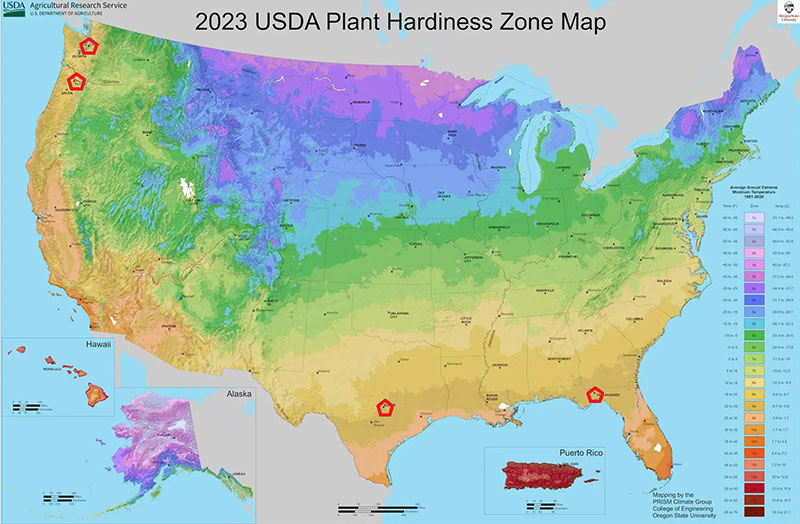
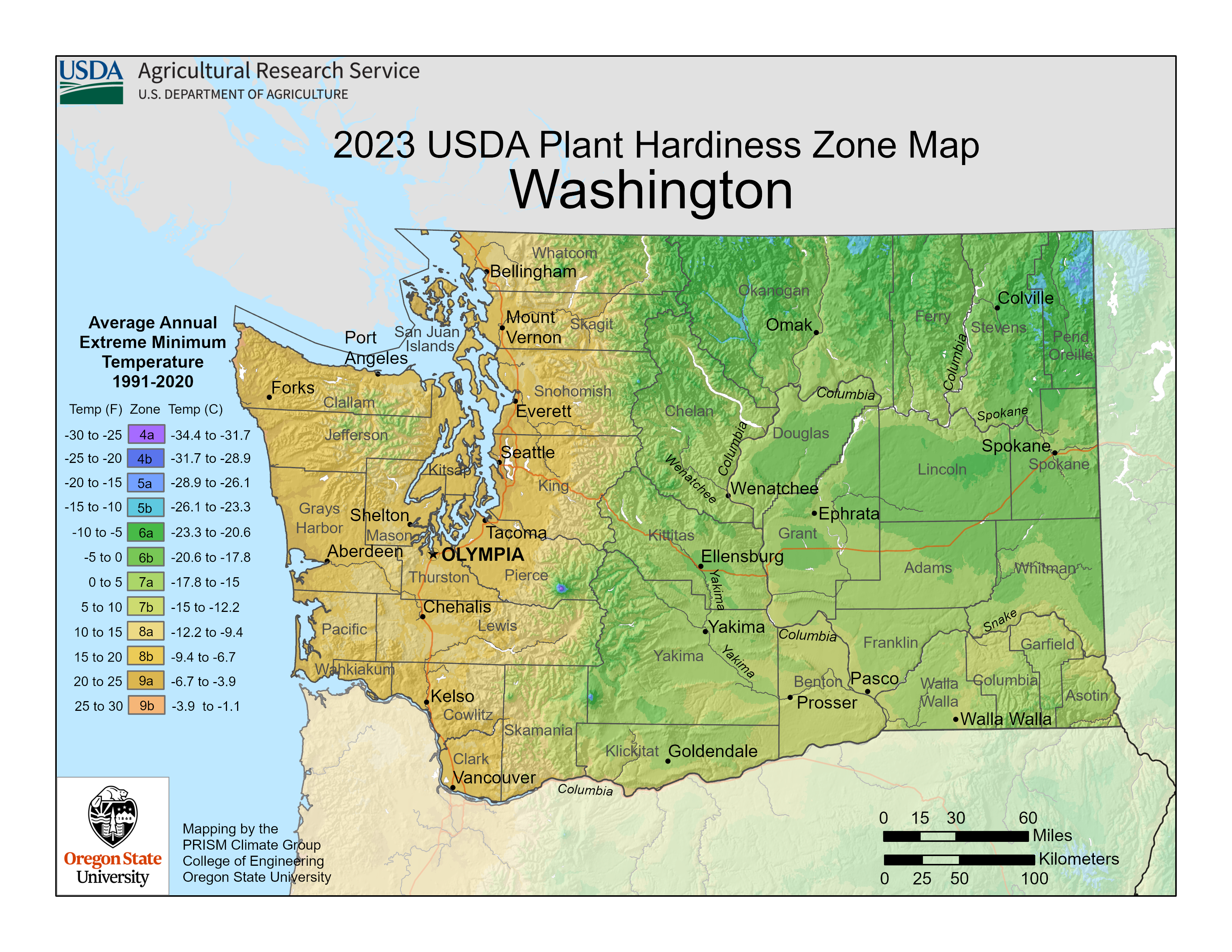
“Welcome to 9a,” screamed the headline of a two-page spread in the March 10 Seattle Times, touting Seattle’s elevation to a warmer echelon on the USDA’s newly revised Plant Hardiness Zone Map2. The article’s second sentence outrageously heralded the spurious claim that “Washington state has landed in Zone 9a—the same zone as northern Florida.” Oh? In reality, the only portions of Washington pushed up into 9a are the “heat island” of the city of Seattle, the suburban trio of actual islands (Bainbridge, Mercer, Vashon), a few adjacent strands on Puget Sound and the eastern shores of Lake Washington, and slivers of land along the Pacific Coast. But even this drastically reduced and localized similarity to the Sunshine State is seriously suspect.

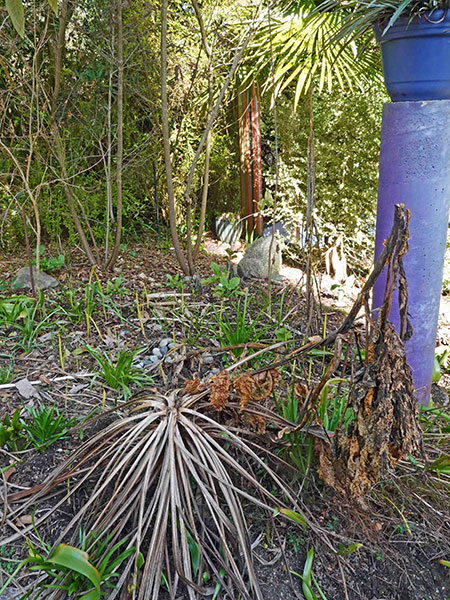
Coming in the wake of the recent mid-January deep freeze, which wreaked botanical mayhem all over the PNW (some of the worst damage my 33-year-old garden has seen), the article added insult to injury. But I’ve been stewing over this issue for a while. Back in November my buddy Bonnie texted me in a flurry of excitement just after the USDA released its update. As would any reasonable gardener, she naturally assumed that we should now expect greater success in growing goodies that lean to the tender side of the spectrum. Curmudgeon that I am, I dismissed her glee with a “Bah, humbug”, although I think my actual phrasing was “zone schmone”. (Not for nothing does my longsuffering husband Jeffrey call me “Danny Downer”.) My reaction may come as a surprise to those familiar with my garden, which is —or was— chockablock with exotics from more southerly climes. Please allow my inner nerd to explain.
First, a bit of background: The USDA’s initial plant hardiness map, issued in 1960, divided the continental U.S. into 10 climate zones based on average annual extreme minimum winter temperatures, in 10-degree increments from 30o Fahrenheit in Zone 10 (coastal California & south Florida) down to minus 60o in Zone 1 (interior Alaska). A revision in 1990 brought in Hawaii, adding an 11th zone for tropical areas. The 2012 version added uber-tropical Zones 12 and 13, and further divided all zones into “a” and “b” categories with finer, 5-degree increments. Since then, according to the USDA’s new 2023 interactive map, the average temperature in much of the immediate Seattle area has risen enough to lift us from Zone 8b to 9a, indicating an average extreme yearly low of 20o to 25oF. (Ironic, isn’t it, that January 2024 registered four consecutive daily lows of 16o, 14o, 14o and 18o at Seattle’s Boeing Field?)

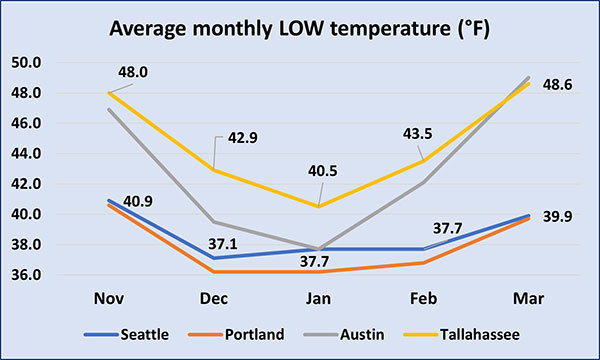
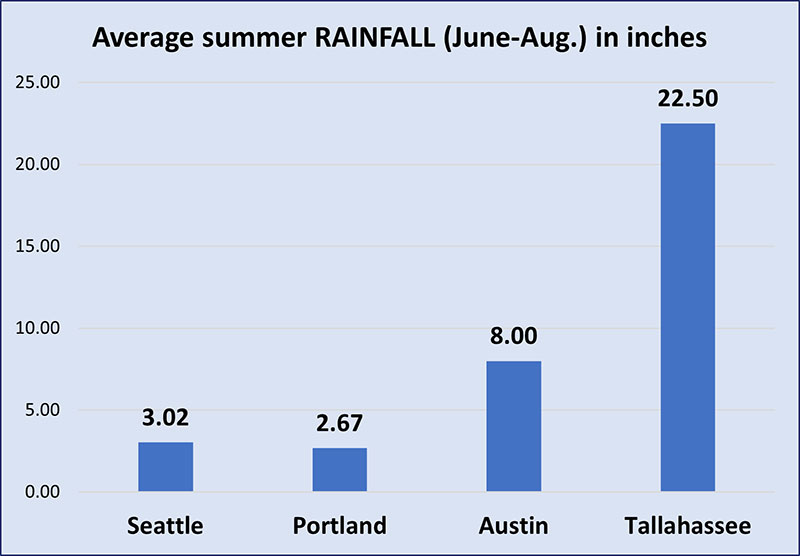
A Tale of Four Cities: Among the fellow travelers promoted to 9a are the capitals of the country’s second and third most populous states, Austin, TX and Tallahassee, FL. Closer to home, our beloved cousin, Portland, is split down the middle, with the town’s eastern half now in 9a while the western portions remain in 8b. Here some uncomfortable truths emerge. Cool-summer Seattle cohabits zones with our warmer-summer neighbor, Portland. Granted, these two share essential similarities of dry summers and wet winters. But what about such fundamentally alien areas —climatically speaking— as Austin and Tallahassee, with their sweltering, sopping summers and mild winters only occasionally subjected to freezing fronts that barrel down from Canada. As the accompanying charts attest, although average winter lows, at least in January, are sort of similar in the four cities, daily winter high temperatures in the southern pair eclipse those of Seattle and Portland by around 20 degrees.
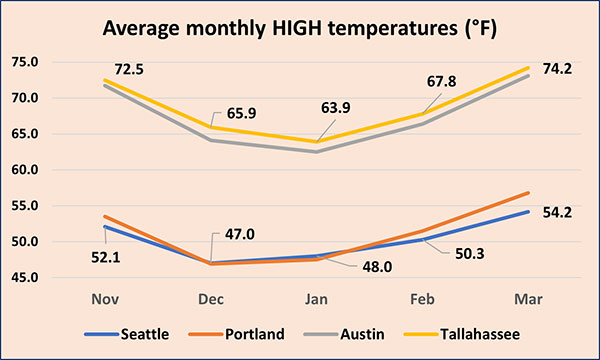
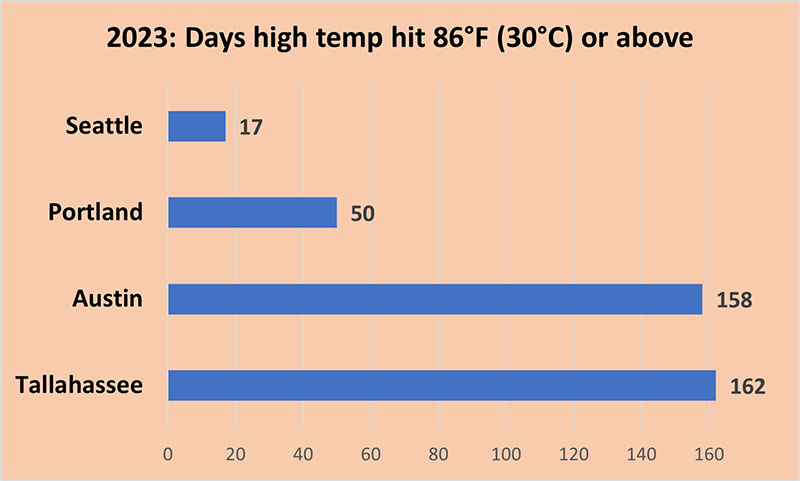
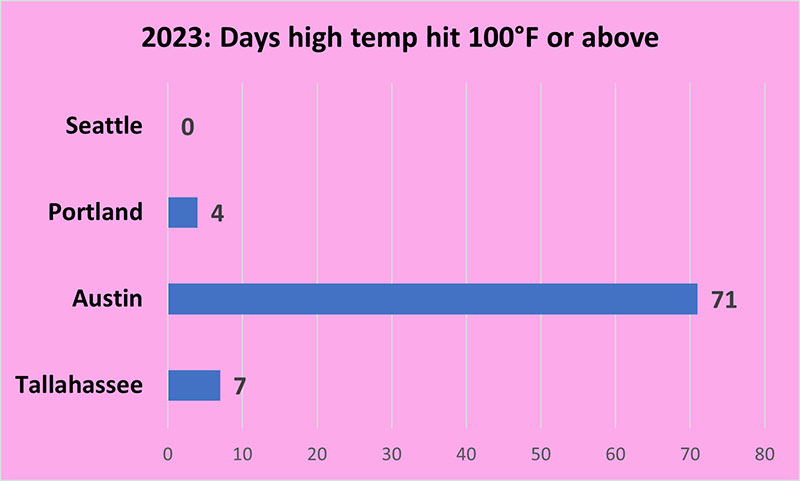
Why this discordance? In part, it’s that the USDA system considers only one data point, without accounting for length, frequency, or duration of coldness. Does the thermometer drop to 20o once a winter for a few hours, or 10 times a season in spells that persist for days? In addition to cold, what about heat, both in terms of tolerance as well as requirement? Things that thrive in Tacoma or Anacortes might perish if planted in Tallahassee or Austin, and vice-versa, despite identical zone ratings. Many plants suffer cellular damage when temperatures exceed 86oF (30oC): Delphiniums languish in torrid Tallahassee, as do fuchsias in incendiary Austin. Other plants crave heat: Caladiums and crotons are crabby in cucumber-cool Seattle. Winter dormancy requirements, drought tolerance and excessive moisture should also enter our calculations.
Yes, our greenhouse-gas-choked planet is trending inexorably hotter. Yet we PNW gardeners can’t deny the destiny of geography. Whether we greet Zone 9a with diffidence or defiance, delight or dismay, let’s face facts: Seattle and Portland are closer to the North Pole3 than to the equator. This means we’re fated to be victims of occasional erratic outbreaks of Arctic air that whoosh down the Fraser River (or the Columbia for Portland) and flash freeze our tree ferns. From time to time, we’re bound to lose even well-established plants. The January onslaught dragged my quintet of 27-year-old pepperbushes (Tasmannia lanceolata) nearly to death’s door. But survivors will astound and elate us: My Sichuan anise tree (Illicium simonsii), an evergreen winter bloomer that on paper isn’t as hardy as the pepperbush, beams more radiant than ever.


Here are a couple of lessons I’ve taken to heart along the bumpy but joyous path of exploratory gardening in the PNW: 1. Don’t do the crime if you can’t do the time. That is, don’t be a zonal renegade if you’re not willing to put in the requisite work of protecting your half-hardy plants. 2. Relying solely on USDA climate zone numbers to determine if a plant is suitable for your garden is a perilous prospect.

Is there an alternative to the USDA scheme? Maybe. The venerable Sunset Western Garden Book’s 1967 edition debuted a sophisticated, 24-zone system for states west of the Continental Divide that factors in heat, altitude, humidity, precipitation, wind, and length of growing season as well as cold. Sadly, this superior system didn’t get widespread recognition, and Sunset itself is on its last legs, its name becoming a self-fulfilling prophecy as it fades away. Nevertheless, the encyclopedic and comprehensive Western Garden Book (9th edition), last published in 2012, is a treasure trove for beginning and experienced gardeners alike. Seek it out in used bookstores, online merchants, or at your local library. Fortunately, Sunset maintains a website with detailed maps and descriptions of its zone system.
Meanwhile, we must keep in mind that individual gardens contain microclimates with varying amounts of heat and cold, sun and shade, drainage and water retention, exposure to wind and rain. With these points in mind, even non-nerdy gardeners can embrace a bit of adventure, viewing a plant’s USDA zone number as a suggestion rather than a straitjacket.
Horticulturally yours,
Daniel
- Opening line of “Grass Geek” on page 229 of the 2005 Heronswood Nursery Catalog.
- Based on average extreme low temperatures for a given location in the 30-year span 1991-2020.
- Seattle’s latitude (47°36’N) is further north than Canada’s snowy Québec City.
