
Kubota's Congenial Comforts
April 2024

So spring’s really come
—Bashō1
The mountains nameless within
diaphanous mist
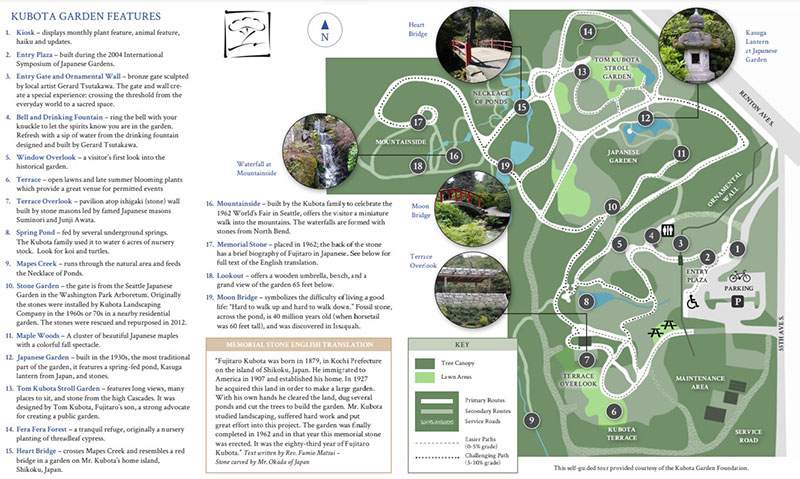
Shimmering through a cluster of fir trees in April’s early-morning haze, the glacier-clad mountain I can barely make out from my kitchen window has two names: Tahoma, or as most people know it, Mount Rainier. Utterly majestic, this grand “mother of waters” is also overwhelming, soaring serenely at a lofty remove from my life as a mere mortal. More approachable and accessible to us city-dwellers is Kubota Garden, an idyllic refuge so close to me that we share the same zip code2. Painstakingly sculpted by human hands, this modest but marvelous 20-acre garden represents in miniature many natural features of the northern Pacific Rim. Its understated beauty is for me an ineffable source of solace when I weary of this woebegone world.
A bit of background: Almost 100 years ago, Japanese immigrant Fujitarō Kubota (1879-1973) purchased a swampy, logged-over plot of land on the southernmost edge of Seattle to further his recently established landscaping business. Over the decades (rudely interrupted by the unjust incarceration of Japanese-Americans from 1942-45) the self-taught Kubota and his sons expanded and shaped the tract to showcase the three essential elements of Japanese-style gardening (trees, water, stone), while adapting them to local conditions and plants for his burgeoning base of home-owning customers3.
With the passing of generations and growing pressures of encroaching urban development, the younger Kubotas arranged to sell the property to the city in 1987. Seattle Parks and Recreation assumed management, creating a public park out of this unique “American Japanese Garden”. For the next 30 years, the indefatigable and visionary Don Brooks served as head gardener until his retirement in 2018. He is largely responsible for the host of improvements4 made in recent years: new structures, installation of several hundred tons of monumental stones, and vast expansion of the plant palette. I spoke with Brooks recently; his commentary informs much of the assessment that follows. (Direct quotations from him will be indicated by “DB:”.)
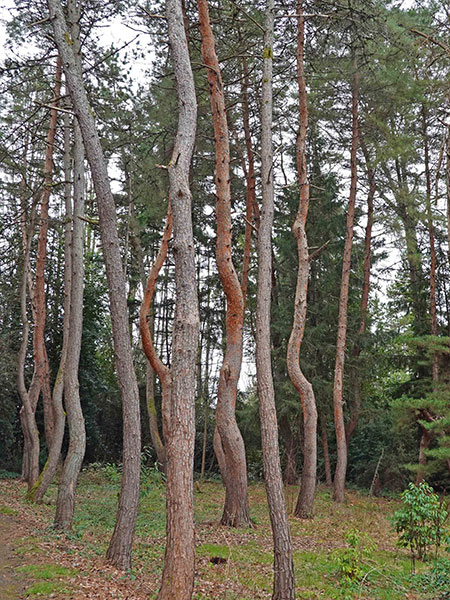
Let’s take a quick look at the current state of the three essential elements noted above, beginning with trees. Mr. Kubota had a hankering for contorted conifers. Of the dozens of notable specimens still present, my favorite is a lanky and sprawling, weeping giant sequoia (Sequoiadendron giganteum ‘Pendulum’) that straddles a wide path like a gang of giraffes. “DB: We call it the car-wash tree,” as maintenance vehicles sometimes need to drive beneath its hanging brush-like branchlets. Another tree-mendously magical spot for me is a spirited grove of Japanese red pines (Pinus densiflora) atop the slope near the garden’s western edge. It’s not hard to figure out why Brooks calls these the “Dancing Pines”. At least one tree survived the logging that preceded Kubota’s initial land purchase of 1927: The Garden’s tallest sentinel is a 140-foot grand fir (Abies grandis) estimated to be 225 years old.



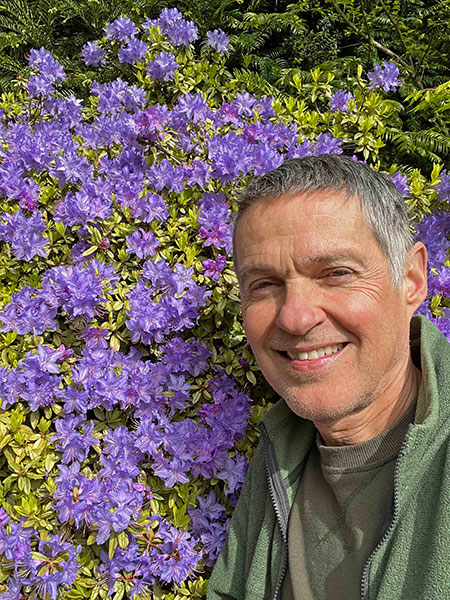
Oddly, the Kubotas maintained only a few Japanese maples on site. Brooks changed that. Under his tutelage, the garden acquired 250 more maples of 140 named cultivars. The most dazzling one at the moment is the shocking pink new foliage of ‘Spring Ruby’ (Acer palmatum ‘Shin-Deshōjō’5). “DB: To me it seems draped in mini-Xmas lights, especially in the sun after a rain shower.” Brooks also added dozens of rhodies, many of them rescued or salvaged from construction sites. Illuminating the garden’s northeast corner today is a huge, dreamy blue Rhododendron augustinii. “DB: We collected it at Seattle Center. As they were demolishing the Key Arena grounds, we grabbed it!”

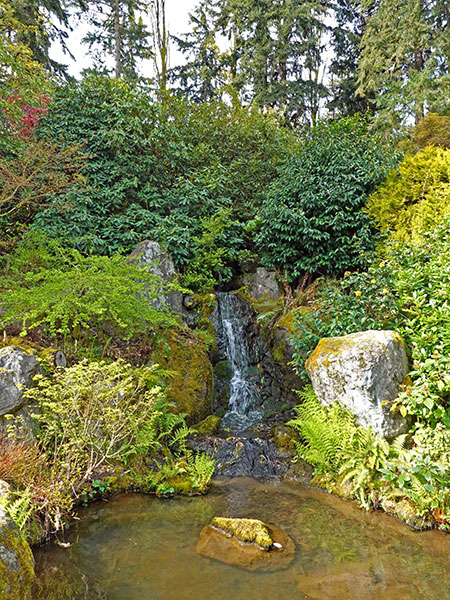
Water: Kubota Garden has it in abundance. The presence of several natural springs and little Mapes Creek were surely key factors in attracting Mr. Kubota’s interest. He developed the springs into a trio of water features, engineered the creek into the charming “Necklace of Ponds” traversed by a series of footbridges, and for his pièce de résistance (completed in 1962 in time for the Seattle World’s Fair) pumped its waters to the top of the garden’s “Mountainside”, from where it returns in a series of rock-lined waterfalls to the source below.
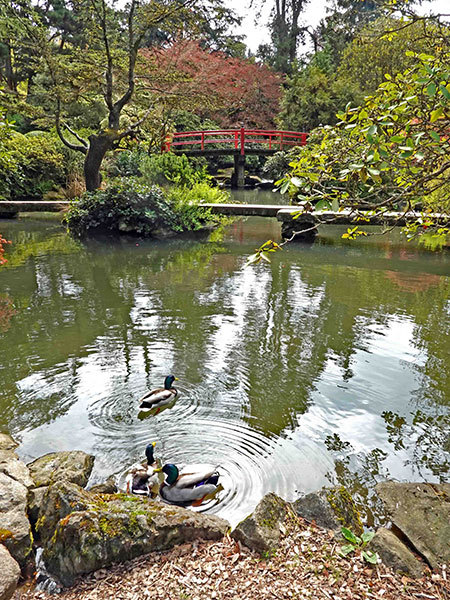
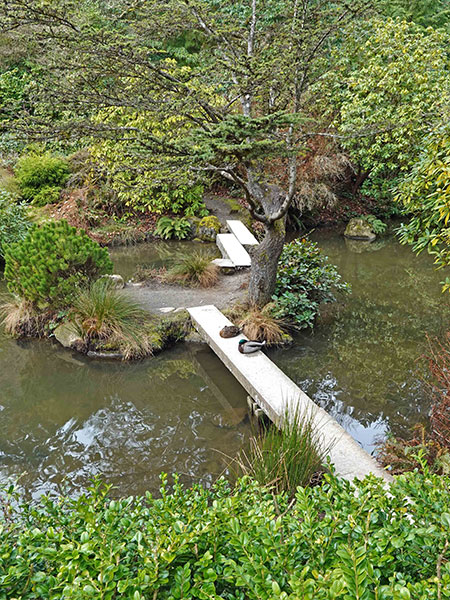
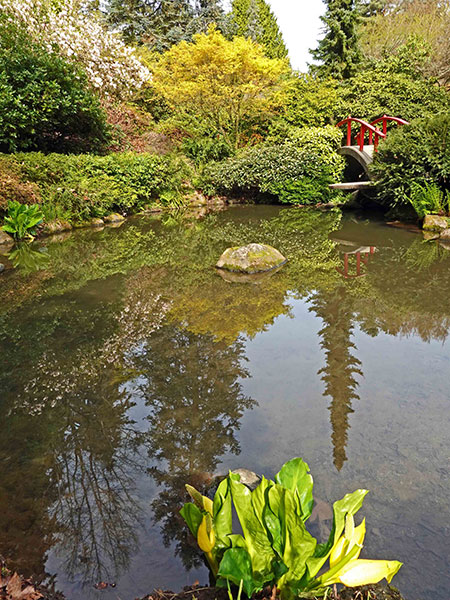
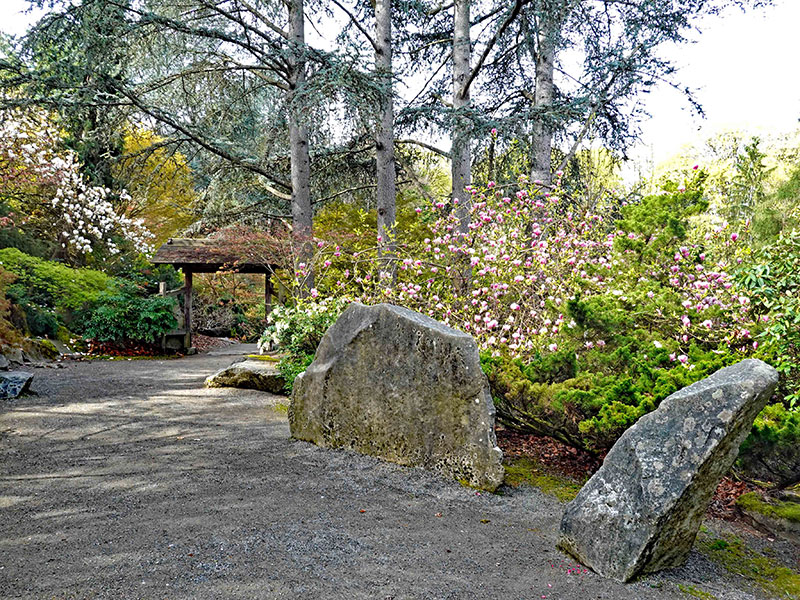
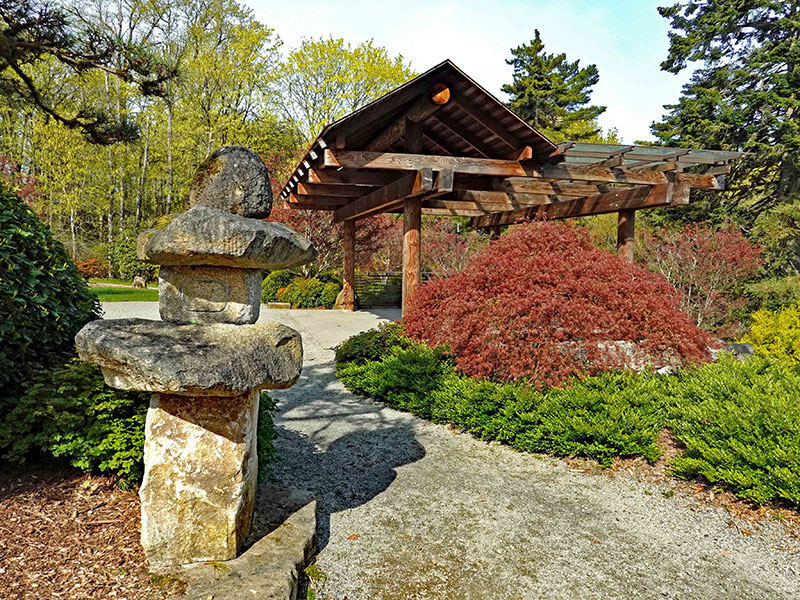
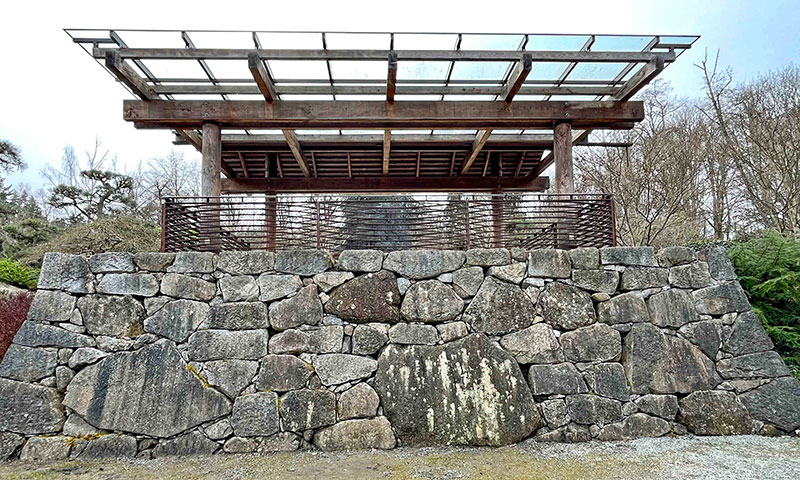
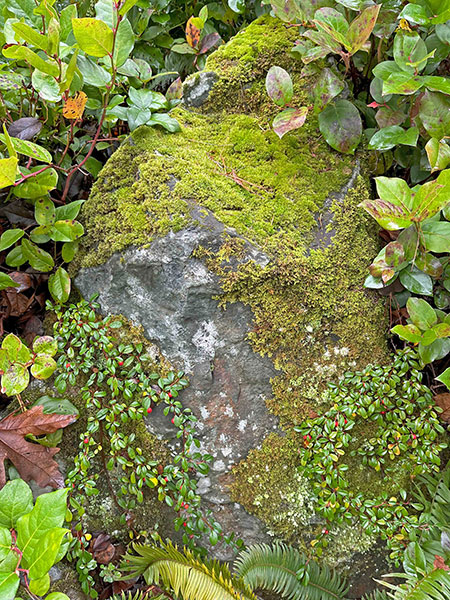
Stone: Arguably the most crucial element of Japanese gardens, stone was as central to Kubota’s landscaping business as it was to his original display area that is now the core of today’s garden-park. Some behemoths hug the ground, barely protruding from it, while others tower heavenward like stalwart guards that seem to protect visitors as they ward off evil. Some, especially in winter, are cloaked in lush moss and rusty lichen, or draped with delicate branches of red-berried, glossy-leaved Cotoneaster dammeri, while others stand resolutely naked. In the last 20 years much more stone has been added to the garden, most notably near the entry gate, in the monumental Ishigaki Wall upon which the Terrace Overlook Pavilion sits, and in the Stone Garden, refurbished in 2012 with a repurposed gate brought in from the Seattle Japanese Garden in Washington Park and a handsome set of granite chunks rescued from a nearby residential garden that the Kubotas had installed half a century earlier.
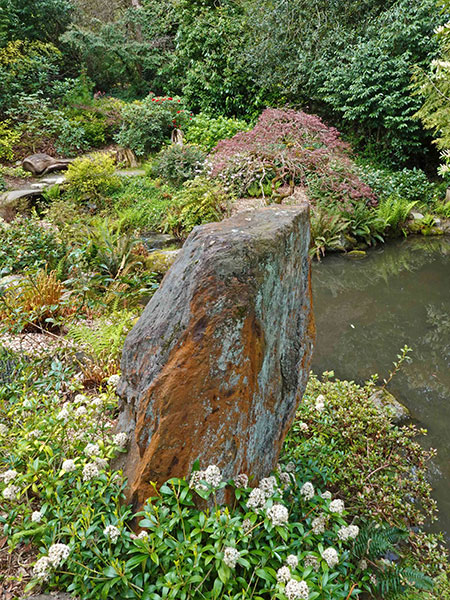
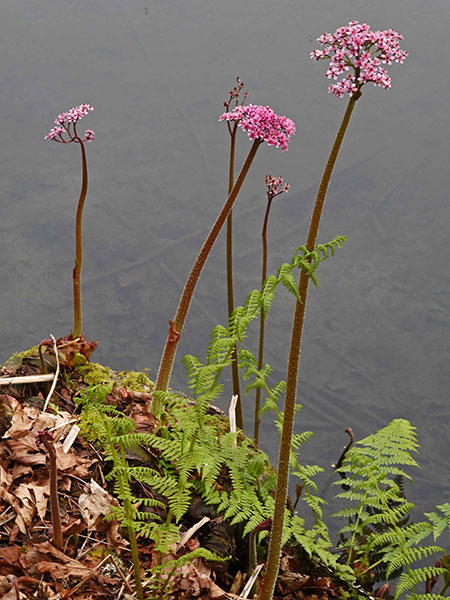
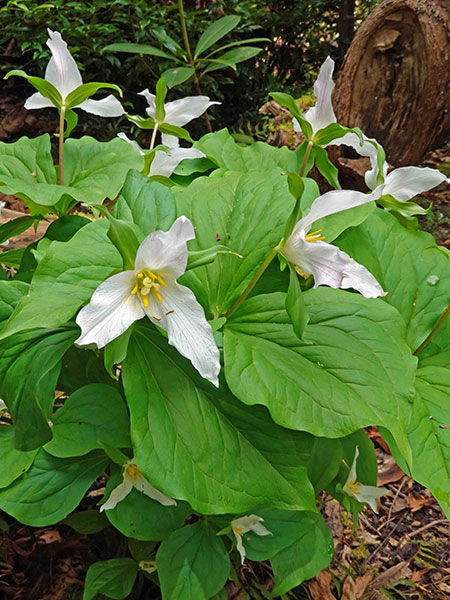
It’s no surprise, given the state of the world, that Kubota’s comforts have been more alluring to me than ever this season: I’ve made five visits in the last fortnight. I’ll share with you a few of the scintillating springtime jewels that bedizen the framework of trees, water and stone right now: Blossoms of Pieris japonica, camellias of several persuasions, and flowering quince (Chaenomeles hybrids), along with PNW natives such as Darmera peltata, Ribes sanguineum, Lysichiton americanus and Trillium ovatum.


Kubota Garden is open to the public, free of charge, every day of the year. If you’d care to learn more about this treasured place, read Spirited Stone: Lessons from Kubota’s Garden6. You can also nurture your soul while volunteering your labor to help maintain the garden. Register here.
We’ll meet again in the merry month of May.
Horticulturally yours,
Daniel
- Haiku 232 (“On the Road to Nara”) by Matsuo Bashō (1644-1694). Published in The Complete Haiku of Matsuo Bashō, translated and annotated by Andrew Fitzsimons (Oakland: U of California Press, 2022).
- Zip Code 98118 is among the most ethnically diverse enclaves in the United States.
- Kubota also installed gardens at Seattle University and at Bloedel Reserve on Bainbridge Island. SU preserves his legacy in 11 campus locations, and Bloedel’s Japanese Garden looks much as it did when Kubota created it.
- Projects are funded by the nonprofit Kubota Garden Foundation with some assistance from the city.
- Designated “Maple of the Year” for 2018 by the Maple Society of North America.
- Hard-cover book published by Seattle’s Chin Music Press in 2019. The Center for Urban Horticulture’s Miller Library has two copies. One is available for loan.