

In the Pink of Early Winter
December, 2021
As soon as rosy-fingered Dawn appeared,
we explored … marveling at what we saw. 1
Scanning the early morning sky between recent atmospheric-river events, I’ve been rewarded on a couple of occasions by cotton candy-colored wisps framing the silhouette of Mount Rainier. Chromatic riches of such caliber in the depths of darkest December are prizes to be treasured, not only in the heavens but also in our gardens. The rosy-fingered dawn that inspired Odysseus eons ago has motivated me to take a color inventory of my immediate surroundings. Expecting little more at this stage of climatological winter than a litany of verdure —for which I am deeply grateful, don’t get me wrong— I was tickled pink, as my Arkansas daddy would have put it, by what I found.
Just as summer and the recently departed autumn are the purview of warm hues —a bonanza of blazing blossoms that exit the stage amidst a flurry of fiery foliage— pastel, rosy shades rule the roost only in springtime. Or so I thought. I’m not alone: Horticultural luminary Penelope Hobhouse, with the vernal season clearly in mind, lays it out like this: “Pink, whether in soft rose or sharper salmon, clearly retains its red derivation, and its essential qualities of warmth and welcome. Pinks are soft, gentle and luxurious, colors which are difficult to grasp and to define.” 2 A bit later she opines that pink flowers “express the essence of garden delight, pale and restful by day, luminous and beckoning at dusk”. Delighted indeed, I find their allure has endured into December in my garden.
What did I discover? Rosy blooms in abundance on a trio of Latin-American lovelies along with flashy, fuchsia-hued bracts and buds on two other compatriots, six-inch-wide lavender-pink disks on a giraffelike species dahlia, sakura-toned blooms on an alpine Pacific Northwest perennial, and to round out the phalanx, a trio of New Zealand natives sporting pink-tinted foliage. Hobhouse warns that even though pink shades are restful and mellow, “there is a fine line between the subtle and the insipid.” I am happy to report there’s none of the latter quality in the dynamic decahedron we’ll explore here.
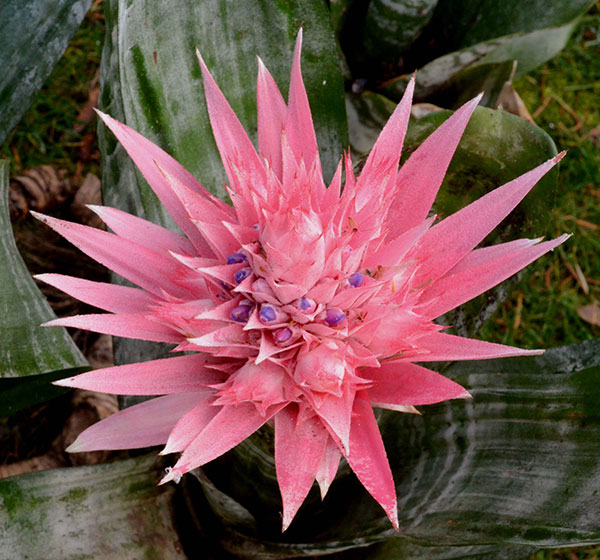
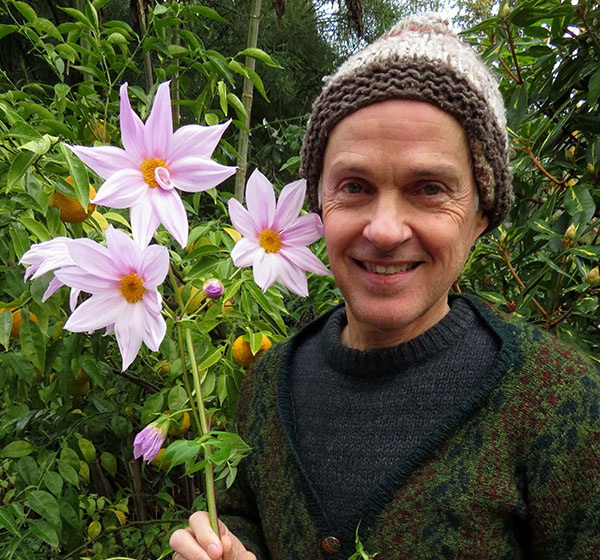
As we sang the praises of a few of these beauties in last season’s Horticulturally Yours segments, we won’t dwell on those today. For a refresher click on the respective hyperlinks to review the bright bracts of the bromeliad Aechmea fasciata, the fuzzy cerise buds of the purple princess flower, Tibouchina urvilleana, and the towering titan Dahlia imperialis, blooming this year more boldly than ever.
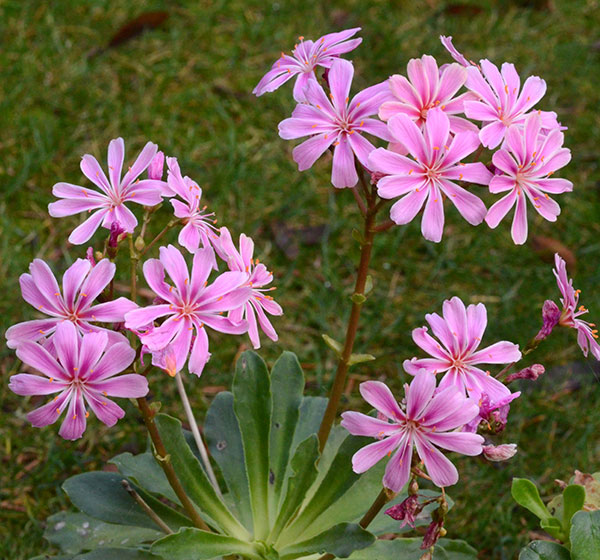
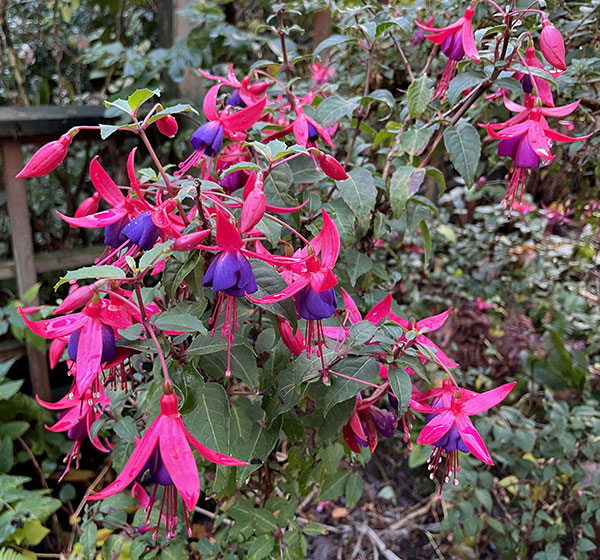

The hardiest of today’s bunch is also the most local, Lewisia cotyledon, hailing from rocky slopes of the Siskiyous in southern Oregon and northern California. The ‘Elise’ strain is a reliable repeat bloomer. In order to savor its diminutive favors, I keep it in a shallow, scree-filled tray on a window ledge near the kitchen door. Two hardy fuchsias are also in the spotlight now: the vibrant and compact ‘Eden Rock’ and the more demure (in terms of color) but irrepressible ‘Surprise’ (aka ‘Pat’s Dream’), which for me is usually in bloom nine months a year.
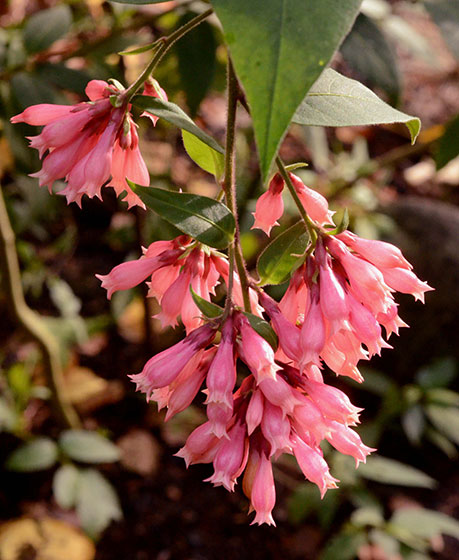
Another repeat bloomer is the half-hardy and decidedly more finicky Cestrum elegans ‘Smithii’, a shrubby nightshade I’ve grown for 12 years. Often dying to the ground in winter, it takes its sweet time to wake up in late spring. This year’s early summer heat was greatly to its liking, however, and it’s been rewarding me with clusters of rosy tubes held at the end of delicately arching 7-foot branches since August.
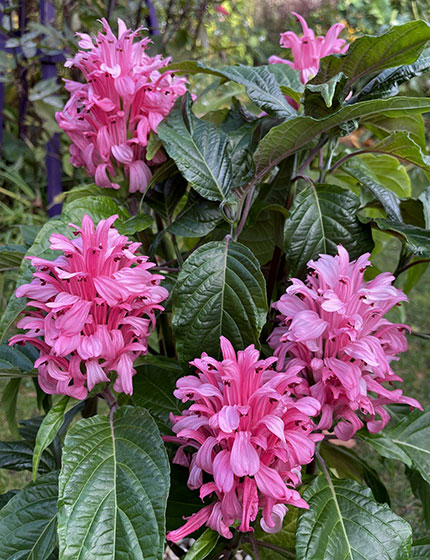
The prize for greatest revelation of 2021 —in the ugly-duckling-to-swan category— goes to Justicia carnea, the flamboyant Brazilian-plume or jacobinia, which I subjected to malign neglect (if not outright torture) in a container for nine years until a moment of reckoning came after the June heat dome. In a quandary over whether to toss its bedraggled, skeletal body into the compost bin, I opted instead to lop its frame back to 4-inch stubs and repot it in fresh soil. One lunar cycle later it burst forth with luscious and lustrous ovate leaves, followed in November by architecturally distinctive flushes of flamingo inflorescences at the tips of six branches. Duly chastened, henceforth I’ll keep it well watered and adequately nourished.
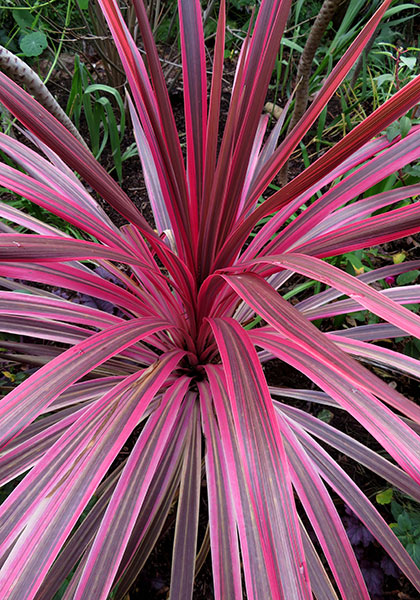
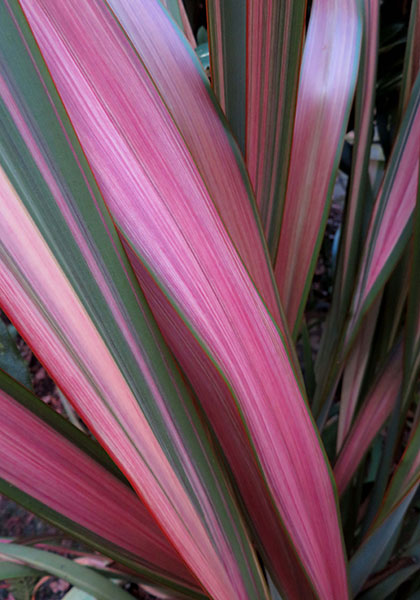
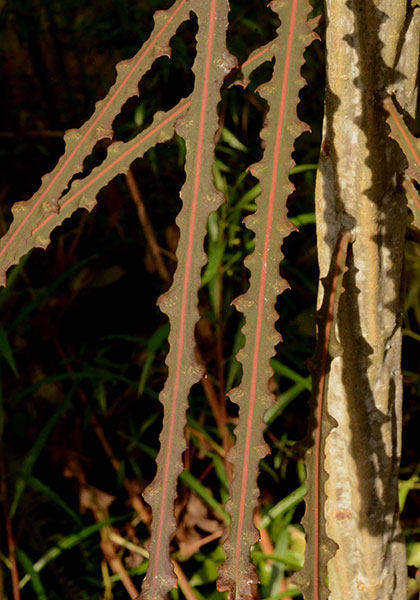
For our finale, we’ll focus on the vivid foliage of three nearly hardy Kiwis: Cordyline australis ‘Cherry Sensation’ (its cultivar name spot-on accurate), usually confined to a container even though I’ve grown mine in the ground for five years, Phormium ‘Jester’ (aka ‘Emerald Pink’), a compact and lovely flax whose rosy striations have proven pleasingly stable in not reverting to all-green in the 11 years I’ve grown it, and to wrap up, the outlandishly weird Pseudopanax ferox, which sports a pink racing stripe down the middle of each rigid, 14-inch-long by ½-inch wide sawblade leaf. Pseudopanax fans, take note: This bizarre genus is the topic of a future Horticulturally Yours segment, coming in early 2022.
Wishing you lots of light and rosy 3 warmth as we plunge further into the holiday season. Think pink!
Horticulturally yours,
Daniel
- Homer’s Odyssey, Book IX, Lines 152-153, translated by A.S. Kline, 2004.
- Penelope Hobhouse,Color in Your Garden (Boston: Little & Brown, 1985), Chapter VI, page 130. (Need I point out her Homeric given name?)
- To my mind, “rose” and “pink” are near synonyms. As David Austin says on page 20 of Old Roses and English Roses, “Pink is the true colour of the rose.” Although the etymology of “rose” is clear (Latin rosa, from Greek rhodon) “pink” in the sense of color arose in the 17th century, its etymology lost in the mists of time. Even the venerable Oxford English Dictionary states “origin unknown”.