

Savoring Citrus in Pugetopolis
November, 2021

Ever wonder how sweet it would be (metaphorically at least) to savor the fruits of your horticultural labor with a late-autumn harvest of mouth-puckering but life- affirming citrus? To a Pacific Northwesterner this may seem like a pipe dream unless one has the resources to pour into a pricy orangerie or sunroom. However, for the eight million or so souls who live close to the Salish Sea, from Vancouver and Nanaimo in the north to Olympia and Shelton in the south, a cluster of affordable and viable options beckon.
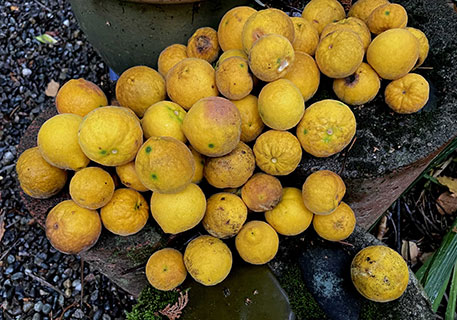

Of the standard fruit-producing citrus, best suited for our cool summers and mild winters is the compact and bountiful Meyer lemon; grow it in a container so you can move it under cover when a deep freeze looms. A relatively new kid on the block, the trendy and zesty yuzu, is the only one in my experience that dwells happily in the ground with no protection required. Before shining the spotlight on these two, let’s consider the merits of ‘Flying Dragon’ —one of the oddest elements of the extended citrus family— grown as an ornamental shrub even though it produces edible fruit.
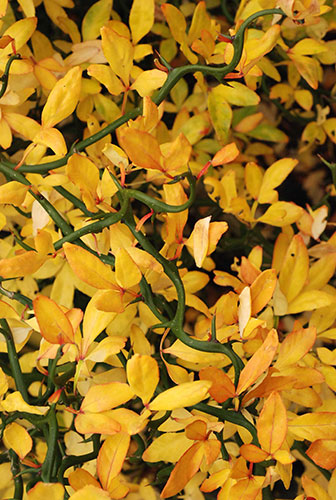
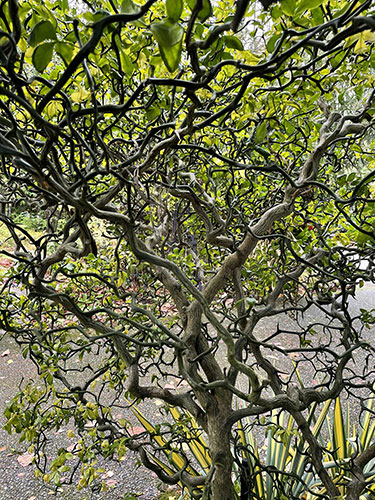
Poncirus trifoliata ‘Monstrosa’ 1 —A dwarf, this contorted version of the trifoliate orange is by far the hardiest of the whole citrus clan, reportedly surviving temperatures as low as minus 20o F. Introduced more than 100 years ago to the U.S., this form is usually marketed as ‘Flying Dragon’, a direct translation of its Japanese name, ‘Hiryu’. Its virtues are many: a fascinating structural network of twisted branches and no-nonsense, recurved thorns (which vividly exemplify its traditional use as a living fence or barrier), brilliant fall foliar color, and an abundance of dainty orange-like orbs, diminutive and downy, that yield just a modicum of ultra-tart but tasty juice. Curiously, my tree — which I’ve had nearly 20 years— drops its fruit one by one as they ripen over the course of October.
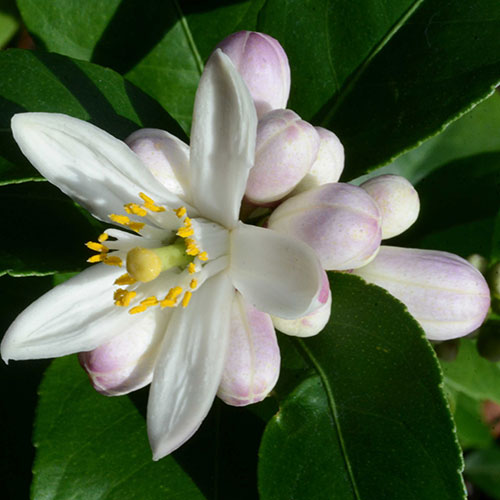
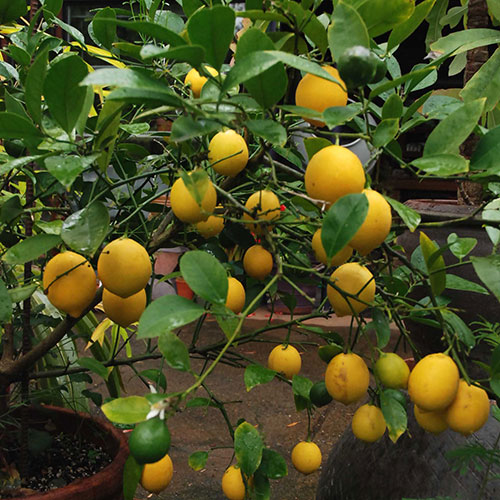
Citrus x meyeri ‘Meyer Improved’ 2 —Most likely an ancient Chinese hybrid of Citrus limon (the standard lemon) and Citrus reticulata (the mandarin orange) the low-growing Meyer lemon is hardier than the former and requires less heat than the latter to produce high-quality fruit. For me it blooms nearly continuously from May to November, with its sweet and super-juicy, thin-skinned lemons maturing from September through March. Although tolerant of light frost, it needs overhead protection in case of a hard freeze. I pull mine under cover at 30° F and drag it inside the house if forecasts call for 26° or lower. Because it languishes if left for long in low-humidity, interior spaces, I mist it regularly and pull it back outside as soon as conditions permit. This is a hungry plant: I feed it three or four times a year with organic citrus fertilizer (NPK content 6-3-3) that includes calcium, sulfur, iron and zinc. For a bit of background on this luscious lemon along with several succulent recipes, check out this NPR story.

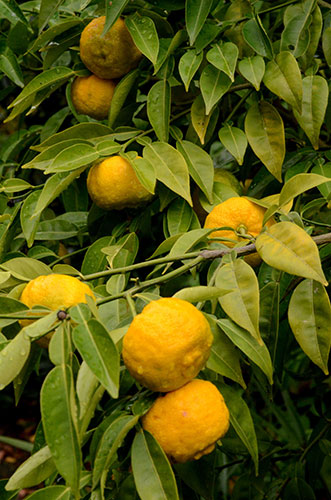
Citrus junos 3 —This gorgeous small tree is the source of yuzu, a fruit now taking the North American culinary world by storm. (The title of a recent New Yorker article, “Nothing Compares to Yuzu,” says it all.) Although thought to have originated in the upper reaches of the Yangtze River in China, Citrus junos came to the U.S. by way of Japan, where its distinctive juice and seductively aromatic peel are essential components of that country’s cuisine. My yuzu tree, planted in a sunny garden bed with well- drained acidic soil, is eight years old and around six feet tall. Not even blushing in Seattle’s winter’s chill, it is reported to be hardy to around 0o F. Its elliptical evergreen leaves, graced with charming, winged petioles, curl up a bit in freezing weather but unfurl without a care when the cold recedes. Blooming in May and June with perfectly formed five-pointed starry petals, its bumpy fruit matures in October and November. As with some types of mandarin oranges, my yuzu clone bears in alternate years: First production came in 2019, with around 30 fruit. In 2020 it bore not a one, but this year it has graced me with around 70 luscious items. Is there a yuzu in your future?
Looming on my acquisition horizon is the sweet and spongy kumquat, which is eaten whole and unpeeled. Several varieties (from about six citrus species) are said to be hardy to 18o F. I’ve no experience growing them, but I’m itching to try.
Horticulturally yours,
Daniel
- Botanists are of two minds on whether Poncirus should stand as a distinct genus or be folded into Citrus. Those advocating the former point to two distinguishing factors: Unlike other citrus, it’s deciduous and its fruit is pubescent (covered in soft fuzz). Many commercial citrus clones are grafted onto P. trifoliata rootstock due to its cold hardiness and superior disease resistance.
- The Meyer lemon is named for Frank Meyer, birth name Frans Meijer (1875-1918), a Dutch- American explorer and botanist who introduced 2500 plants into cultivation (including the lemon hybrid that bears his name) while working for the U.S. Department of Agriculture.
- Although Citrus junos is the accepted binomial for yuzu per World Flora Online, recent studies show it to be an ancient F1 hybrid of Citrus reticulata (mandarin orange) and C. cavaleriei (ichang papeda).