
Sunnylands: A Palm Springs Paradox
April 2023
I create another beauty
—K. Satchidanandan 1
beyond the moonlight,
this side of dreams,
a piercing, parallel language.
As airplanes descend for landing at Palm Springs International Airport, passengers near window seats may marvel at sweeping fields of preternatural green that cover the otherwise dun-colored desert floor. This incongruous emerald carpet comprises more than 100 golf courses, all enabled by the vast aquifer that underlies the nine contiguous cities of the Coachella Valley, of which Palm Springs is the linchpin. One of these tufts of turf is tucked inside Sunnylands, a 200-acre estate established in the 1960s by publishing magnates Walter and Leonore Annenberg in the aptly named municipality of Rancho Mirage, about a 15-minute drive from the Palm Springs airport. Now managed by the Annenberg Foundation, the tract’s centerpiece is the sprawling (at 25,000 square feet) midcentury modern house that hosted every president from Nixon to Obama. This manse is surrounded by a 9-hole golf course, 11 artificial lakes, a sash of tamarisks and eucalyptus, 850 olive trees and a token pair of Washingtonia robusta palms (planted reluctantly, it seems, at the suggestion of Ex-President Dwight Eisenhower after his stay in 1966). Although house and grounds can be visited (for a fee and with restrictions, see here), these are tangential to today’s topic.
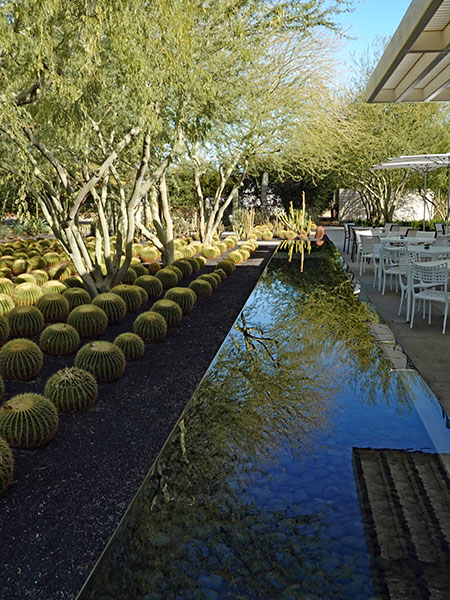
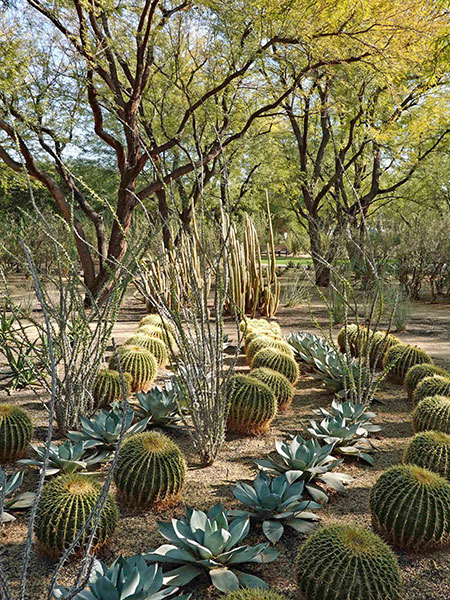
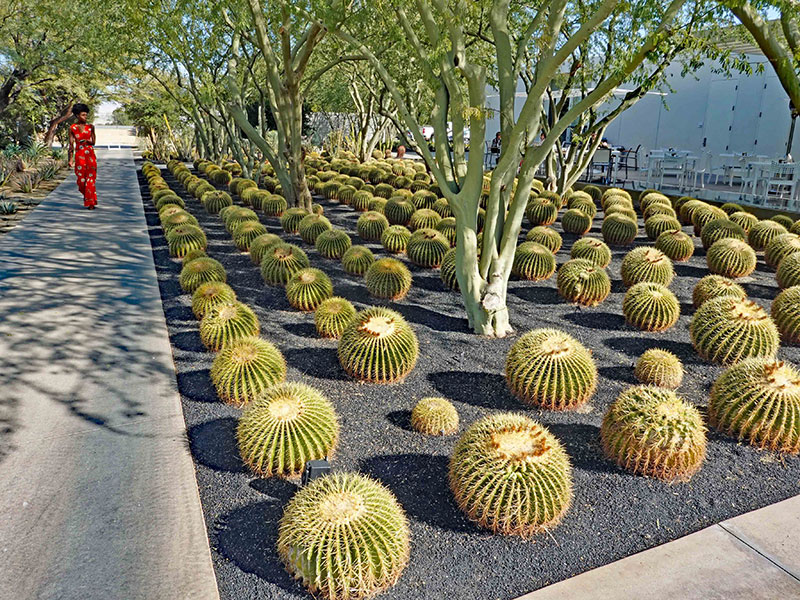
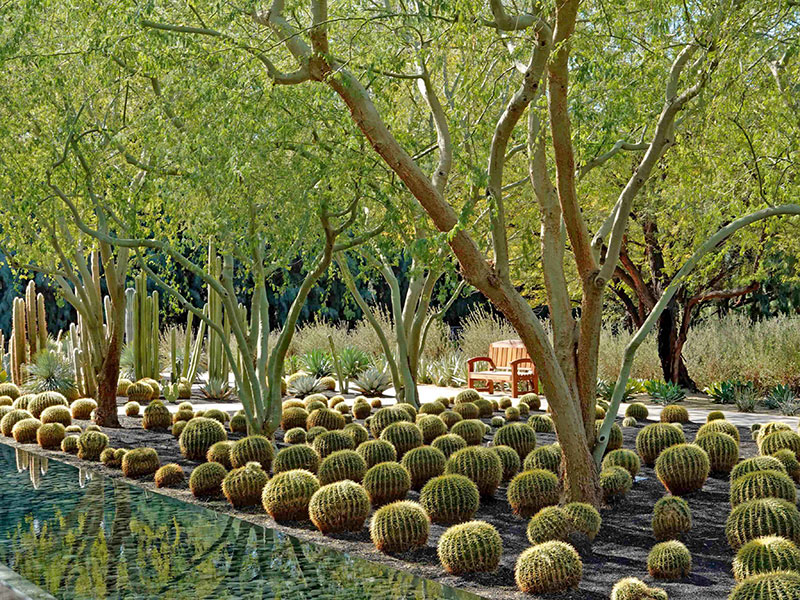
Our focus is a 15-acre site on the periphery of the estate, the sublime Sunnylands Center and Gardens that opened to the public in March 2012. Nine acres of this space, laced with 1.25 miles of interwoven pathways, is devoted to a set of formal and naturalistic gardens of xeriscape plants. Designed by landscape architect James Burnett in concert with horticulturalist Mary Irish 2, the garden’s plantings were meant to embody the spirit of the Annenberg’s eye-popping collection of Impressionist and Postimpressionist paintings, which was valued at $1 billion in 1991 when donated to New York’s Metropolitan Museum of Art. What this means in practical terms is that in the formal garden zones to the west of the visitor center, several sets of single-specimen beds twist and arc around each other with plantings in gradations of greens and grays under the dappled shade of feathery-foliaged trees and their seasonal lemon-hued blossoms.
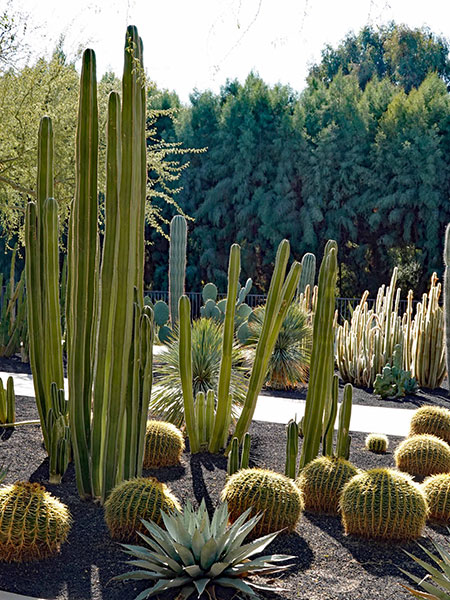
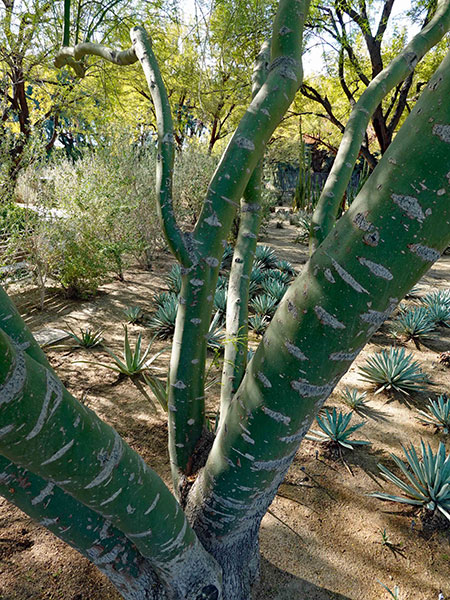
The garden’s hundreds of sheltering, multi-trunked trees, all native to the Southwest and belonging to the leguminous pea family, Fabaceae, are limited to four genera, and flower exclusively in pastel tones of yellow, Leonore Annenberg’s favorite color. These include the twice-blooming sweet acacia (Vachellia farnesiana), ethereally green-trunked palo verde (Parkinsonia × ‘Desert Museum’), ruddy-trunked mesquite (Prosopis cultivars), and Texas ebony (Ebenopsis ebano).
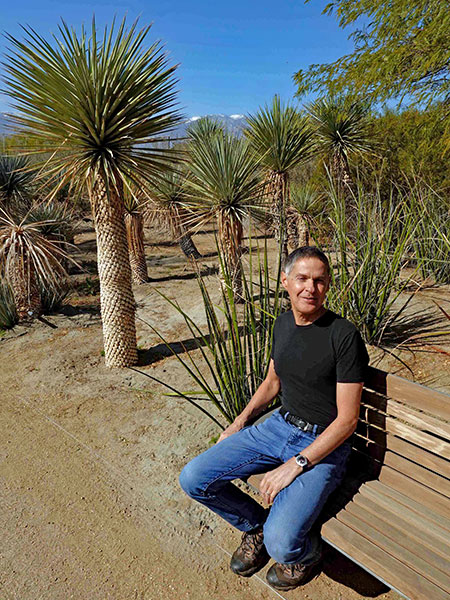
Beneath them dwell spiny battalions of 21 species of cactus, 17 of agaves, and about 20 affiliated genera such as yuccas, hesperaloes, dasylirions, nolinas, and iconic desert shrubs such as ocotillo (Fouquieria splendens) and creosote bush (Larrea tridentata). The seven species of annuals in the extensive wildflower garden feature natives —including four highlighted last month in the “Poppypalooza” segment of Horticulturally Yours: California poppy (Eschscholzia californica), desert Canterbury bells (Phacelia campanularia), desert primrose (Oenothera deltoides) and sand verbena (Abronia villosa)— along with salvia, penstemon and desert marigold (Baileya multiradiata).
Exotic plantings are limited to compatible taxa from arid areas of the African continent that are close counterparts of our Western Hemisphere cacti and succulents. These exemplify par excellence the concept of convergent evolution: four representatives of the genus Euphorbia that are dead-ringers (at first glance) of certain cactus, and six of Aloe that are near doppelgangers (except when in flower) of some agaves.
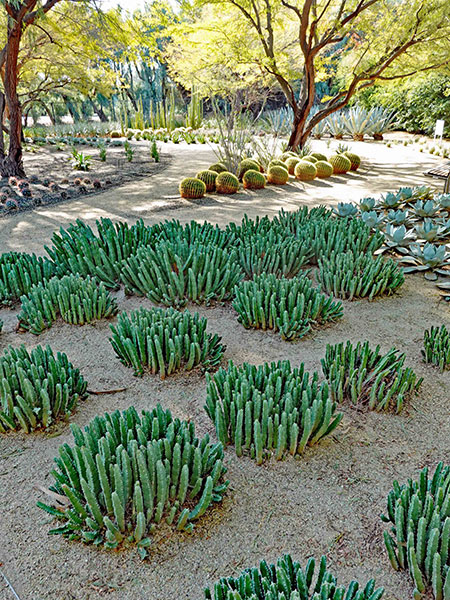
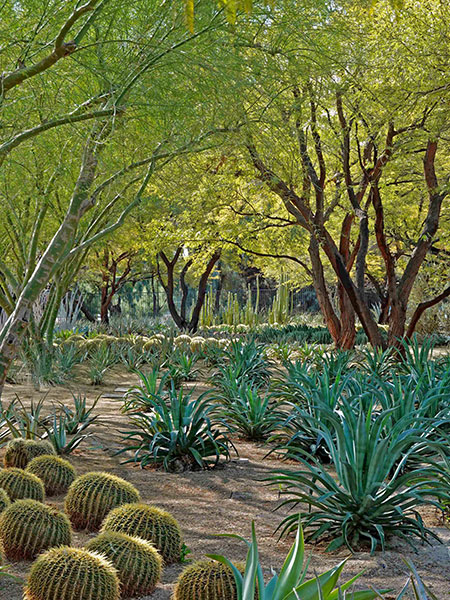
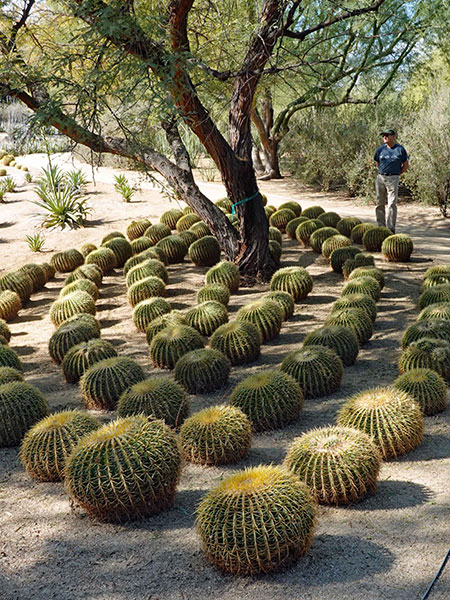
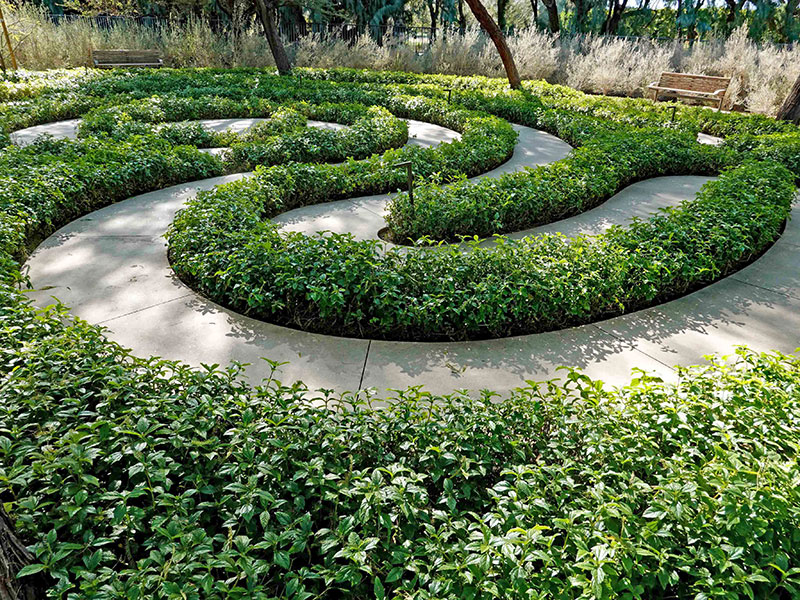
All told the gardens display a princely sum of around 53,000 perennial plants, shrubs and trees, although from a limited palette of just 70 species. Some of my favorites include whirls and swirls of around 2000 spineless and smooth Agave desmetiana (now properly called A. demeesteriana), several phalanxes of golden barrel cactus (Echinocactus grusonii), and a charming, meditative labyrinth formed among calf-high mounds of wedelia (Sphagneticola trilobata). This evergreen, mat-forming, trailing daisy relative native to Mexico is considered a noxious weed in some parts of the humid tropics, but it’s on its best behavior in the desert.
Not only is this highly organized Eden easy on the eye as well as the pocketbook (admission and parking are free of charge), it’s also remarkably gentle on the environment —in contrast to the private golf course still lurking in the heart of the estate. Sunnylands’ 15,000 square foot visitor center and the garden proper have earned LEED Gold status for sustainable design. All on-site water is recycled, and the garden uses only 20% of its allotment from the local water district. Power is supplied by a solar panel field, and 96 geothermal wells that plunge 396 feet below the surface are used to cool the center’s interior spaces.
Meanwhile, although the Coachella Valley’s legions of golf courses continue their siege of the landscape, a few are being converted to more benign and inclusive interfaces. Two defunct golf and country clubs along the scenic Tahquitz Wash near the center of Palm Springs have recently been acquired by the Oswit Land Trust, rescued from impending development and opened to the public as the Prescott Preserve, a 120-acre tract that already boasts 2.7 miles of walking and biking trails. Plans call for establishment of a butterfly garden, a “celebration forest” of native trees, floats for migratory birds and areas reserved solely for wildlife. I, for one, will be shouting “fore!” as this trajectory launches.
Horticulturally yours,
Daniel
- Final verse of the poem “Cactus” from the collection So Many Births by Koyamparambath Satchidanandan (Delhi: Konarak Publishers, 2001).
- Mary Irish, who died in August 2021, was co-author of one of my go-to reference books, Agaves, Yuccas and Related Plants: A Gardener’s Guide (Portland: Timber Press, 2000). The UW’s Miller Library has two copies.