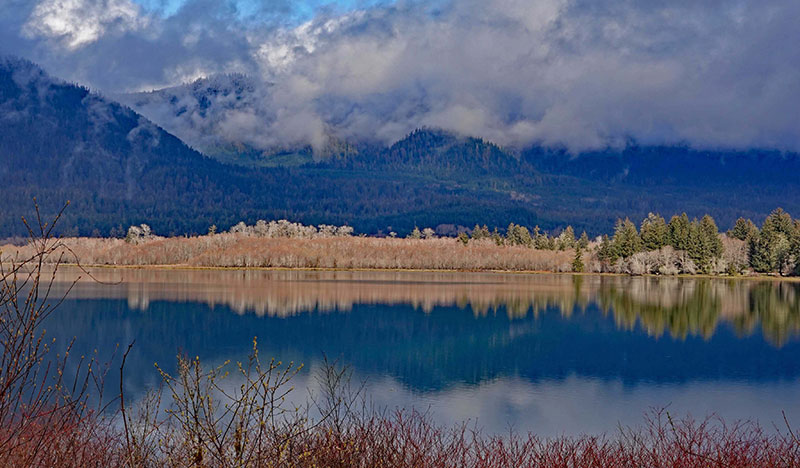

Immersed in Moss: An Ode to Bryophytes
April 2023

If you are blessed with moss, enjoy it.
—Ken Druse 1
Demure in the shadows of their taller cousins, squat and humble mosses rarely capture our attention. How often do we stop and stoop to appreciate their understated but intricate brocades? Among the very first plants to colonize land, bryophytes (collectively the 20,000 or so species of mosses, liverworts and hornworts) have been around half a billion years. Silently at work transforming the planet, they break down rocks and extract minerals that feed more complex plants and provide a nurturing seedbed for towering trees. Sequestering huge amounts of carbon from the atmosphere, they also control erosion by absorbing water. What they lack in stature they more than compensate in ubiquity: bryophytes are found on every part of the planet except in salt water.

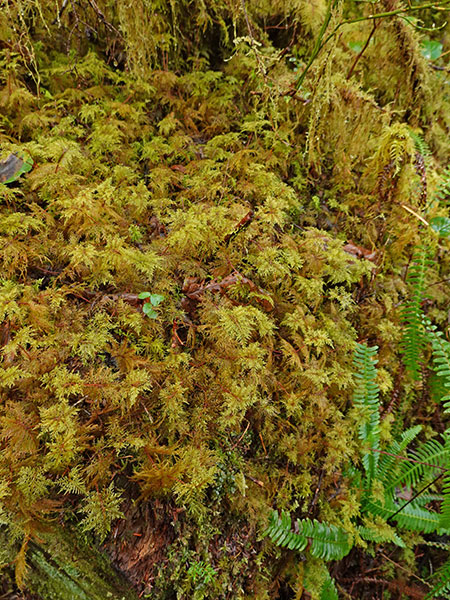
Even though some mosses and liverworts live in deserts and even in Antarctica, most prefer the shady, moist habitats with which we are oh-so-familiar. The indispensable reference Plants of the Pacific Northwest Coast2 informs that around 1000 species of bryophytes abound in our corner of the world. The book provides thorough descriptions illustrated with color photographs of 71 species of mosses and 17 of liverworts that thrive here. Two of my favorite spots to mosey among mosses are the old-growth portions of Seattle’s Seward Park and the Quinault Rain Forest near the southwest corner of Olympic National Park.

Before we explore these two sites, let’s pause to consider the happy convergence of the following: April is National Poetry Month, April 22 is Earth Day and April 23 (as designated by UNESCO) is World Book Day. As this year’s UNESCO book-day theme honors indigenous languages, it’s only fitting that this segment of Horticulturally Yours tap into the poetic imagery, scientific erudition and ethnobotanical wisdom embodied in the visionary book Gathering Moss by Robin Wall Kemmerer3, SUNY Distinguished Teaching Professor of Environmental Biology and an enrolled member of the Citizen Potawatomi Nation.


Referring to the Pacific Northwest coastal regions, Kemmerer notes on page 146: “There is a positive feedback loop created between mosses and humidity. The more mosses there are, the greater the humidity. More humidity leads inexorably to more mosses. The continual exhalation of mosses gives the temperate rain forest much of its essential character, from bird song to banana slug.” Following are three more excerpts from Gathering Moss that particularly resonate with today’s topic:
● You can look at mosses the way you can listen deeply to water running over rocks. The soothing sound of a stream has many voices, the soothing green of mosses likewise. … Slowing down and coming close, we see patterns emerge and expand out of the tangled tapestry threads. (p. 11)
● A close encounter with a mossy log always makes me think of entering a fantasy fabric shop. Its windows overflow with rich textures and colors that invite you close to inspect the bolts of cloth arrayed before you. You can turn your fingertips over a silky drape of Plagiothecium and finger the glossy Brotherella brocade. There are dark woolly tufts of Dicranum, sheets of golden Brachythecium, and shining ribbons of Mnium. The yardage of nubbly brown Callicladium tweed is shot through with gilt threads of Campylium. To pass hurriedly by without looking is like walking by the Mona Lisa chatting on a cell phone, oblivious. (p. 10)
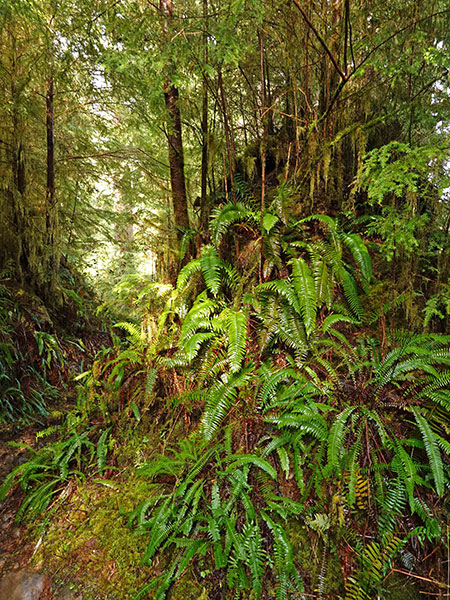
● It seems as if the entire forest is stitched together with threads of moss. Sometimes as a subtle background weave and sometimes with a striking ribbon of color, a brilliant fern green. The ferns which decorate the trunks and branches of the old-growth trees are never rooted in bare bark, always in moss. Ferns give thanks for mosses. Licorice fern runs rhizomes beneath the moss, anchored in the accretion of organic soil. (p. 147)


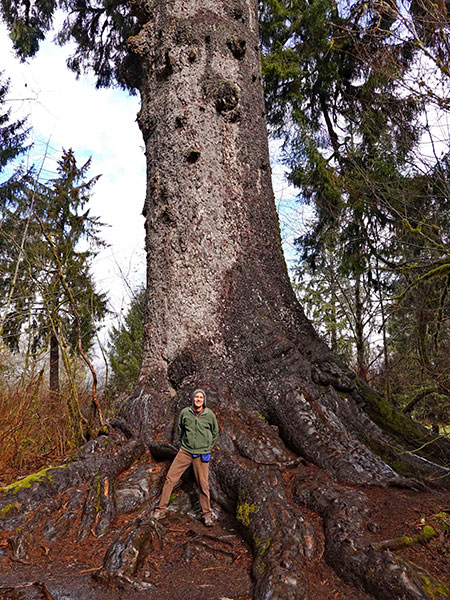
Motivated by Kimmerer’s vision, I set out with a new mindset on a mid-March foray to the Quinault area of the Olympic National Forest, just outside the National Park boundary. This valley (among the most well-watered portions of North America, averaging a mind-blowing 159 inches of annual precipitation) is perhaps best known as the home of several gargantuan world-record specimen trees. Two of these titans —a Thuja plicata (western red cedar) and Picea sitchensis (Sitka spruce)— can be easily admired by the casual visitor. Ardent tree lover that I am, this time I was determined to share my attention on a series of short day-hikes with the startlingly plush and opulent bryophytes that line waterfall-embracing cliffs, drape over boulders large and small, carpet nurse logs, festoon fields of ferns, and slither up to vertigo-inducing heights on the trunks of Acer macrophyllum (bigleaf maple).
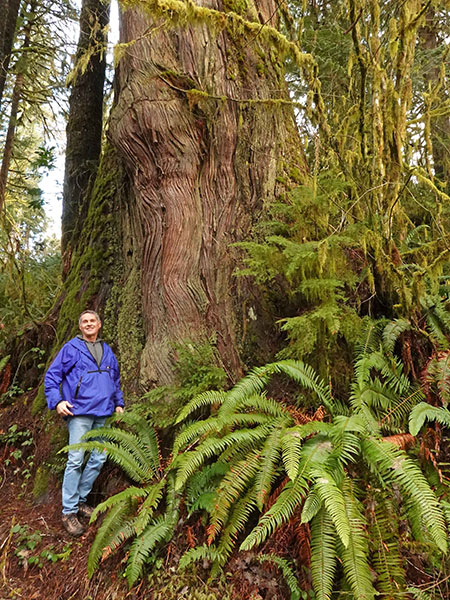
Back home, I resolved to pursue my rekindled interest in moss (I first fell for the fluffy stuff during frequent visits to moss gardens that adorn Kyoto temples during a year-long stay in Japan half a lifetime ago). The other day I inspected the bryophytes along the fully accessible Sqebeqsed Trail that runs down the spine of the old-growth grove in Seward Park. I also intend to hop on a ferry in the next couple of weeks to take a fresh look at the region’s best-known moss garden, which constitutes one of the crown jewels of the storied Bloedel Reserve on Bainbridge Island.
We’ll meet again amid ever-brightening days of May.
Horticulturally yours,
Daniel
- From page 72 of The Natural Shade Garden by Ken Druse (New York: Clarkson Potter Publishers, 1992).
- Compiled and edited by Jim Pojar and Andy MacKinnon of the British Columbia Forest Service, published in 1994 with a revised version in 2004 by Lone Pine Publishing.
- Gathering Moss was published by Oregon State University Press in 2003. Kimmerer is also author of the best-selling Braiding Sweetgrass: Indigenous Wisdom, Scientific Knowledge, and the Teachings of Plants (Minneapolis: Milkweed Editions, 2020).