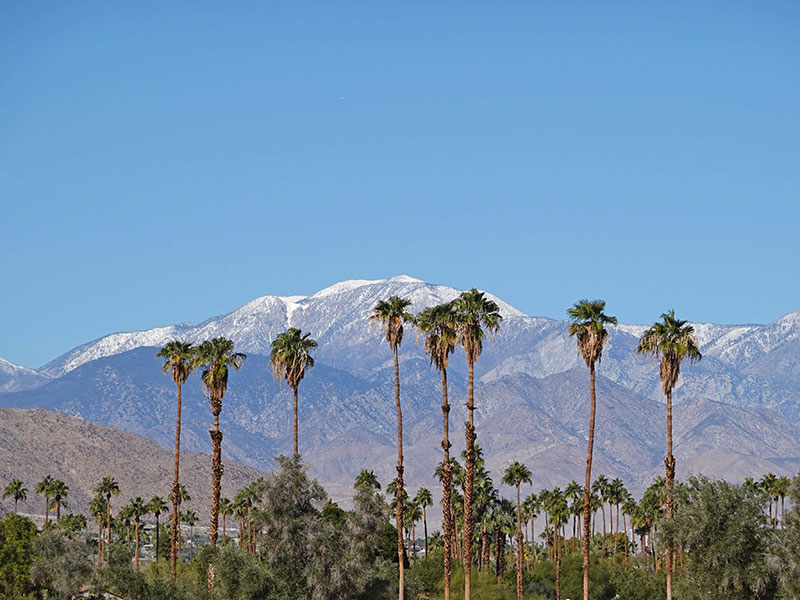

Washingtonia: A Pair of Desert Jewels
March 2023

The palm stands on the edge of space.
—Wallace Stevens 1
The wind moves slowly in the branches.
The bird’s fire-fangled feathers dangle down.
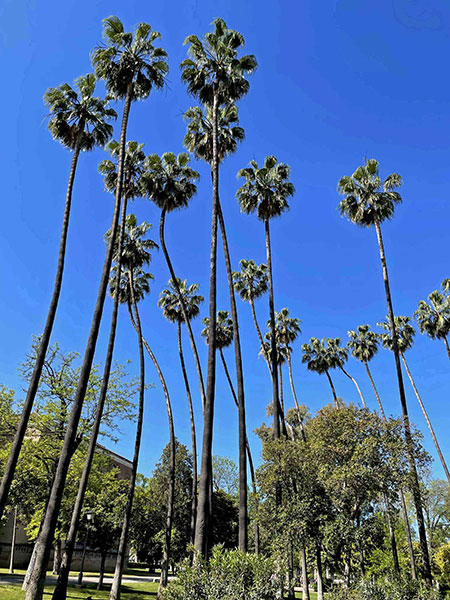
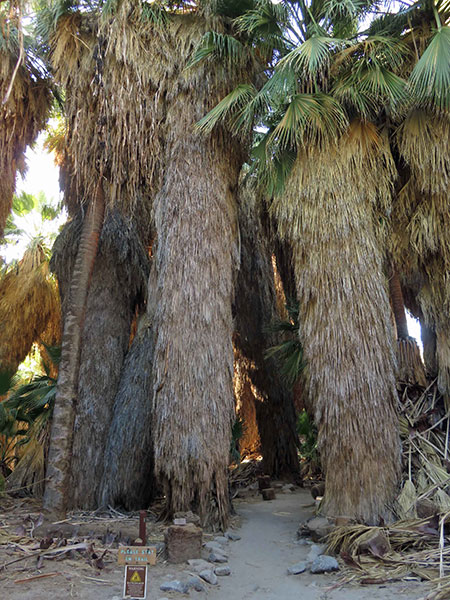
Across the southern tier of the United States, cities from San Francisco to Savannah rely on soaring palm trees to bestow an air of subtropical splendor to municipal avenues and parks. However, in almost all cases (Miami is a prominent exception), these towering arboreal lollipops are of exotic origin, immigrants from elsewhere. About a dozen species of palms are indigenous to the United States, the two largest being south Florida’s royal palm (Roystonea regia), which is the tallest, and southern California’s desert fan palm (Washingtonia filifera), the most massive. The latter —the only palm native to the western portion of the country— is immediately recognizable by its enormous skirt of dead fronds that cling to the trunk beneath the emerald-green fresh fans of foliage unless reduced by fire or an overzealous gardener. In nature it grows in 158 scattered and often isolated oases, many of them found in the vicinity of one of the most aptly named of all places: Palm Springs.2
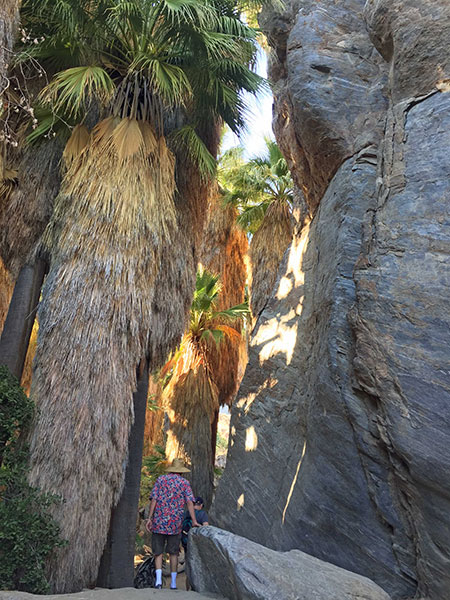
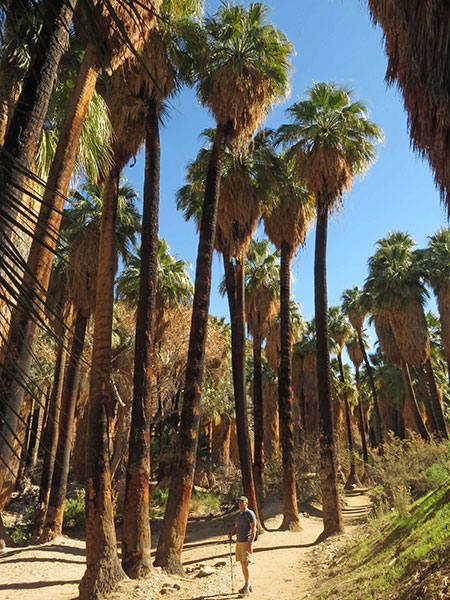
Originating just south of the border in the nearby states of Baja California Sur and Sonora is the only other species in the genus, Washingtonia robusta, often called Mexican fan palm. This taller, elegant and adaptable sibling of W. filifera is much more widely grown than the California fan palm and dominates the horizon in Mediterranean-climate cities from Los Angeles to Seville. In fact, in cultivation W. robusta outnumbers its sibling even on W. filifera’s home turf: Palm Springs has planted and maintains about 13,800 trees representing 160 species along city streets and in parks. Around 6000 of these are Washingtonia specimens, of which just under 60% are the Mexican fan palm. (I confess that I have twice tried to grow W. robusta in the sunniest spot in my garden. Both attempts limped along for two or three years only to result in lingering death brought on by a series of deep freezes. Dear Readers, have any of you met with greater success growing this plant in the Pacific Northwest? If so, please let me know!)
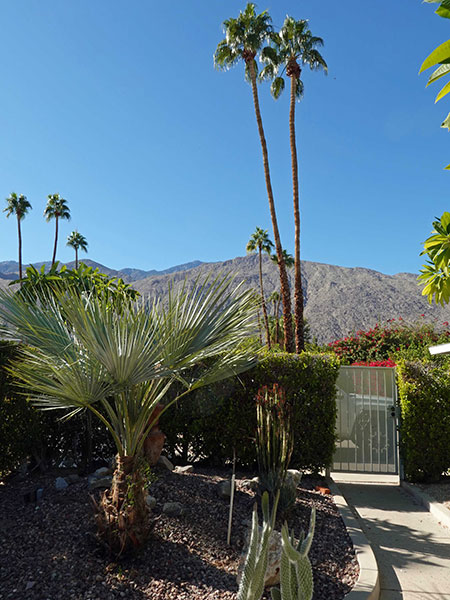
Back to the California fan palm: The water that gives Palm Springs its name emerges along the San Andreas fault at the base of the San Jacinto Mountains that rise more than 10,000 feet above the Coachella Valley floor, providing the necessary hydration for Washingtonia filifera in its native habitat. Of the 30,000 or so wild specimens living today, the greatest concentration resides in the three segments of the Indian Canyons complex just south of town. The southernmost portion, Palm Canyon, is said to be the largest undisturbed palm oasis on the planet. (Another area, Andreas Canyon, we visited in the last segment of Horticulturally Yours.) For the ancestral owners of this land, the Agua Caliente Band of Cahuilla Indians, the long-lived W. filifera is inextricably linked with their existence: The tree’s presence indicated a water source and created a cooler microclimate that attracted wildlife, its dried fronds used to build waterproof dwellings, its sweet fruit a major food source.
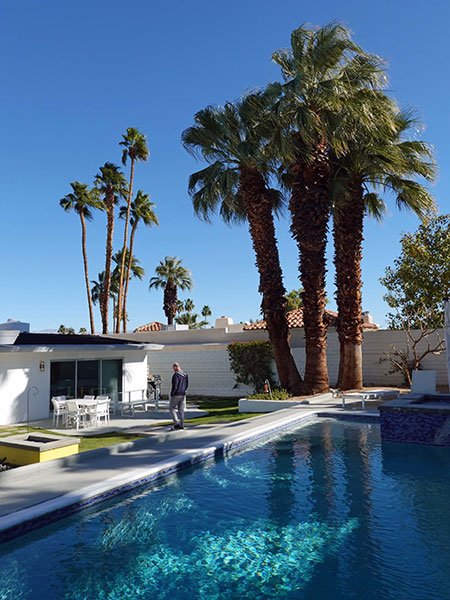
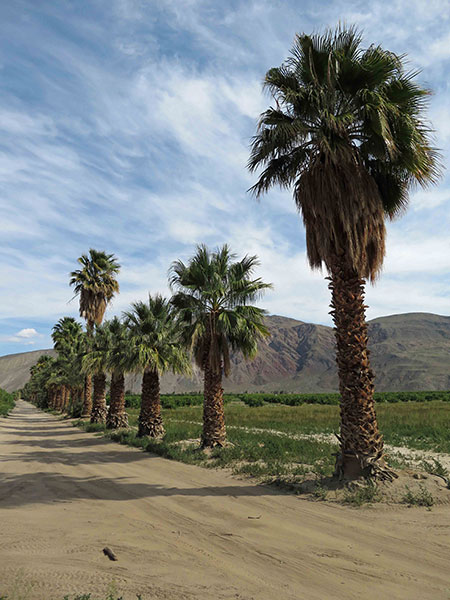
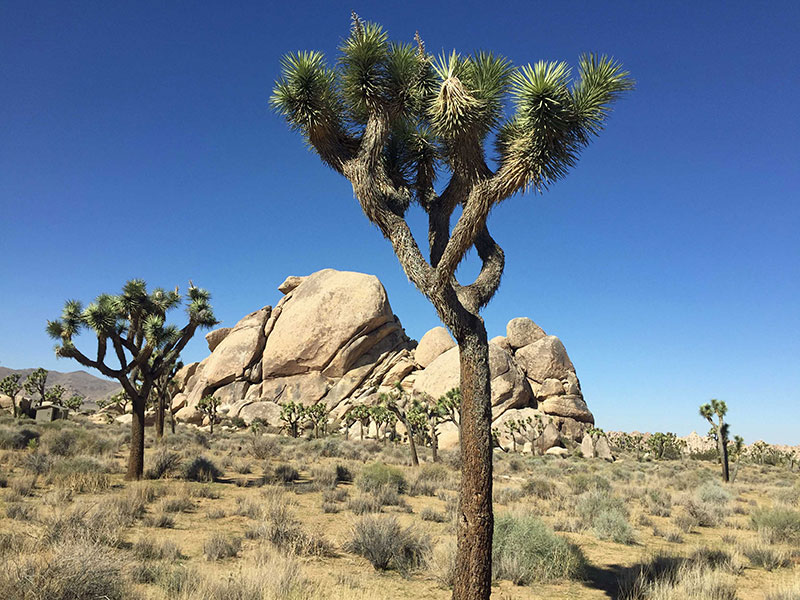
About an hour’s drive east of Palm Springs, the sprawling Joshua Tree National Park is host to five palm oases. All can be reached by formal hiking trails, and two (Cottonwood Spring and Oasis of Mara) are a short, easy, accessible stroll from a paved parking lot. Those in search of a little more adventure will enjoy Lost Palms Oasis, reached by a 7.5 mile round-trip hike from Cottonwood Spring. One shouldn’t visit the park without admiring stands of Yucca brevifolia, the eponymous and weirdly handsome Joshua tree itself. Unlike the native fan palm, W. filifera, that is thriving and even expanding its natural population, the Joshua tree is under severe stress from climate change, which could reduce its suitable habitat by 90% within a few decades.
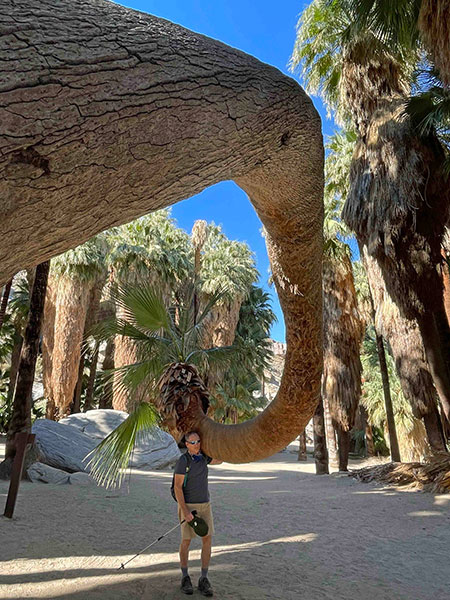
West of Joshua Tree NP and only a 30-minute drive from Palm Springs lies the alluringly named Thousand Palms Oasis Preserve, whose 880 acres are owned by the nonprofit conservation agency Center for Natural Lands Management 3. The preserve’s two oases are connected by the easy, flat, just-under-a-mile-long McCallum Trail, which leads to a surprisingly large spring-fed pond lined with even more Washingtonias. In addition to dozens of the plump, skirted palms, the pool (called both Simone Pond and McCallum Pond) is also home to the endangered desert pupfish, Cyprinodon macularis. One can convert this short trek into a 4½-mile loop by returning via the more exposed and slightly hillier Moon Country Trail, from which the San Andreas Fault is clearly visible. Admission to the oasis preserve is free of charge. Hours are 7 a.m. to 5 p.m., Wednesdays through Sundays.
My original intent for this column, as stated last time around, was to include the Sunnylands Garden in Rancho Mirage (just east of Palm Springs), but that worthy object of veneration will have to wait until the next segment. Meanwhile, I’m heading outside to give some belated love and attention to my own brood of the family Arecaceae: four non-fussy species of Trachycarpus (Chinese windmill palms) and one reliably cold-hardy Chamaerops humilis (Mediterranean dwarf palm). They’ve been whispering to me that Palm Sunday is just around the corner.
Horticulturally yours,
Daniel
- Final verse of Wallace Stevens’ poem “Of Mere Being”, published in The Palm at the End of the Mind: Selected Poems and a Play (New York: Alfred A. Knopf, 1971).
- The Agua Caliente Band of Cahuilla Indians, the original inhabitants of the surrounding Coachella Valley and still the largest collective landowner in Palm Springs, called the area “Séc he” (or “Se Khi” in some sources), which means “boiling water”.
- CNLM protects and manages eight nature preserves in Washington State, mostly in Thurston County.