

Nights in White Satin: Twilight in the June Garden
June 2025
As dusk falls, colors transition into contrast.
—Lorene Edwards Forkner 1
Shimmering white … a bit of celestial wizardry that
gardeners can use to animate the night garden.
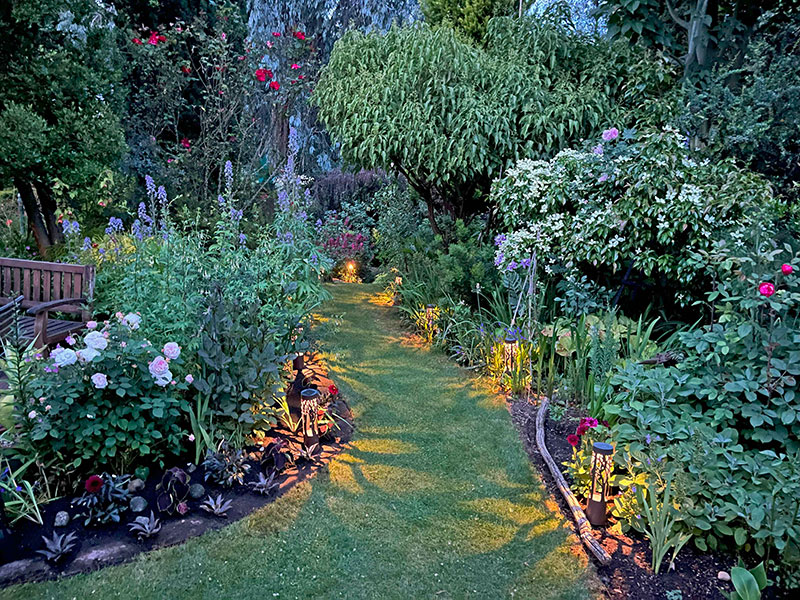
Summertime and the livin’ is… a decidedly mixed bag. Yes, we’ve just passed the longest day of the year, the debut of astronomical summer and the acme of our all-too-brief season of light in the Pacific Northwest. Seattle at present enjoys 16 hours between sunrise and sunset. Twilight around dawn and dusk delivers an additional 90 minute reprieve from darkness, but one needs to be a bit further north to revel in the full white nights experience of midsummer. Given the current combative climate, could our fractious and fractured world ever use a Summer of Love! The idealistic but ill-fated intent of the original 1967 social movement fluttered right over my bratty, 9-year-old, small-town Arkansas head, yet I was all ears that year as the radio introduced and illuminated a pair of now classic tunes that resonate with today’s topic: The Moody Blues’ “Nights in White Satin” 2 and Procol Harum’s “A Whiter Shade of Pale”.
Apropos white, is it a color or not? Most people treat it as one3 even though it isn’t on the visual chromatic spectrum. More refined and sophisticated gardeners than Yours Truly liberally endorse and employ white flowers and foliage, extoling their values of nuance and subtlety. I am of two minds regarding its virtues. While white can connote innocence and purity, it’s also a universal symbol of surrender. Wan, washed out, drab, ghostly, lifeless: It seems fitting that white is associated with mourning in many cultures. Eminent plantsman and all-around good-guy-cum-garden-guru Duane West doesn’t cotton at all to the white garden camp. “Looking at white flowers is like staring at a light bulb,” he opines. I mostly agree with that assessment during daylight hours, especially when the sun is out, but dusk delivers a natural rheostat that dials down diurnal dazzle to a soothing nocturnal simmer.
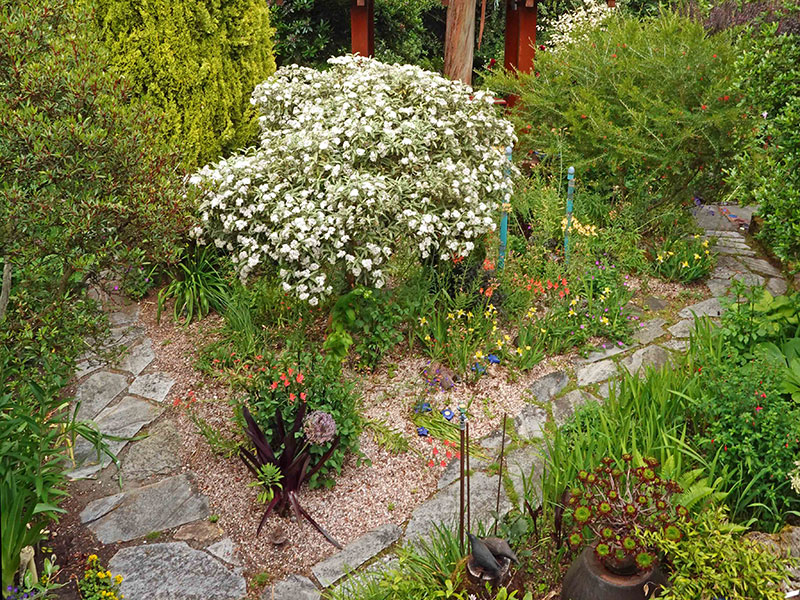
As a happily haphazard gardener, I’ve scarcely paid attention to concepts of harmony and contrast, much less color theory. However, Penelope Hobhouse’s encyclopedic (and somewhat sententious) compendium, Color in Your Garden, raises a few uncharacteristically non-snooty, straightforward questions on this subject: “Are white gardens popular because they are fashionable or because, as in interior decorating, white is considered ‘safe’? Or is it that they strike a cool chord of simple restfulness away from the harsh discords of pure spectral colors and man-made dyes of garish hues?”4 Although “garish” is practically my middle name, I see her point about restfulness. Looking around my Garden of Exuberant Refuge the last few days, it dawns on me that over the past three decades I’ve inadvertently accrued a (heavenly?) host of perennials, shrubs and trees whose flowers or foliage in the waning light shimmer in shades of cream, eggshell, pearl, silver and palest pink.
In previous segments of Horticulturally Yours we’ve pranced through patches of pink, blue, yellow and orange plants. Isn’t it proper to consider now the paler portions of the chromatic (and achromatic) visual experience in the twilight hour? Since the beginning of June, I’ve embarked on a “magical mystery tour”5 of my own garden in the waning, post-sunset glimmer, slowly shuffling along pathways aglow with the silky sheen of alabaster alstroemerias and effulgent euphorbias, ivory olearias and frosted fatsias, pewtery pulmonarias and powdery persicarias. Especially this year, I’ve found this practice not only restful, but also profoundly restorative. With only the pair of exceptions noted, every photograph in this posting was taken over the last few days at dusk, between 9:00 and 9:45 p.m., the time one can “breathe deep the gathering gloom, watch lights fade from every room,” as sung in the “Late Lament” section of “Nights in White Satin”. Of the 24 taxa discussed and portrayed here (arranged by plant height in groups labeled A, B and C), only the agave and orchid cactus are frost sensitive and grown in pots; the others have proven hardy in the ground for me.
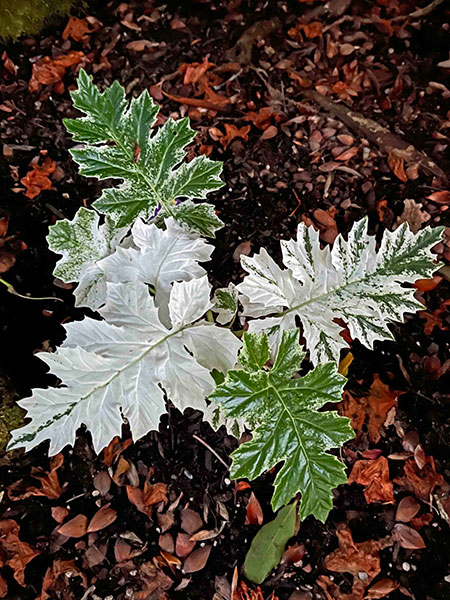
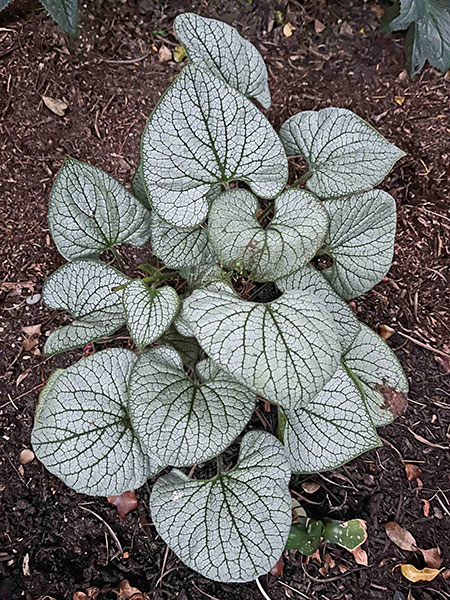
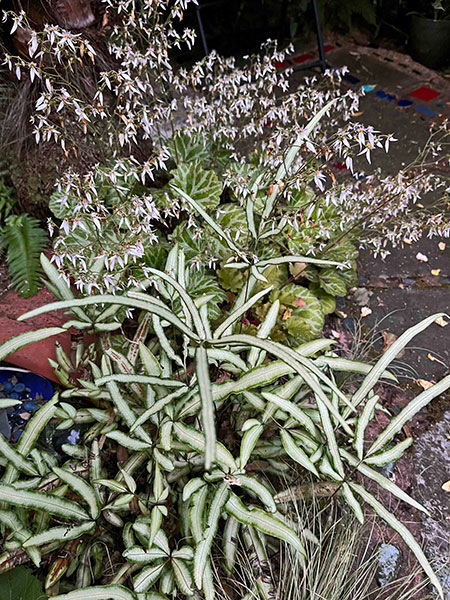
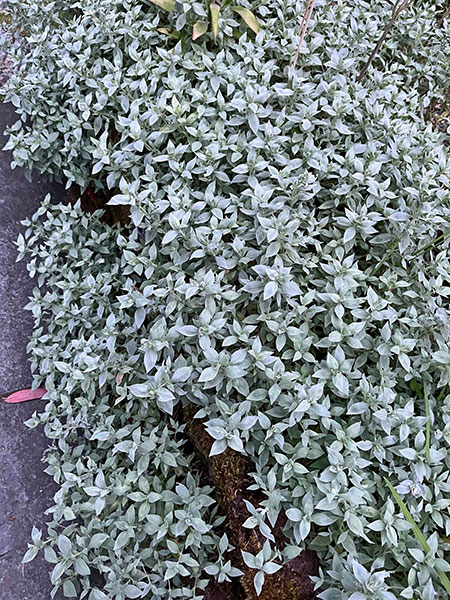
A. Let’s begin with an octet of ground-hugging perennials, mostly shade lovers. Acanthus mollis ‘Tasmanian Angel’, much slower-growing and better behaved than the straight species, sports new leaves that shine like a floodlight. Brunnera macrophylla ‘Silver Heart’ (PP #24,685) is totally true to its name, right down to the leaves’ prominent veins. The silver ribbon fern, Pteris parkeri, requires a little protection (I insulate my 10-year-old clumps with a blanket of maple leaves and throw a couple of layers of burlap on top during severe cold snaps), but its prolific neighbor, Saxifraga stolonifera, merrily waltzes through winter.
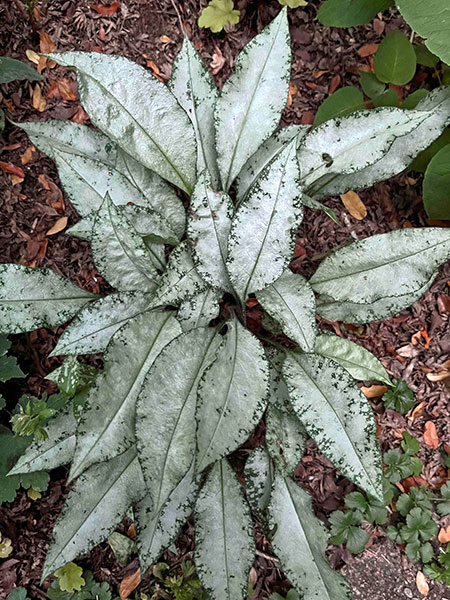
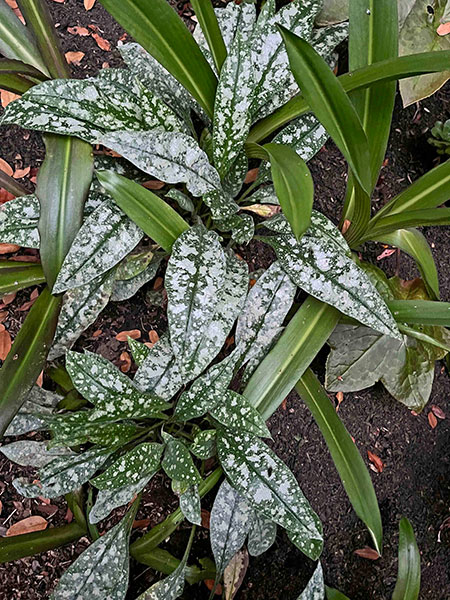
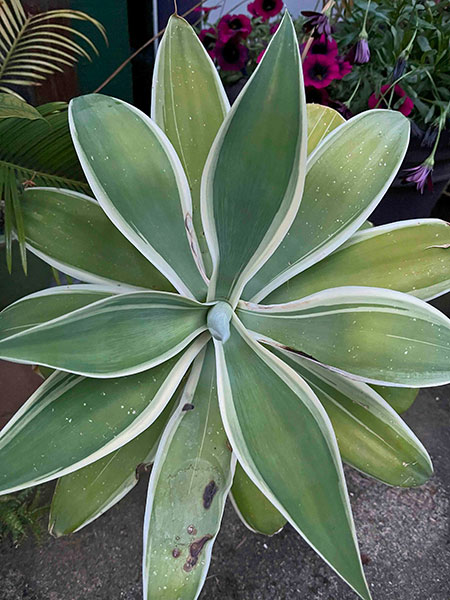
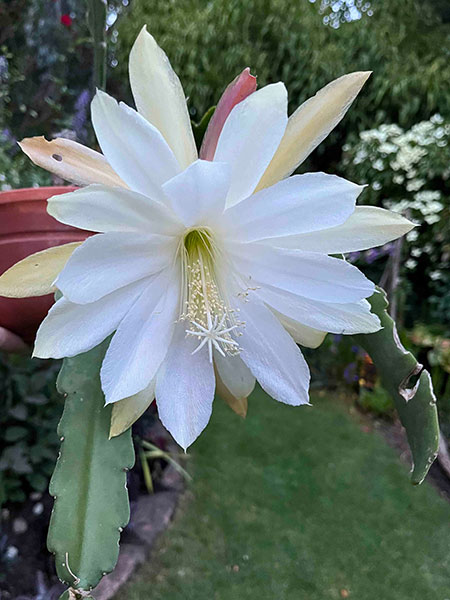
What is a shade garden without lungworts? My picks for a moonlit stroll are a pair of hybrids of Pulmonaria longifolia: ‘Diana Clare’ and ‘Trevi Fountain’. A low-growing trio that requires sunlight includes Epilobium septentrionale ‘Select Mattole’ (aka California fuchsia), whose profuse blooms arrive in August atop its graceful, glaucous foliage; the docile, soft as silk and aptly named Agave attenuata ‘Ray of Light’ (PP #21,854); and an epiphytic orchid cactus that produces creamy blooms up to 9” wide. The latter pair need to overwinter under cover.
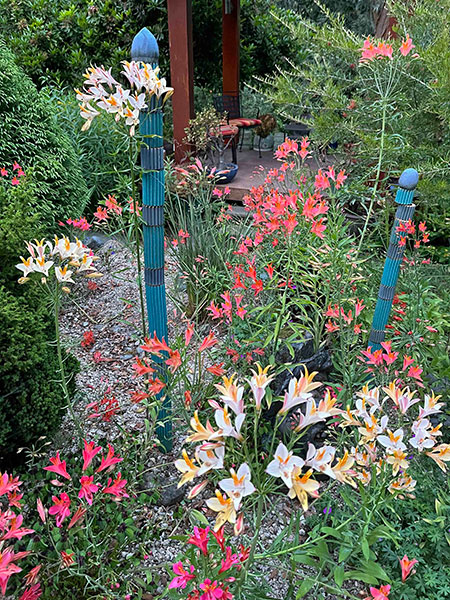
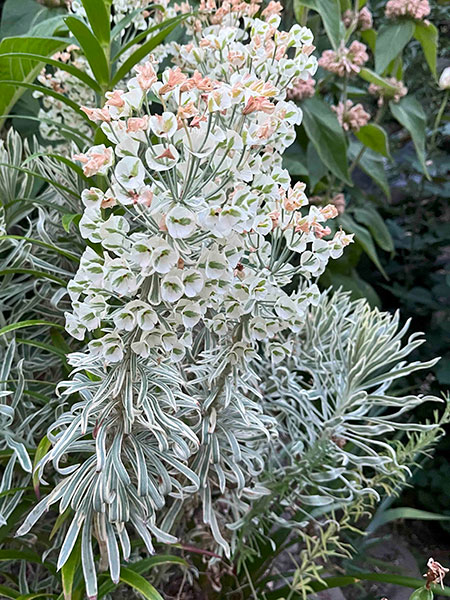
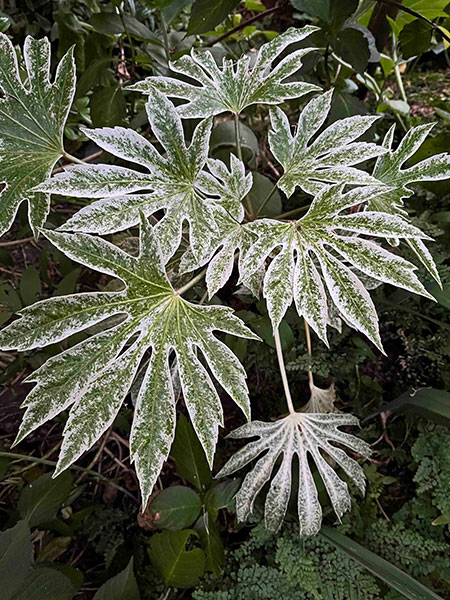
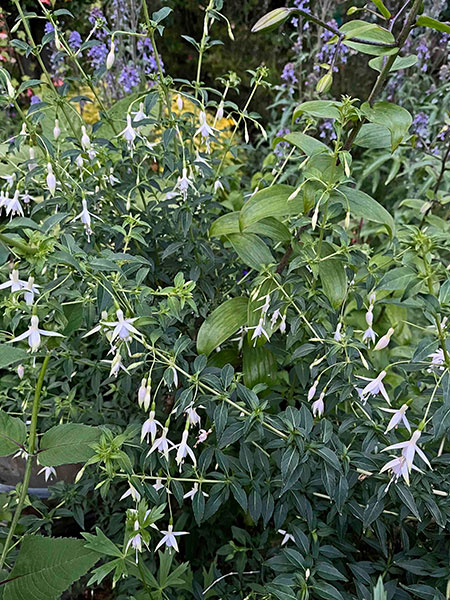
B. The midlevel coterie —of roughly knee-to-eye stature— commences with Alstroemerias. Although a bonanza of new selections has hit the market in recent years, pictured here are light-hued seedlings of old-fashioned A. ‘Ligtu Hybrids’. Unless you want a whole field of this fertile flock, be sure to yank out the stems before the seed pods ripen and explode. Next comes the tony and tame Euphorbia characias ‘Tasmanian Tiger’, followed by the slow-growing Fatsia japonica ‘Spider’s Web’ and demure but vigorous (as in very hardy and long-lived) Fuchsia magellanica ‘Hawkshead’.
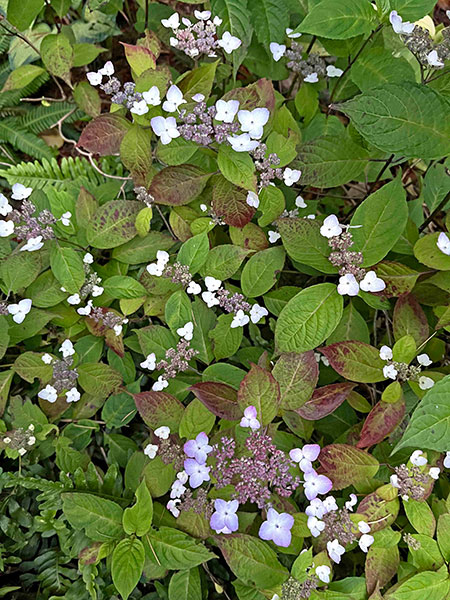
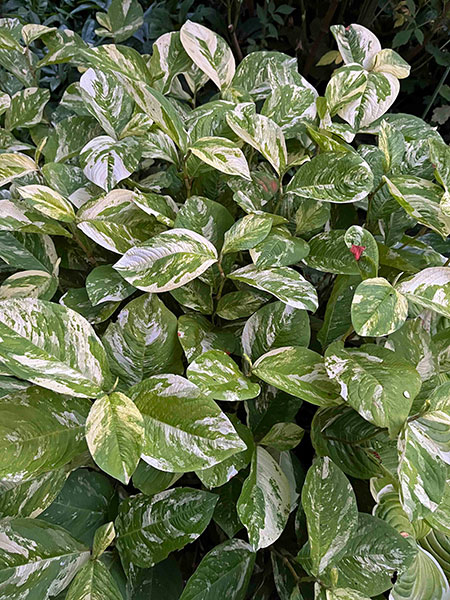
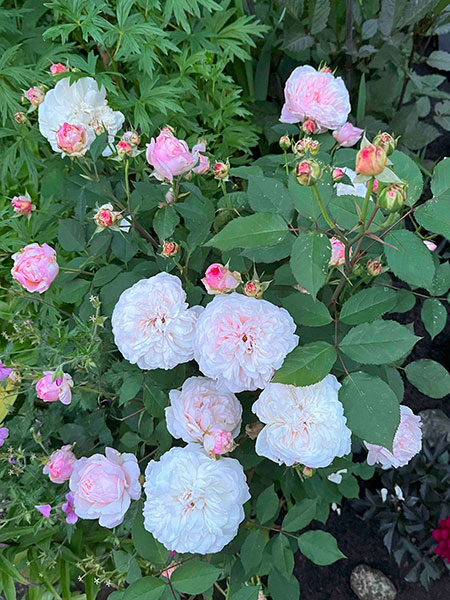
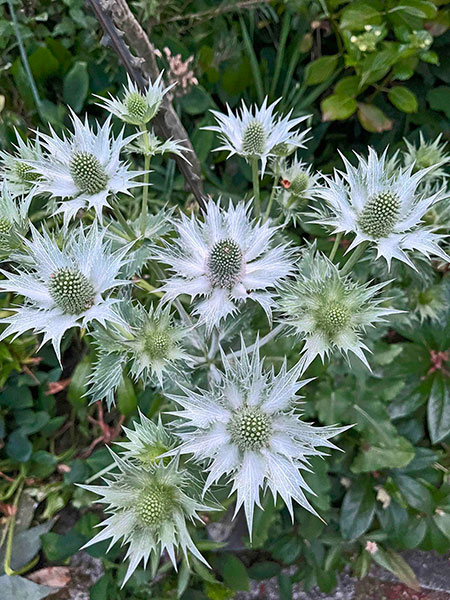
Completing the octagon are Hydrangea serrata ‘Beni-gaku’, a compact cutie that shifts color over several weeks; followed by the reliable and adaptable North American native Persicaria virginiana ‘Variegata’; then a healthy, remontant and fragrant old German floribunda, Rosa ‘Gruss an Aachen’; and finally the prickly, profligate and persuasive Eryngium giganteum, aka Miss Willmott’s ghost.
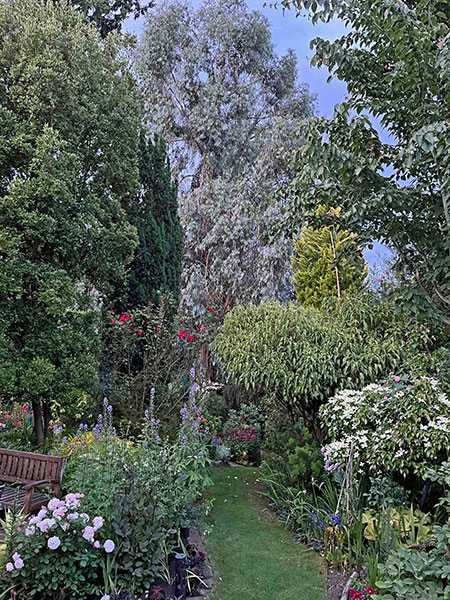
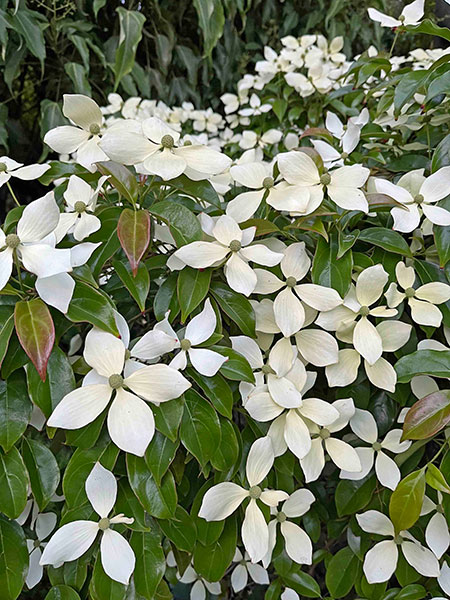
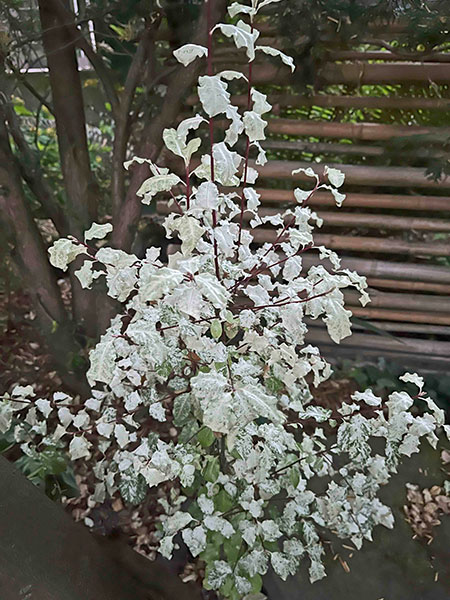
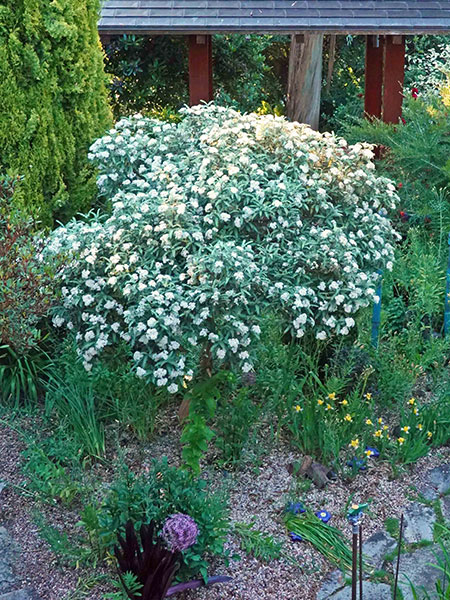
C. At the apex is a strapping cohort of stately and steely shrubs (plus a tree and a perennial) that entice admirers to look up. We begin with the titan, a towering, awe-inspiring and fear-inducing 26-year-old Eucalyptus glaucescens that looms both protectively and threateningly over the lower half of my garden, followed by one of the most elegant of all dogwoods, the mostly evergreen, June-blooming Cornus elliptica ‘Elsbry’ (aka ‘Empress of China’). Next are a pair of New Zealand natives: Pittosporum tenuifolium ‘Irene Paterson’ (sources cite its mature height as 4-6 feet, but my 23-year-old approaches 20 feet) and the so-called mountain holly, Olearia ilicifolia, a gorgeous shrub whose mounded canopy is smothered in tiny white daisies in early June.
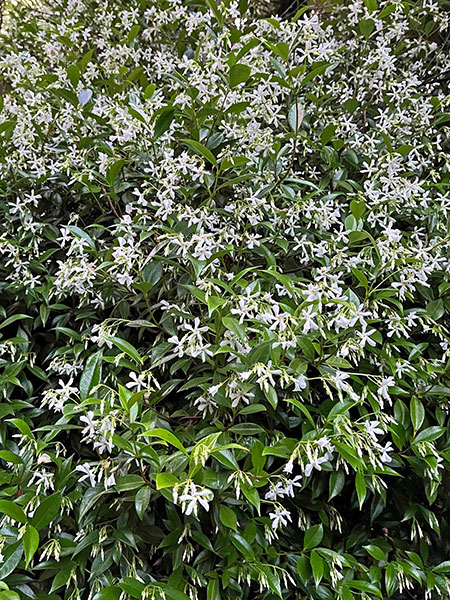
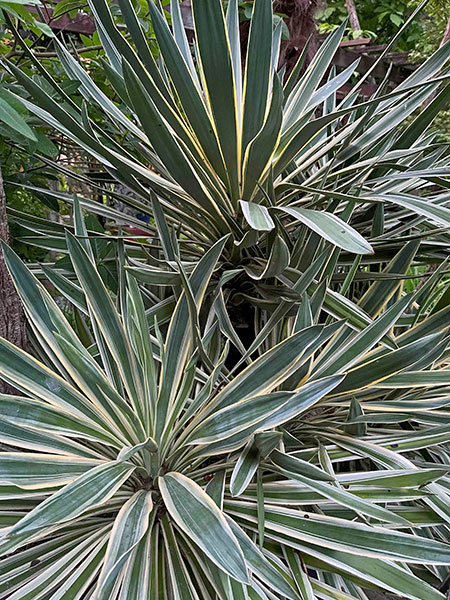
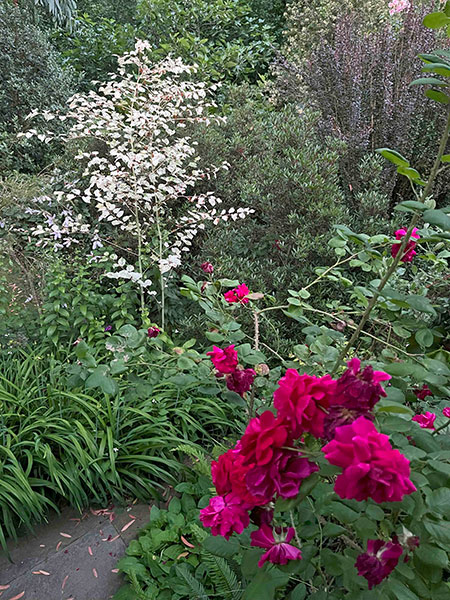
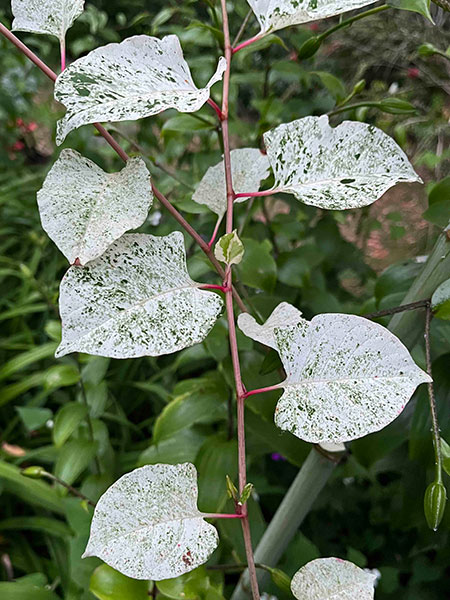
Queen of the night right now is star jasmine, the evergreen woody liana Trachelospermum jasminoides that perfumes summer evenings for weeks. Close by is her bodyguard, a sprawling, handsome and well-armed Yucca gloriosa ‘Tricolor’. Wrapping it up is the oddest ball of all, Reynoutria japonica ‘Variegata’ (formerly classified as Fallopia or Polygonum), a weird and wonderful mutant of Japanese knotweed with none of the nasty traits of the straight species, which is condemned as one of the “worst invasive species on the planet”. A winter-dormant perennial, my 33-year-old specimen sends up only two or three 9-foot canes a year, never having budged from its original spot.
Wishing you all silky and satiny nights in the garden, I’ll see you again in the dog days of July.
Horticulturally yours,
Daniel
- From page 20 of Forkner’s scintillating guide, Color In and Out of the Garden (New York: Abrams, 2022).
- Written by The Moody Blues’ frontman Justin Hayward, the song took on new life (and found its greatest success) in 1972, five years after its initial release, due to the diligence of Seattle FM radio DJs.
- Merriam-Webster defines white as “the achromatic object color of greatest lightness characteristically perceived to belong to objects that reflect diffusely nearly all incident energy throughout the visible spectrum”.
- From page 52 of Hobhouse’s Color in Your Garden (Boston: Little, Brown & Co., 1985). The UW’s Elisabeth C. Miller Library has a lending copy.
- Hats off to The Beatles, whose “Magical Mystery Tour” album was also released in 1967.