

In Brooklyn's Groves and Gardens
December 2022
Smile O voluptuous cool-breath’d earth!
—Walt Whitman1
Earth of the slumbering and liquid trees!
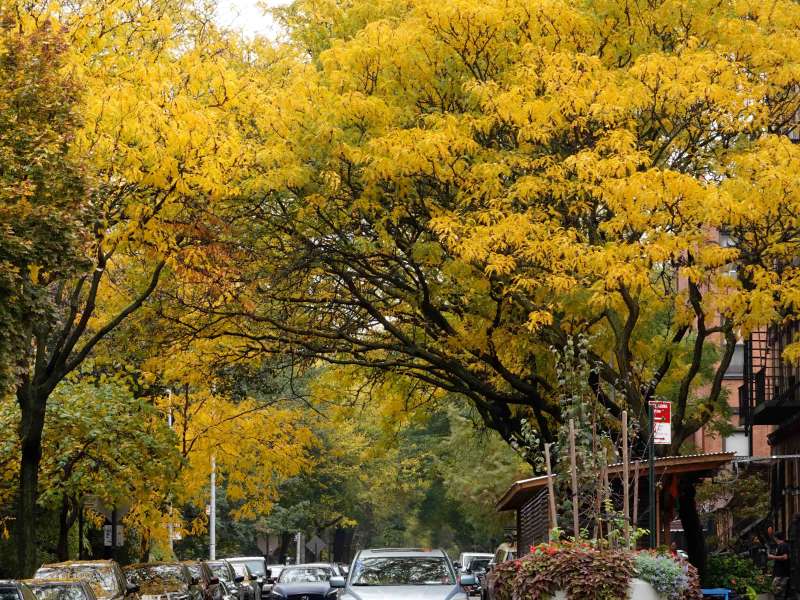
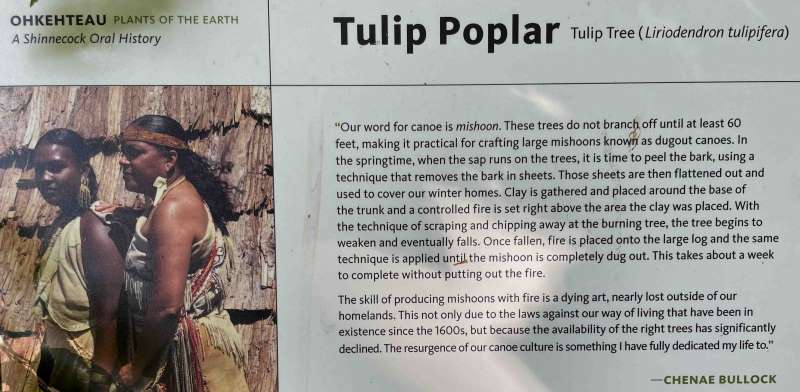
Among the constellation of America’s most beloved poets, arguably none shines brighter than Brooklyn’s own Walt Whitman. Although the bearded bard expressed his admiration of trees in verse, his love and respect for these botanical titans was even more sharply focused in prose. Here he comments on a favorite tulip poplar (Liriodendron tulipifera), “How strong, vital, enduring! how dumbly eloquent! What suggestions of imperturbability and being, as against the human trait of mere seeming. Then the qualities, almost emotional, palpably artistic, heroic, of a tree; so innocent and harmless, yet so savage. It is, yet says nothing.”2 Whitman’s arboreal advocacy had an impact: As editor of the Brooklyn Daily Eagle, he was instrumental in converting the city’s historic Fort Greene into a public park. Brooklyn returned the compliment in 1954 with the establishment of the nearby Walt Whitman Park in honor of the centennial of the first edition of the poet’s magnum opus, Leaves of Grass.
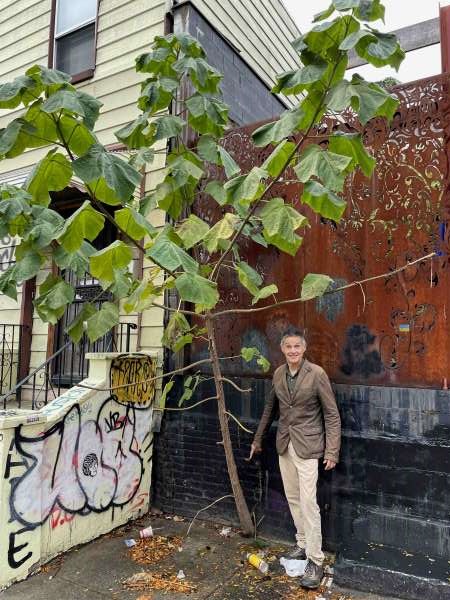
Perhaps it’s fitting that Brooklyn’s best-known tree is a literary one —the scrappy Ailanthus altissima referenced in Betty Smith’s lauded 1943 novel, A Tree Grows in Brooklyn. Here she introduces the subject: “Some people called it the Tree of Heaven. No matter where its seeds fell, it made a tree which struggled to reach the sky. It grew in boarded-up lots and out of neglected rubbish heaps and it was the only tree that grew out of cement. It grew lushly, but only in the tenement districts.”3 Although Smith intended this tree as a metaphor for tenacity in the face of overwhelming adversity, the aggressively invasive Ailanthus (sardonically labeled “tree of hell” by many ecologists) does not play well with others. In my recent travels through Brooklyn I haven’t noted many Ailanthus, although I have marveled at the countless number of Paulownia tomentosa (“empress tree”) sprouting in the same circumstances Betty Smith noted regarding her titular tree.
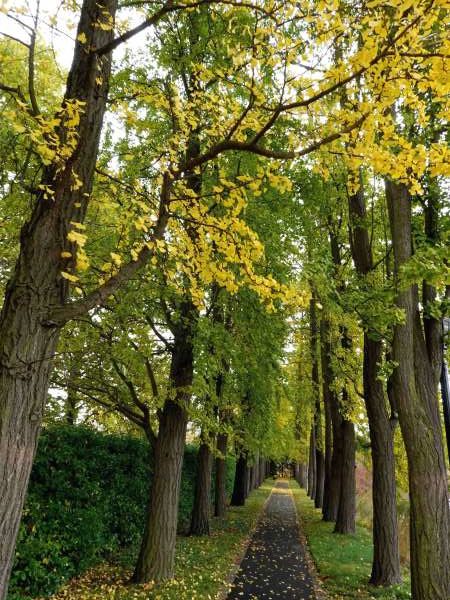
Brooklyn’s 2.7 million human residents make it the most heavily populated borough of New York; it also has the least amount of greenspace per person. But this doesn’t mean Brooklyn is bereft of verdure. The slightly smaller sibling of Manhattan’s Central Park, Brooklyn’s Prospect Park encompasses in its 585 acres nearly 250 acres of woodland, including the borough’s last remaining native forest. In total the park’s trees are said to number 30,000 individuals representing 203 species, including many types of native Acer, Prunus, Quercus and Ulmus (maple, cherry, oak and elm).
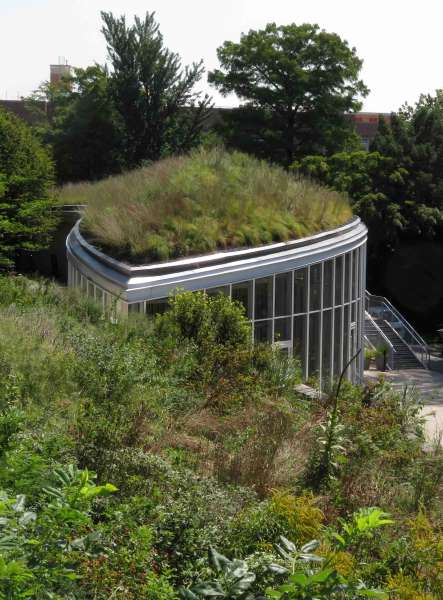
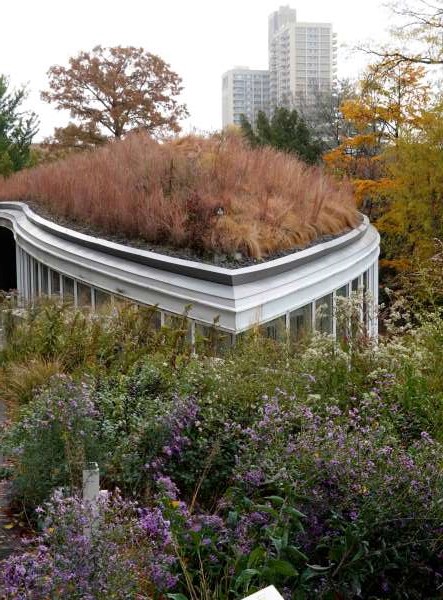
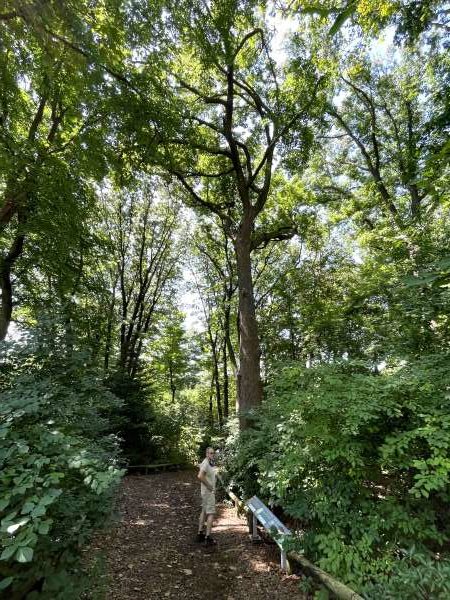
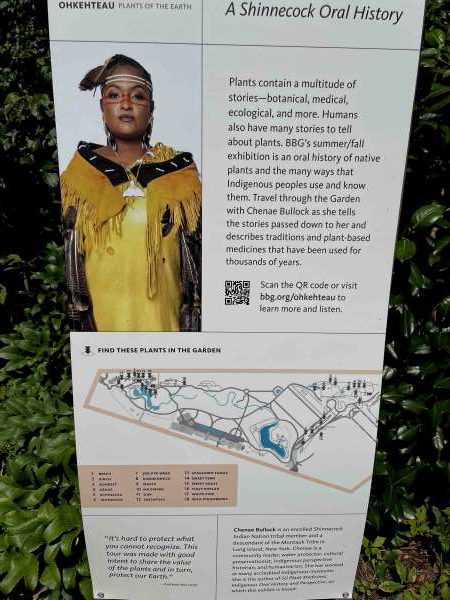
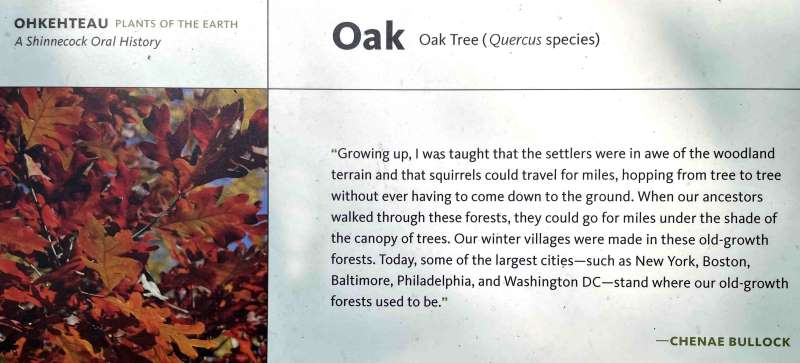
Like a bedizened beret anchored at a jaunty angle just across Flatbush Avenue from Prospect Park is the sumptuous jewel box of Brooklyn Botanic Garden. Comprising 52 acres and founded in 1910, the original site plan is by the Olmsted Brothers, who also designed the core of Seattle’s park system. The first portion of the garden to open to the public was the Native Flora Garden in 1911, whose forests, meadows and wetlands embrace plants found within a 200-mile radius of the city. Originally focusing on wildflowers, a 1931 revision repositioned it as a rambling deciduous and coniferous woodland. As the first ecologically themed native plant garden in the United States, its goal is to recreate the diverse plant communities that flourished in the area prior to the arrival of colonizers in the 17th century. Fittingly, informative and colorful signage throughout the Native Flora Garden educates visitors on how people of the indigenous Shinnecock nation, still resident on Long Island, managed and utilized many of the featured perennials, shrubs and trees.
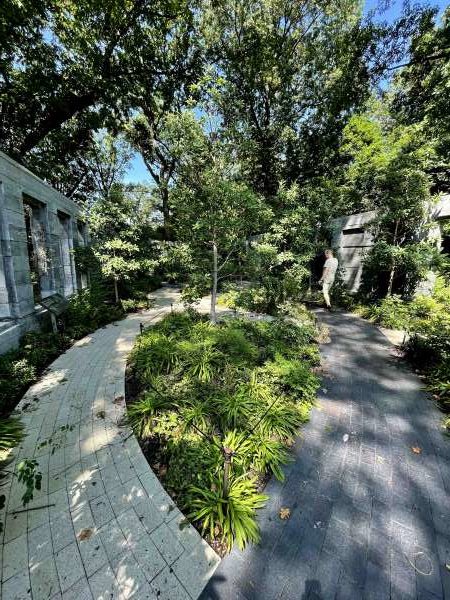
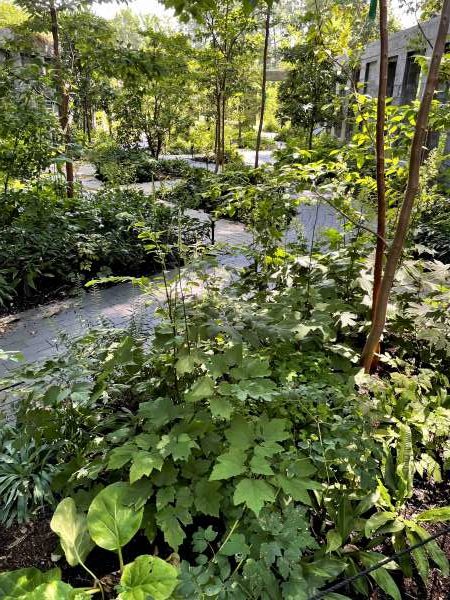
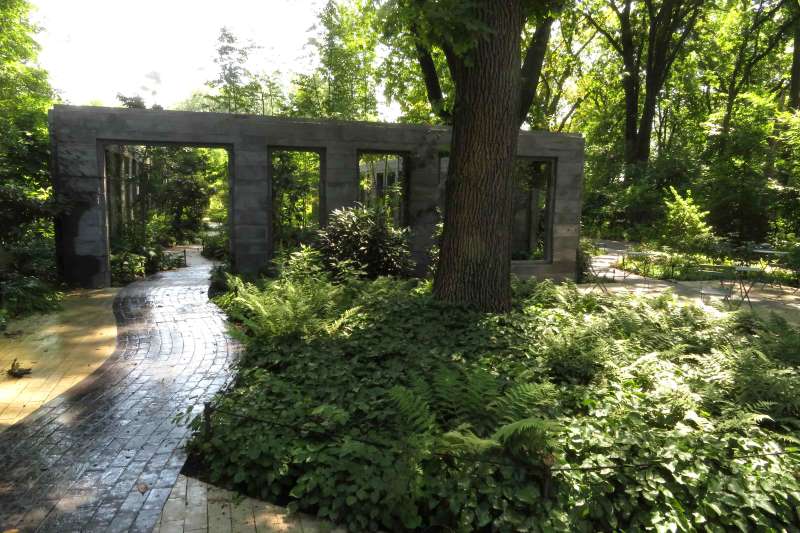
The BBG’s newest section, the Elizabeth Scholtz Woodland Garden, which opened in August 2020, is a naturalistic marvel of graceful design that eludes easy categorization. The hardscaping consists of swirls of color-differentiated interlocking stone pathways that lead to, within and through the open-air enclosure of a faux ruin that reminded me of an abandoned cloister reclaimed by an exuberant but tidy Goddess Flora. Indeed, its gentle but penetrating beauty inspires meditative contemplation if not outright reverence. A casual observer might well assume this garden has been in place for decades. Designed by Brooklyn-based landscape architect Michael Van Valkenburgh, the garden’s mixture of Asian, European and North American trees and perennials is meant to evoke a forest edge. Peppered within the enclosure are stewartias and magnolias, while paired groves of North American native Franklinia alatamaha (extinct in the wild) and several Asian Acer species guard the exterior.
Sadly, the garden’s honoree, the irrepressible Elizabeth Scholtz, died just short of her 99th birthday a few months before the public opening of the space that bears her name. Scholtz, who worked at the BBG in varying capacities for 60 years, directed the garden from 1972 to 1980. She was the first woman to head a major botanical garden in the United States. The BBG has immortalized a second Elizabeth in the precocious (flowers open before emergence of leaves) yellow-blossomed Magnolia ‘Elizabeth’, which honors benefactor Elizabeth Van Brunt (1893-1986). This hybrid of M. acuminata and M. denudata, developed by the BBG on land donated for botanical research by Ms. Van Brunt, was introduced to the public in 1977.
Wishing you all green-bedecked, happy holidays, we’ll meet again in the new year.
Horticulturally yours,
Daniel
- From Verse 21 of “Song of Myself” published in Leaves of Grass, page 46 (Philadelphia: David McKay, 1892).
- Excerpted from Whitman’s “The Lesson of a Tree,” page 89 of Specimen Days (Philadelphia: Rees Welsh & Co., 1883).
- From page 3 of Betty Smith’s novel A Tree Grows in Brooklyn (New York: Harper & Brothers, 1943).