

Hortum Botanicum Autumno Visitavi
November 2022
Walk through the garden’s dormant splendor.
—Ross Gay1
Say only, thank you. Thank you.
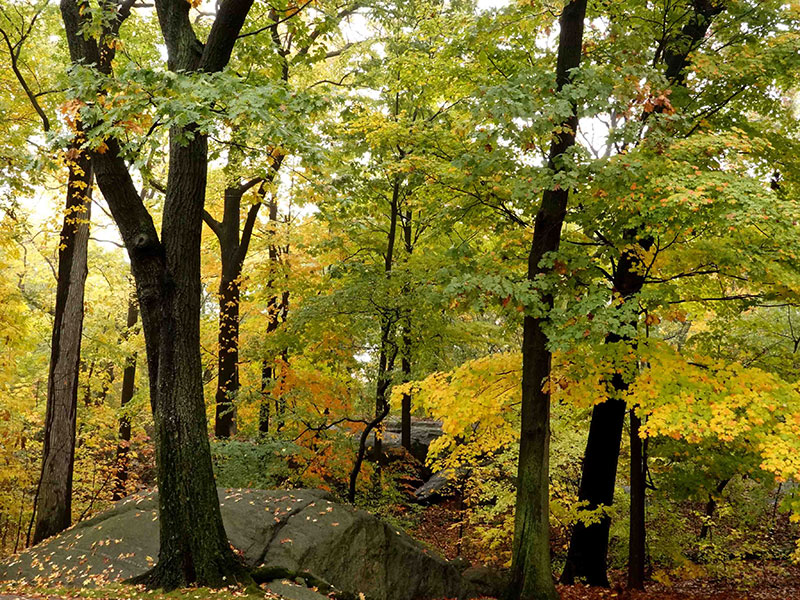
It’s the middle of November, when even intrepid gardeners start spending more and more hours indoors. What an apt time to indulge in a quick botanical Latin lesson! I promise it will be brief and easy. For starters, we’ll decode the title of this segment of Horticulturally Yours, which forms a complete sentence in Latin. The last of the four words is the verb, so move it into first place, and voila: “I visited the botanical garden in autumn.” Now let’s insert the word “noveboracensis” after “botanicum” to specify the city whose gardens recently blew my mind. Stumped? Consider the common names of these two lovely plants native to most of Eastern North America: Thelypteris noveboracensis (New York fern) and Vernonia noveboracensis (New York ironweed). You’ve got it!
Fittingly, both New York and its “old” counterpart in England bear botanical themes regarding the city’s name (for York) or nickname (for New York). “Nov-” is the Latin prefix for “new” and “Eboracum” is the name given York by the Romans who founded the town. The latter derives from an ancient regional term for “place of yew trees”. (The linguistic clash resulting from the eventual arrival of Anglo-Saxons and Norman French in post-Roman Britain smooshed Latin “Eboracum” into English “York”.) As for our great American metropolis, the Latin version of its nickname would be something like “Magnum Malum”. (Hint: Malus domestica is the botanical name for the apple tree, and “mālum” is Latin for the fruit of said tree). Now, let’s suss out the sense of this sentence: Magnum Malum multos hortos pulchros habet. The final word is the verb “has”, and “pulchros” means “pretty/beautiful” (as in the highfalutin English word “pulchritude”). Have you got it now? — “The Big Apple has many gorgeous gardens.”
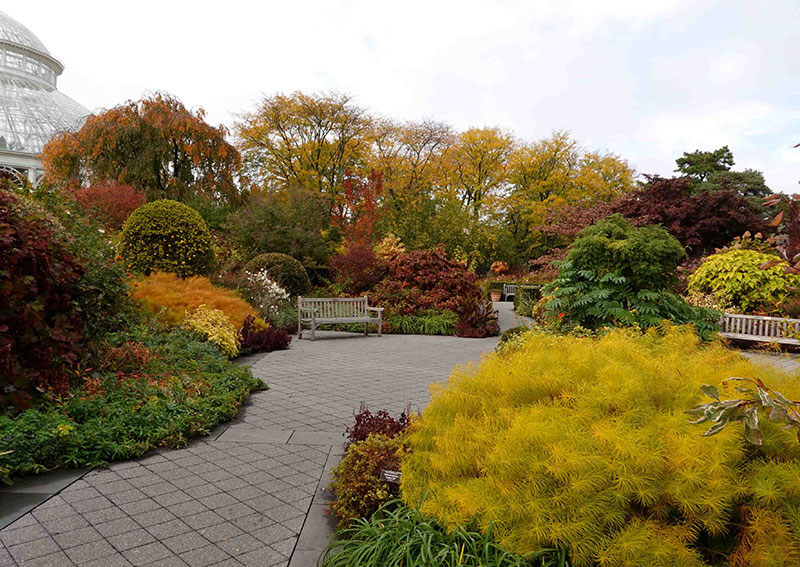
The grand dame of them all is the New York Botanical Garden, among the most splendid on the planet in that it hits a trifecta of educational eminence, ease of public access and gob-smacking beauty. Among the oldest public botanical gardens in the country —founded in 1891— it is also the largest, covering 250 acres of rolling terrain in the Bronx, including a 50-acre old-growth hardwood forest, 50 specialty gardens that host more than a million plants, the largest horticultural library in the western hemisphere, and the world’s second largest herbarium. In recent years I’ve made the pilgrimage three times, the first two in high summer, the last just a few days ago near the apex of the garden’s autumnal splendor. Here are a few highlights:

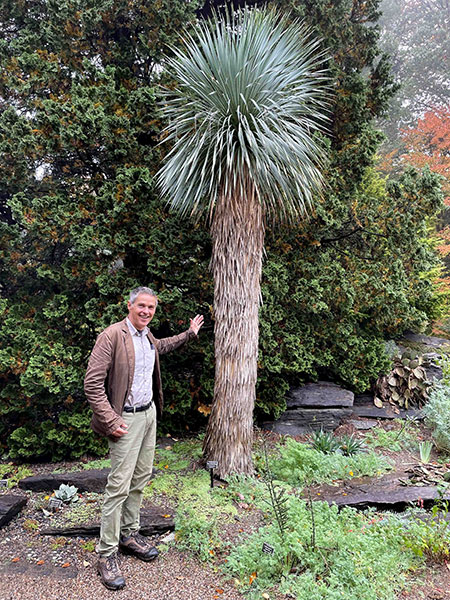
1. Nearly 90 years old, the Rock Garden’s 2.5-acre enclosure is astonishingly successful in its mission to showcase both alpine and woodland plants. This is even more impressive given its location —near sea level and only 20 minutes by train from Grand Central Station. A major key to its success must reside in ideal drainage afforded by the native stratum of billion-year-old metamorphic gneiss that underlies the grounds and, in many spots, gracefully breaks the surface in waves of wide, low mounds. Adjacent to the Rock Garden, the award-winning Native Plant Garden’s 3.5 acres host 100,000 trees, shrubs, ferns, grasses, aquatics, and other perennials which are viewed from a recently renovated and fully accessible circuit of pathways.
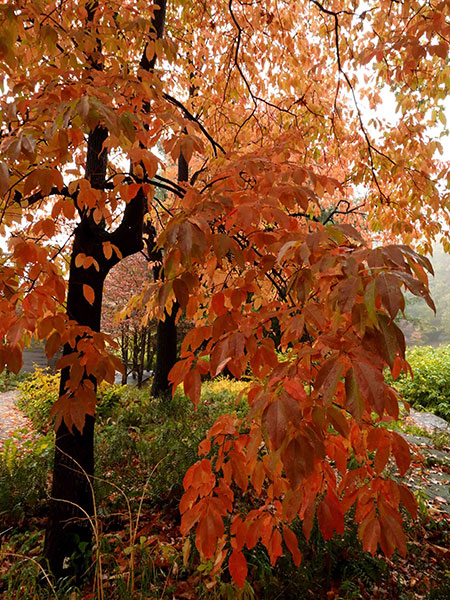
Oxydendrum arboreum (L), Children’s Garden (R)
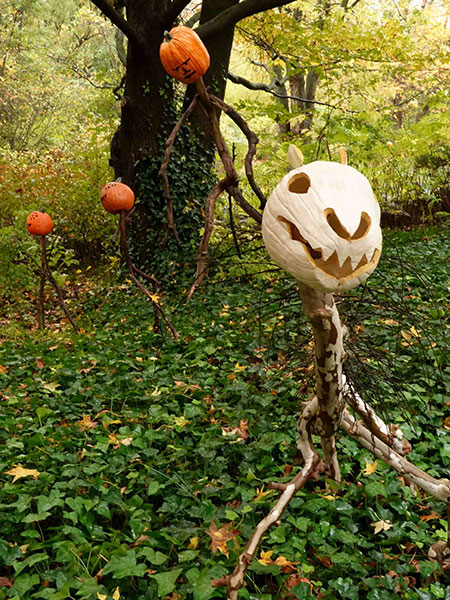
2. Kids of all ages delight in the Everett Children’s Adventure Garden, a huge (12 acres!) living classroom and botanical playpen that encompasses ponds, woodlands, meadows and boulders. Large, intricate and whimsical seasonal displays elicit gasps of delight and amazement: I was blown away just before Halloween by an ultra-creatively carved cadre of pumpkin and gourd-based critters that popped up around every twist in the trail.
3. Inaugurated 120 years ago, the Enid Haupt Conservatory is one of the most comprehensive and elaborate glasshouses in the world. After falling into disrepair in the 1970s, it was slated for demolition until the philanthropist whose name the conservatory now sports spearheaded its renovation and guaranteed an endowment for future maintenance. The most recent project rebuilt the soaring translucent cupola of the central Palm Dome in 2019. The sprawling structure’s other wings house halls dedicated to lowland tropical, cloud forest, Mediterranean and xeriscape plants, with an enormous open-air interior courtyard for tropical aquatics.
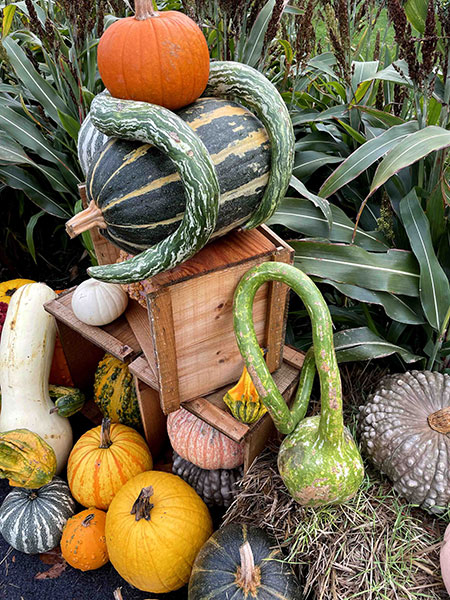
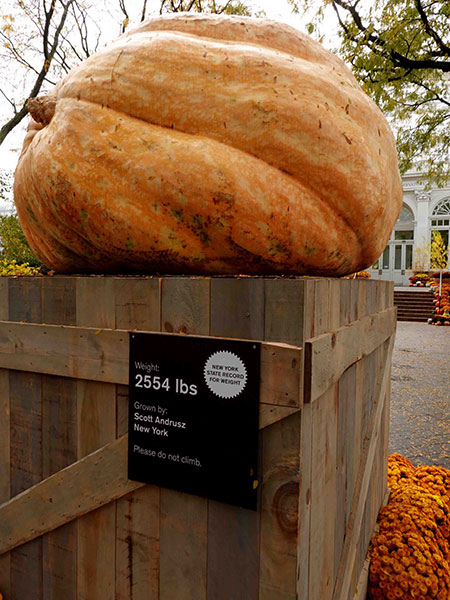
4. Formal, meticulously designed spaces adjacent to the conservatory include the Ladies’ Border (originally designed by Ellen Biddle Shipman), a Tudor-inspired Herb Garden (redesigned in 1991 by Penelope Hobhouse), the Perennial Garden (created by Lynden Miller) and the Seasonal Walk (redesigned in 2014 by Piet Oudolf). On my recent visit, the patios and wide steps leading up to the conservatory served as stages for theatrical arrangements of cucurbits (ornamental pumpkins, squashes and gourds of all persuasions), including the recently crowned NY State champion pumpkin that weighed in at a mind-boggling 2554 pounds.
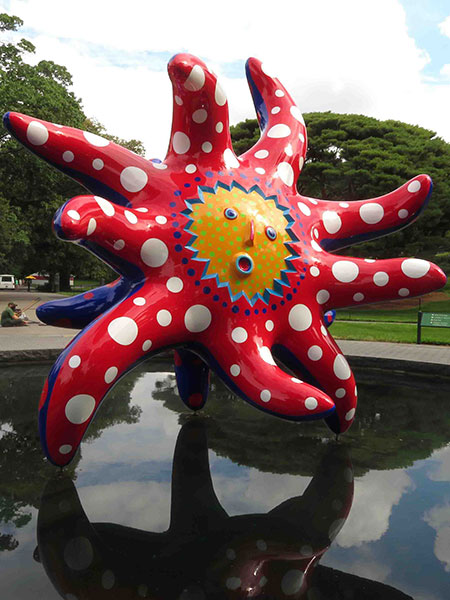
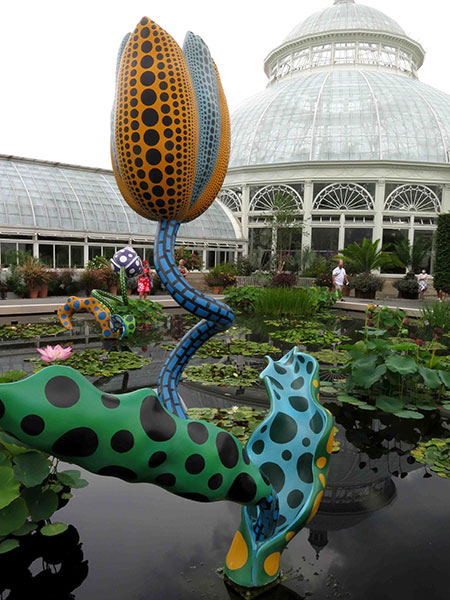
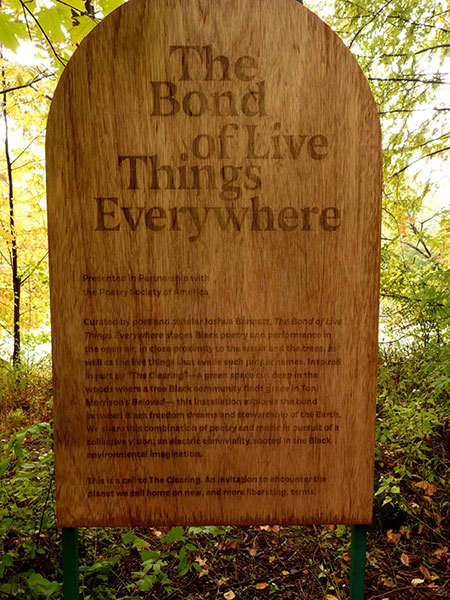
5. Annual special programs spice up the environs: In 2021 it was dozens of pieces by conceptual artist Yayoi Kusama, and this year “The Bond of Live Things Everywhere,” co-sponsored by the Poetry Society of America and curated by poet and scholar Joshua Bennett, who staged garden-related verse created by some of our country’s most accomplished Black poets (from Richard Wright to Claude McKay, Lucille Clifton, Ross Gay, Nikki Giovanni and several others) etched on wooden planks lining a forest path and accompanied by sound sculpture playing from concealed speakers. Simply stated, it was magical, hauntingly moving and transcendent.
We’ll take a Thanksgiving break and reconnect in December with a visit to another great Hortus Botanicus in the “Magnum Malum”, the equally meritorious but much more compact Brooklyn Botanic Garden, a world-class treasure in its own right.
Horticulturally yours,
Daniel
- Excerpted from “Thank You”, in Ross Gay’s collection of poems, Against Which (Fort Lee, NJ: CavanKerry Press, 2006).