
Kauri & Redwood: A Tale of Two Threatened Titans
April 2025
Beyond a desolate shore,
—Jane Campion1
On the edge of a far-off country
In a land of massy ferns and flightless birds
Toitu te whenua (Leave the land undisturbed)
—Māori precept
In the first scene of Jane Campion’s acclaimed 1993 film The Piano, a befuddled young Scotswoman, having been unceremoniously deposited on a nameless black-sand beach in the subtropical antipodes, gazes around in stupefied silence. “Ada looked…up at the huge confusion of unfamiliar trees…and cliffs…covered with the densest foliage she had ever seen. … A green and thick screen of bush met the sky and the sea, and there was nothing, no people, no building, no track, no trace of the hand of man upon it. She had come to the end of the earth, it seemed.” It was the mid-1800s, and Ada had landed on New Zealand’s North Island in the initial phases of what eventually resulted in the near annihilation at the hands of the British of the “impassive emerald forest” that awed her. The most coveted tree of all was the massive and emblematic kauri, considered a sacred treasure to the indigenous Māori who had long been stewards of that land. Diametrically across the vast Pacific, another totemic titan was facing a similar fate: the coastal redwood, deeply revered by the native Yurok of northern California.
Straddling opposite arcs of the Ring of Fire, Aotearoa New Zealand (ANZ) and the western coast of North America share several physical characteristics —volcanos, earthquakes, shimmering lakes and copious precipitation that nourishes some of the planet’s largest trees. These rainforest biomes, vitally important carbon sinks, have long been the dominion of gargantuan gymnosperms. Today’s topic traces a pair of the most prominent of these enormous, regal and long-lived conifers: the redwood (Sequioa sempervirens) on our side of the Pacific, and its Kiwi cousin, the kauri (Agathis australis).
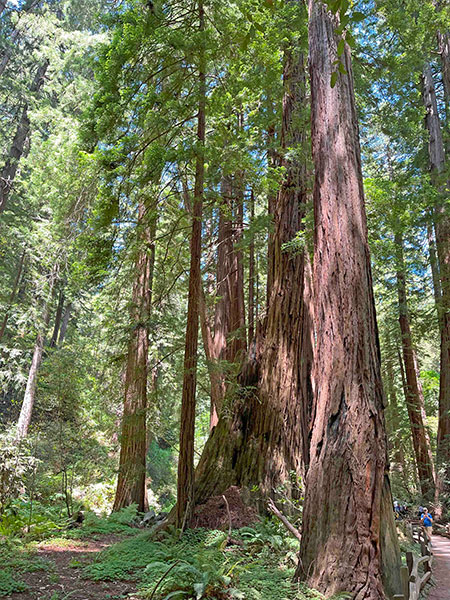
Although the California redwood’s natural extent is a narrow coastal strip about 450 miles long, from Monterey County north to the southwestern tip of Oregon (roughly between latitudes 36o and 42oN), it also grows well in New Zealand —and in the Seattle area, unlike its kiwi counterpart. Kauri range is much more restricted. A shade more subtropical, it’s confined to the tip of ANZ’s North Island southward about 250 miles, between latitudes 34o and 38oS. If overlayed on the California coast, this span would stretch from Malibu to Point Reyes in Marin County. Fittingly, kauri’s only suitable home in North America is coastal California. Most botanical gardens in the Golden State host a kauri or two. While the New Zealand Forest in Seattle’s Washington Park Arboretum does boast a few conifers, it is, alas, bereft of kauris, which don’t tolerate our erratic winters. However, we can grow a couple of kauri’s closest kin, the Chilean monkey-puzzle tree (Araucaria araucana) and—if you manage to find one—the Australian Wollemi pine (Wollemia nobilis).
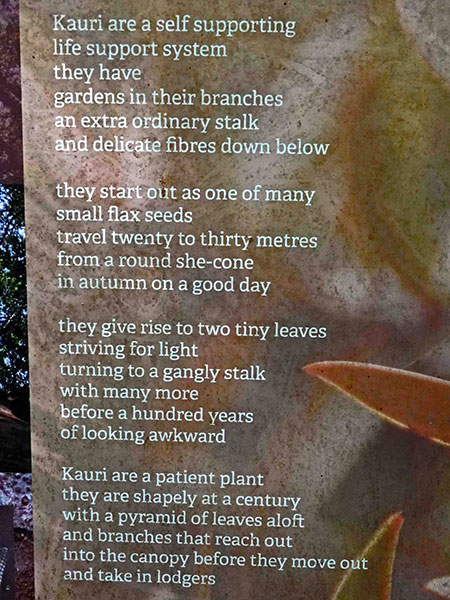
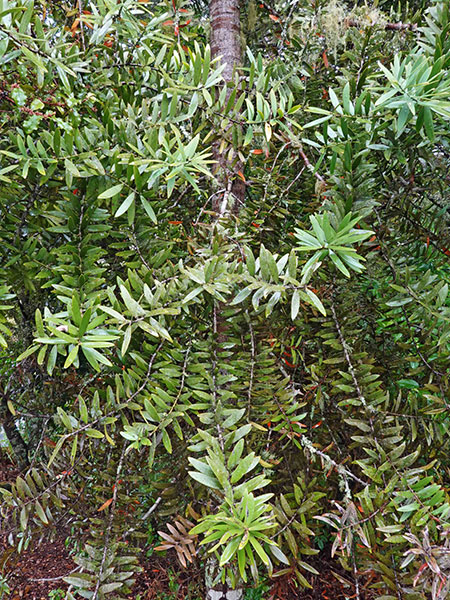
ANZ, a tad larger than Oregon in terms of area, was one of the last hospitable plots on the planet to be populated by Homo sapiens. The first people—Eastern Polynesians now called Māori—arrived around 800 years ago. It wasn’t until the intrusion of Europeans 600 years later (in the early 1800s) that the forests began to suffer. The British quickly calculated the economic value of kauri and unleashed a tsunami of ecological destruction even as the fertile land attempted a sort of recovery, as illustrated in The Piano by the misguided musings of Ada’s abusive settler husband, Alisdair Stewart: “At first his land had provided a fine harvest of kauri trees—the massively tall, straight-limbed and near knotless trees so valued for ship’s masts—and since then Stewart had battled against the continual wanton regrowth of all manner of vine and fern. He thought sometimes that if he paused for even one day the bush would overtake all his labors, drowning his hard-won clearance in mossy green waves of luxuriant vegetation.”2
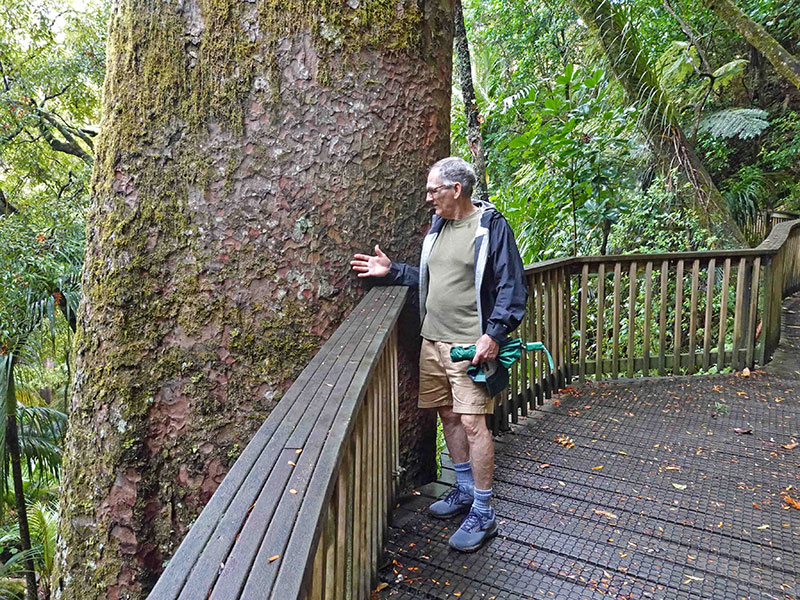
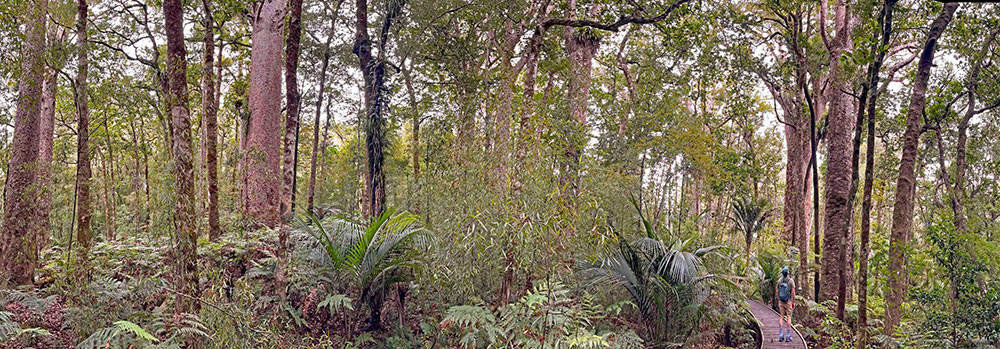
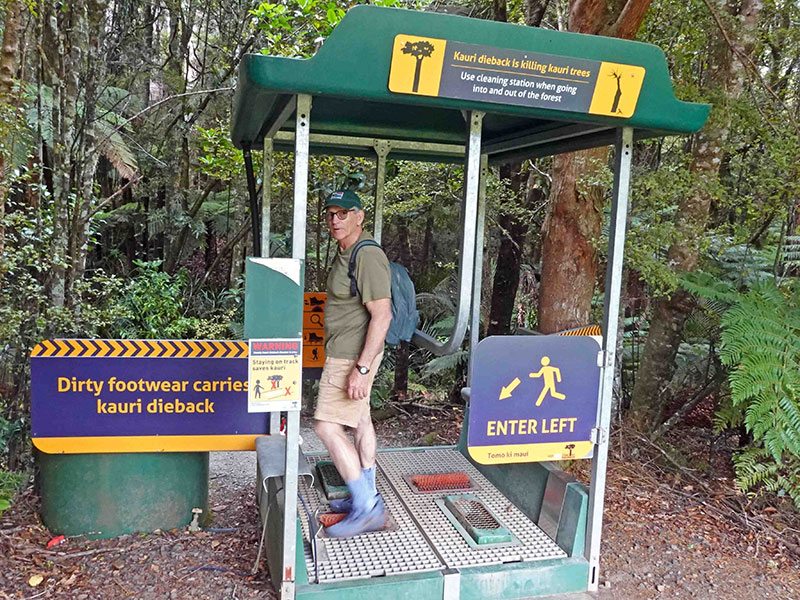
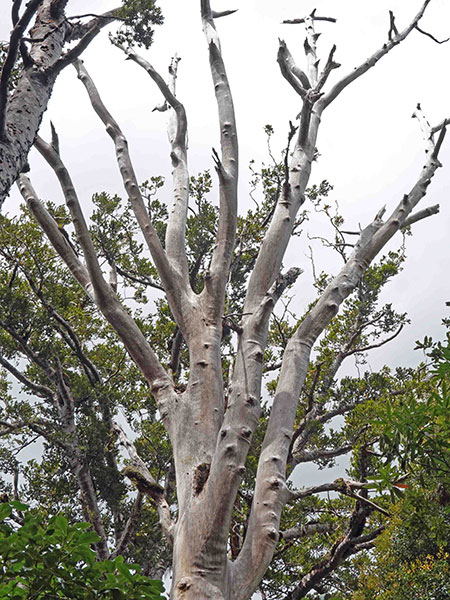
Kauri forests originally covered more than 2.5 million acres. Less than 1% of old-growth tracts remain. In 1985 logging of kauri on state land was banned in New Zealand, and since then around 150,000 acres of kauri forest has regenerated. This late-in-the-game awakening may not be enough to save the kauri: A nonhuman threat emerged in the 1970s with kauri root-and-collar dieback disease, its cause identified as a new type of water-mold (oomycete) pathogen, Phytophthora agathidicida.3 First observed on Great Barrier Island, kauri dieback disease spread to the New Zealand mainland about 20 years ago. The mortality rate in infected trees is thought to be 100%. Although the pathogen’s origin is unknown, it’s clear that the soil-borne disease is spread by human activity. That is, shoes pick up the spores and carry them from tree to tree as they infect and attack the kauri’s superficial root network. Some kauri reserves are now off limits to visitors, while others have instigated mandatory shoe cleaning and disinfecting stations at entrances and exits to the fenced forests. Those that do admit respectful visitors also require them to stick to newly erected elevated walkways built around the monumental trees.
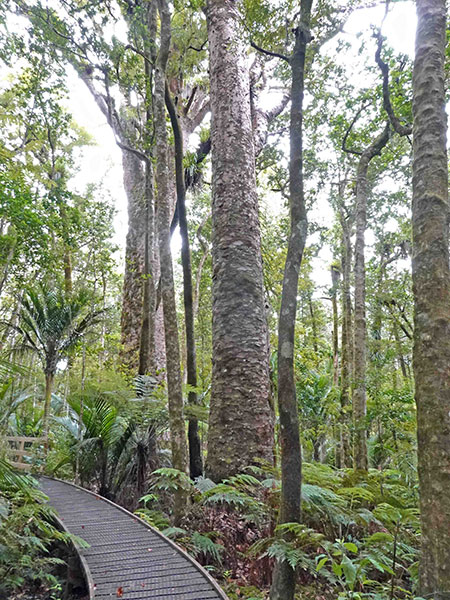
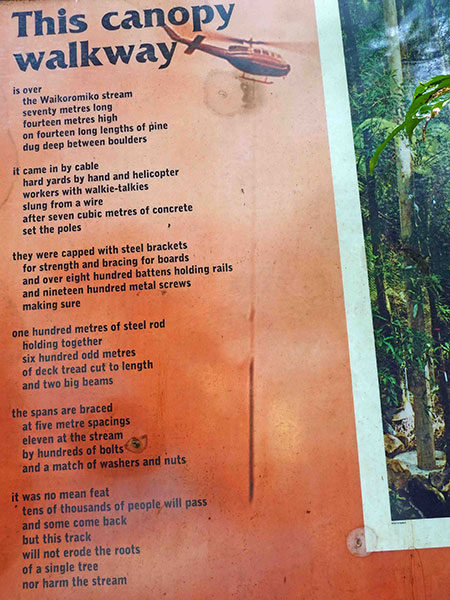
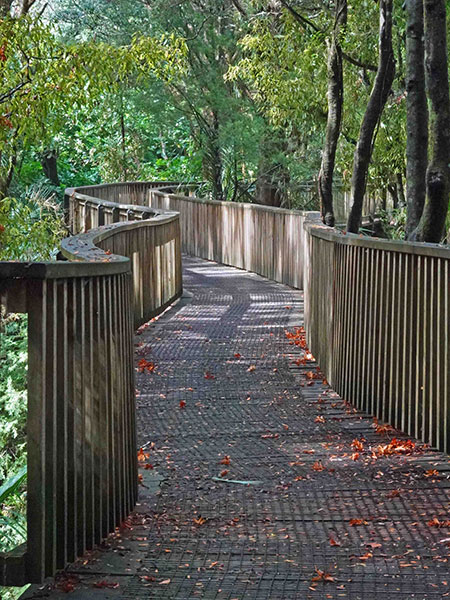
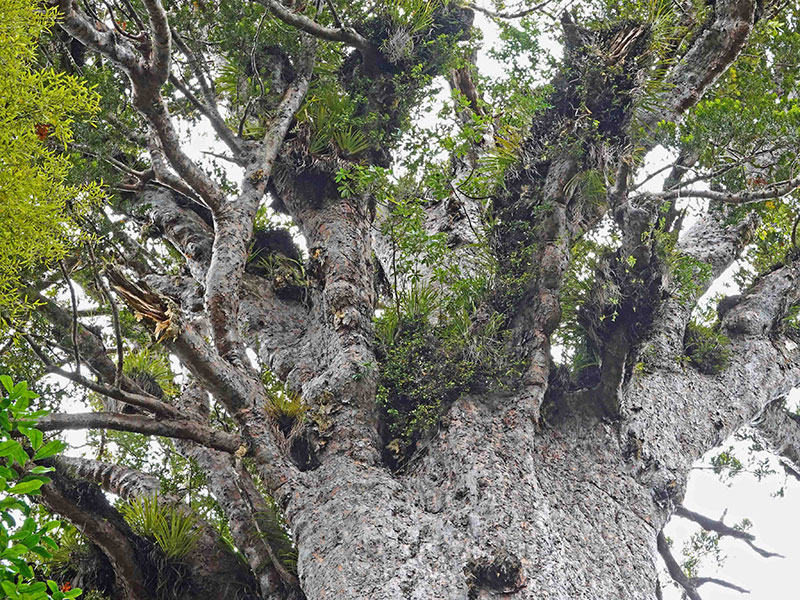
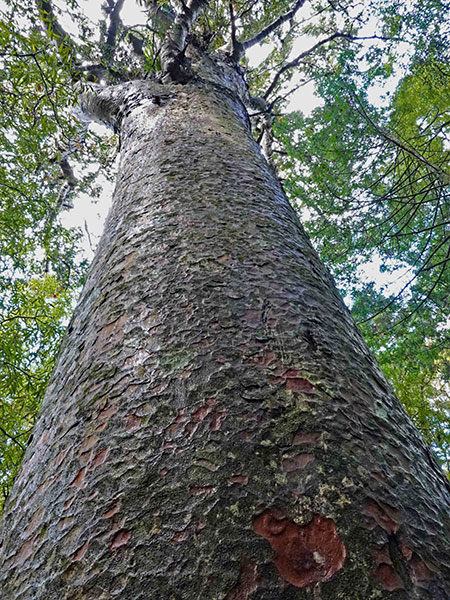
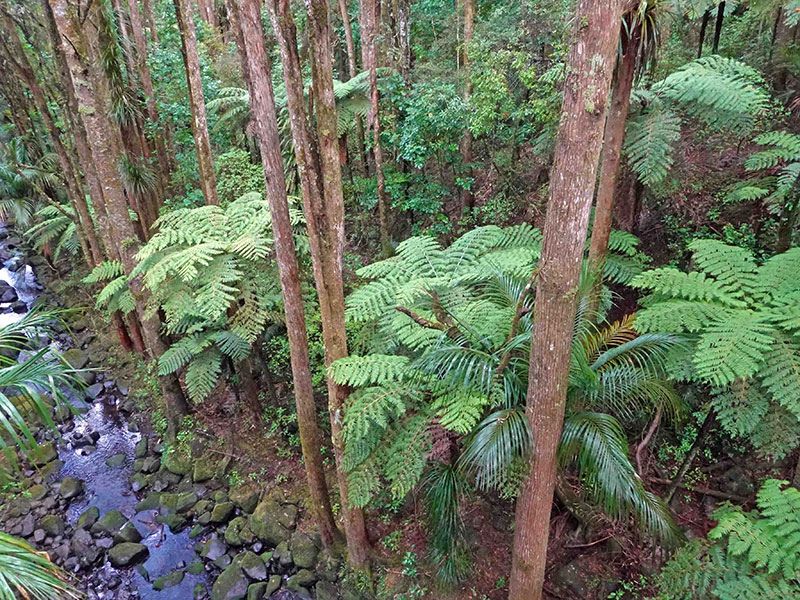
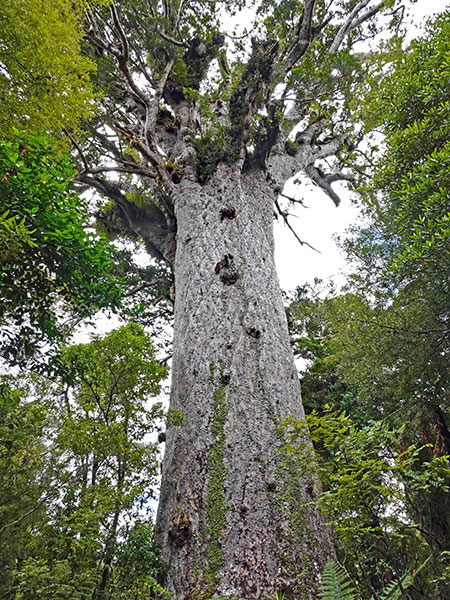
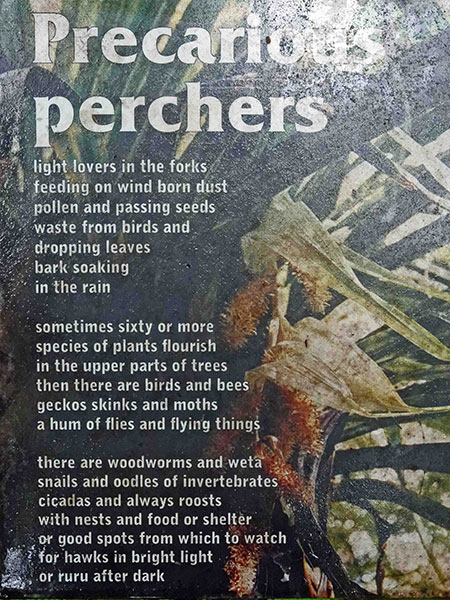
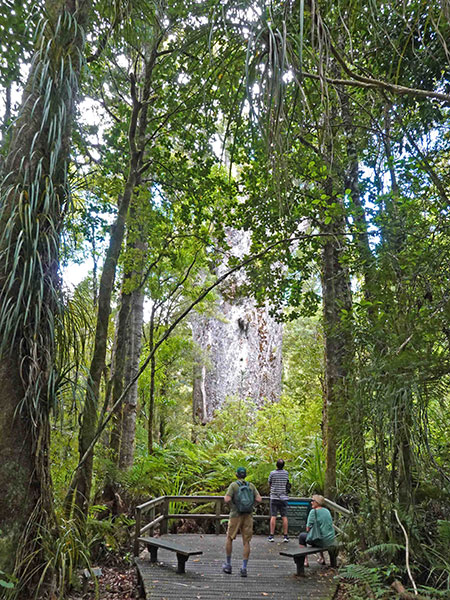
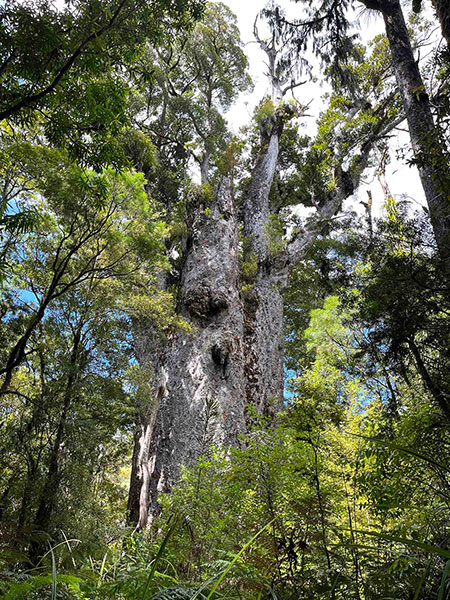
My favorite open reserves are a trio in ANZ’s Northland Region. I’ll begin with the most accessible, located inside the region’s major city, Whangārei : 1) AH Reed Memorial Park, established as a reserve in 1889, lets visitors approach 500-year-old kauris along a mile-long loop trail bisected by a stunning canopy walk suspended 50 feet above a fern-studded stream. A couple of hours north of Whangārei are the weightiest stands of old-growth kauri. 2) Trounson Kauri Park is a 1500-acre reserve containing one of the largest remaining kauri-dominant forests. Although half the reserve’s ancient trees (some are 1000 years old) are thought to be infected, most maintain their magnificent mien. Predator-free Trounson Park is also one of the surest spots to see (or more likely hear) nocturnal, flightless kiwi birds, the national symbol, in their native habitat, but this requires a nighttime visit. 3) Waipoua Forest Reserve protects 31 square miles of the largest and oldest kauris, including two that have acquired mythic status: Tāne Mahuta (“Lord of the Forest”), the most colossal living kauri, estimated at 1250 to 2500 years old, and the nearby Te Matua Ngahere (“Father of the Forest”), likely the oldest tree in ANZ. Although not as tall as the “Lord”, the ancient “Father” has a larger girth. Astonishingly, both host more than 50 species of plants (including ferns, orchids and other trees) growing on their trunks and enormous arms.
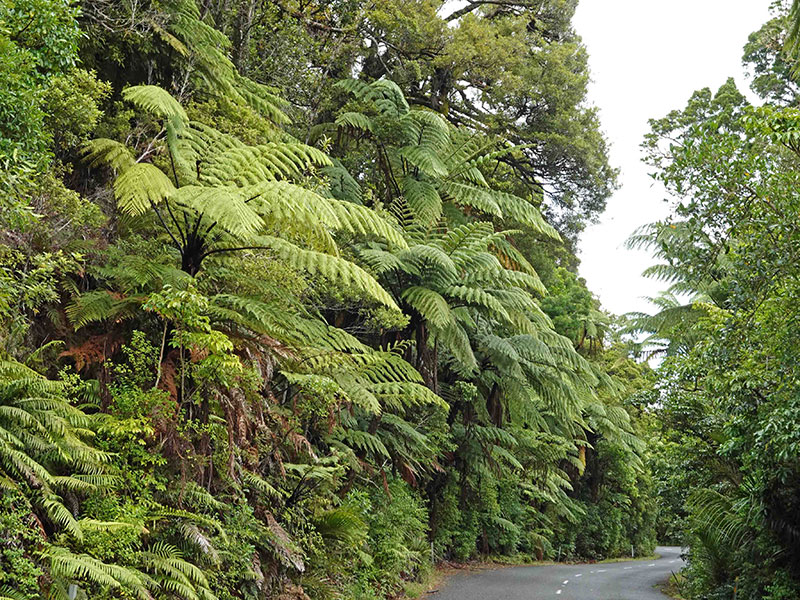
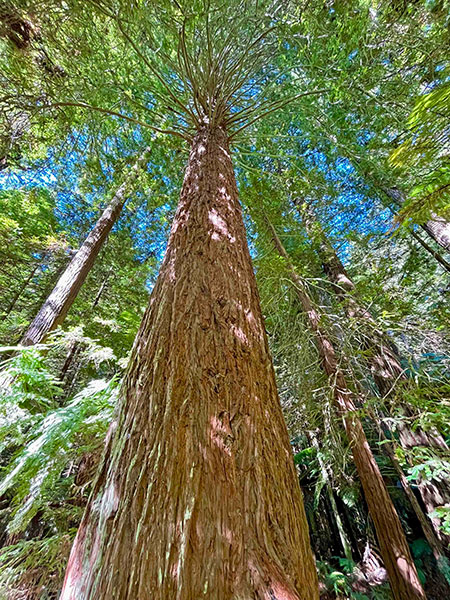
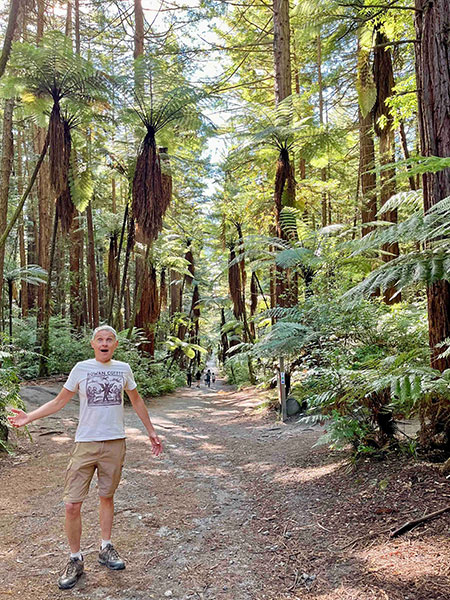
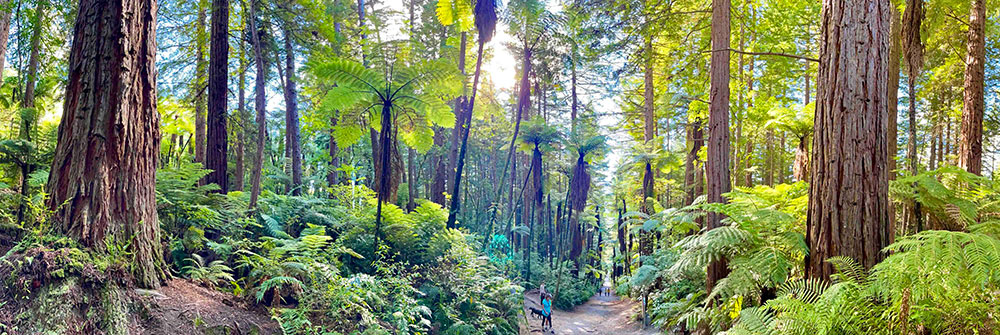
While both kauri and redwood are endangered due to the rapacity of humans, the vagaries of climate change, and their vulnerability to pathogens4, redwoods face a brighter future as they are easier to propagate and grow than kauri. In fact, large stands of 100-year-old redwood grace several spots on ANZ’s North Island. Established with the intent of developing a new hardwood cash crop to replace the depleted kauri, this came to naught when it emerged that redwood grows much more rapidly in ANZ than in California and thus produces softer wood. This is due to two factors: abundant, year-round rainfall (in contrast to California’s summer drought) and much richer volcanic soil. The most prominent of these plantations is now a prime tourist attraction. The Whakarewarewa Forest in Rotorua boasts thousands of robust redwoods planted in 1901, the tallest of which have reached 75 meters (nearly 250 feet) in height. In charming contrast to California redwood groves, the understory plants in Rotorua’s forest are dominated by towering tree ferns (Cyathea medullaris and C. dealbata).
This brings us back to The Piano and the protagonist’s transformation from apprehensive to appreciative of the exuberant verdure of her new home: “Ada marveled at the exotic abundance of the bush as they moved slowly through it; all variety of filmy frond, bracken, and moss seemed to grow in this country, new trees sprouting out of decaying, dead trees, all intertwined in a jumble of thick and trailing vines, leaves and roots. The flat green face of the forest was transformed within by filters of sunlight, revealing a shifting kaleidoscope of color, from the palest new curl of fern to the purple-black gloss of the gigantic palms.”5
As the abundance of April yields to the kaleidoscope of May in our gardens, please come along for a virtual visit to a few of New Zealand’s formal gardens in the next segment of HY.
Horticulturally yours,
Daniel
- Opening lines of The Piano. Film director Jane Campion converted her original screenplay to a novel (London: Bloomsbury, 1994), cowritten with Kate Pullinger and published the year after the movie’s appearance.
- The Piano, Chapter 2
- Here’s a double dose of taxonomical Latin at its most potent: “Phytophthora” is made of Greek elements meaning “plant-destroyer” and “agathidicida” means “kauri-killer”.
- Redwoods are attacked by another oomycete pathogen, Phytophthora ramorum, which is also causes sudden-oak-death disease.
- The Piano, Chapter 3