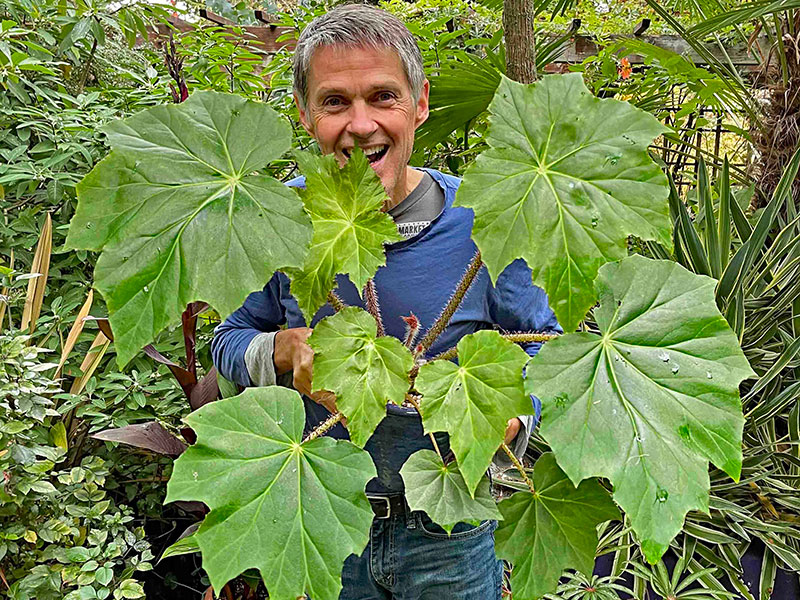

Begonias for Beginners (Part II)
January 2025
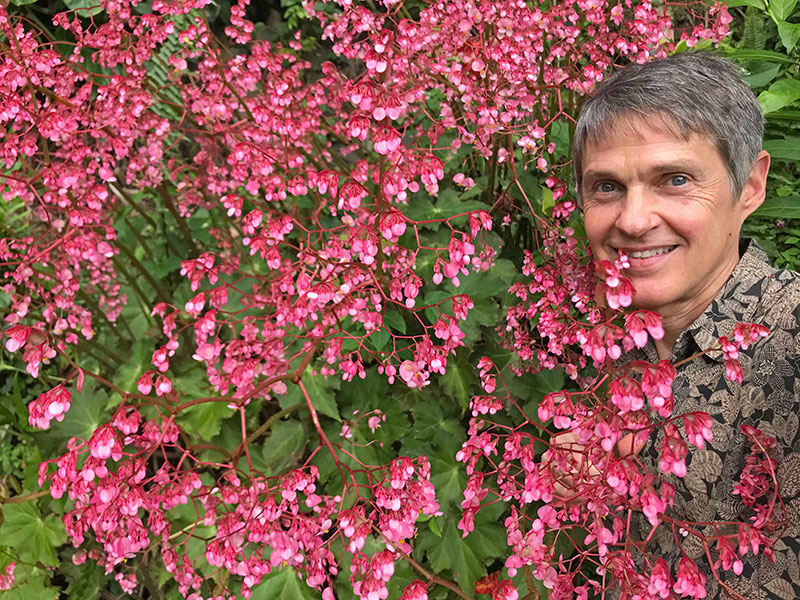
The most valuable of all lessons for the gardener
—Henry Mitchell 1
is that if we are not quite sure what we are doing
(which is almost all the time) it is infinitely better
to do nothing than to guess.
I’m not one to make New Year’s resolutions, but if I were, wouldn’t I be well served to embrace the wise words of Mitchell’s maxim cited above? I can’t make up my mind. Paradoxically, what’s infinitely difficult for this restless gardener is to “do nothing” —even though I’m rarely “quite sure” of what I am doing. I guess it’s time to tie this “most valuable of all lessons” into today’s topic: a further exploration of my (mis)adventures with begonias. (If you missed Part I last month, click here.) In this initial episode of 2025, we’ll ogle a trio of oddball species in the opening act, followed by the main attraction, a septet of easier-going cultivars whose florid foliage puts on a snappy show in our region despite January’s insults. In the spirit of this inaugural season, let’s start with the freakiest, fussiest of them all.

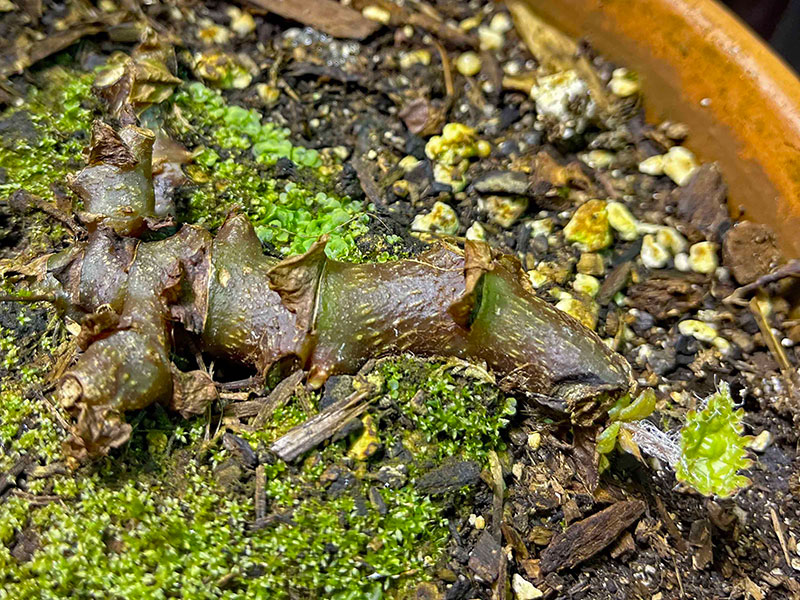
Begonia ferox—One of the gardening world’s most bizarre little creatures (its specific epithet is Latin for ferocious) this dwarf lithophyte looks like the love child of an African violet and a horned frog: Its ovate leaves when mature are covered with spiky, shiny, chocolate-colored cones called bullae. Bursting onto the horticultural scene just a decade ago, having been discovered in 2011 in a remote forest floor between limestone cliffs in Guanxi, China, B. ferox quickly caught the eye of many a LoWP (Lover of Weird Plants). For a collector’s item, it’s surprisingly available if one sniffs around here and there, and at a manageable price. (The standard, whether by mail order or at a local full-service nursery seems to be $30 for a small pot.) Here’s the rub: While it’s easy for professionals to propagate, it’s a real bear for the hapless home gardener to keep alive.
I first laid eyes on the wee imp a couple of years ago at my friend Ciscoe’s house. The widely acknowledged Prince of Plantoholics later informed me that his specimen had succumbed to a horrible malady, its leaves covered with a ghastly layer of gunk in what looked like a terminal case of powdery mildew. Despite his heroic attempts to save it by applying a baking-soda solution, it croaked. Before tossing it into the compost bin he intoned a few ceremonious words to commemorate its passing. (Something to the tune of “No, la la!”2, I imagine). No wonder he calls it the “Heartbreak Begonia”. Aware of Ciscoe’s disappointment, I avoided attempting to grow the little bugger myself until one fell into my lap last August, left behind (whether accidentally or on purpose, he won’t say) by my houseguest, the eminent Atlanta plantsman David Ellis, profiled last year in “Carolina on My Mind”.
It seemed to thrive –for a few weeks– but then slowly contracted the same dreaded dermatological affliction as Ciscoe’s. In desperation I sprayed it with a homemade concoction of dish soap and isopropyl alcohol, which erased the visible mildew but also hastened the total defoliation of the plant. Guess I should have heeded Mitchell’s advice. Not having the heart to toss its skeletal remains, (and eking out a scintilla of hope because its teeny ground-hugging rhizome was still firm, not yet having turned to dust –or mush), I plopped it in my cool greenhouse in late October and put it out of mind. A few days ago, it popped into my head to peep in on it: I gasped upon spotting signs of life: It’s producing a new leaf! “Doing nothing” actually paid off! Stay tuned as Act III of this drama unfolds.
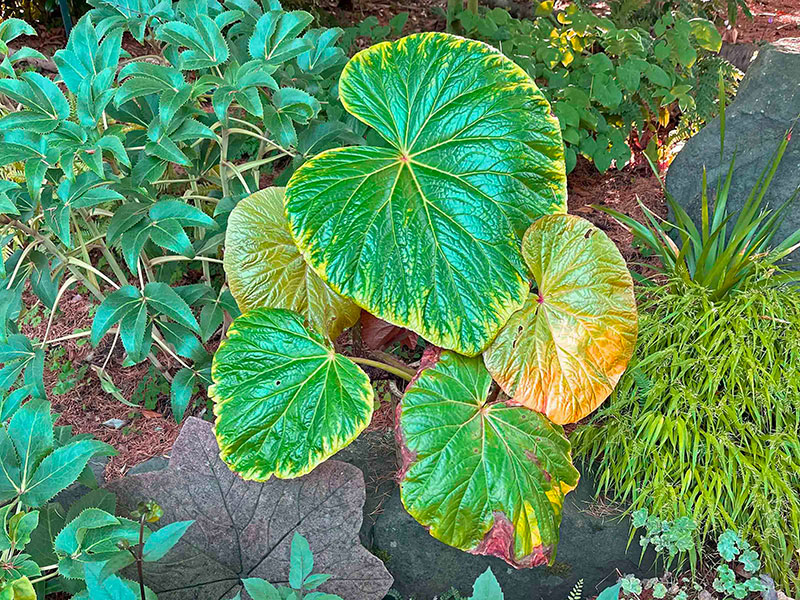
B. fusca—In every way a stark contrast to B. ferox, this sugar bear of a begonia boasts huge leaves so downy and velvety I can’t resist rubbing my face against them. A rhizomatous geophyte native to seasonally dry regions of southern Mexico and northern Central America, B. fusca adapts well to container culture and tolerates the milder side of our wet winters if pulled under cover during downpours and sheltered from freezing nights.
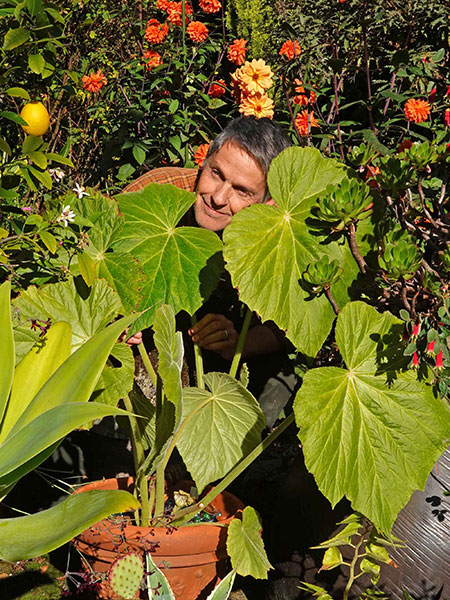
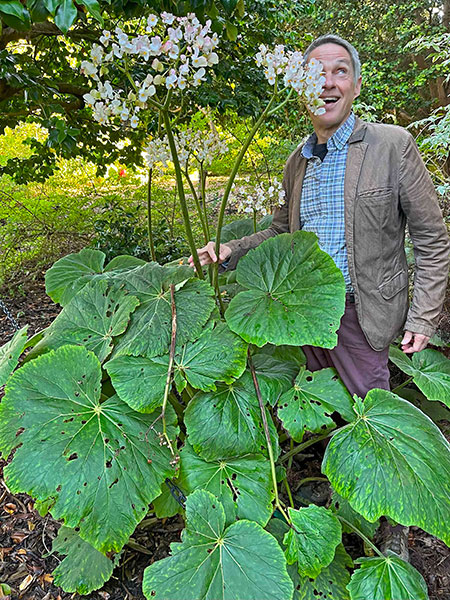
B. silletensis (or B. macrantha)—Even though it hails from the opposite side of the planet, B. silletensis bears equally large elegant, cordate foliage (although glossy) and has similar cultural requirements to the felty-soft B. fusca. This rhizomatous species is native to wet upland tropics from NE India into SW China and northern Indochina. My clone was collected by Dan Hinkley in Arunachal Pradesh, India in 2018. [Note: After this column was published, Hinkley wrote to inform me that this clone is more than likely a different but closely related species, Begonia macrantha, recently identified in 2024.]
CULTIVARS & HYBRIDS
Now we’ll set the stage for an ensemble of reliable winter-interest begonias (presented in alphabetical order) that in my experience cloak themselves in dandy displays of luscious leaves year-round. Their flowers, while sometimes attractive, clearly play second fiddle to the foliage. As to how long they’ve been on the scene, most are middle aged, a couple are ingenues and one is practically paleolithic.
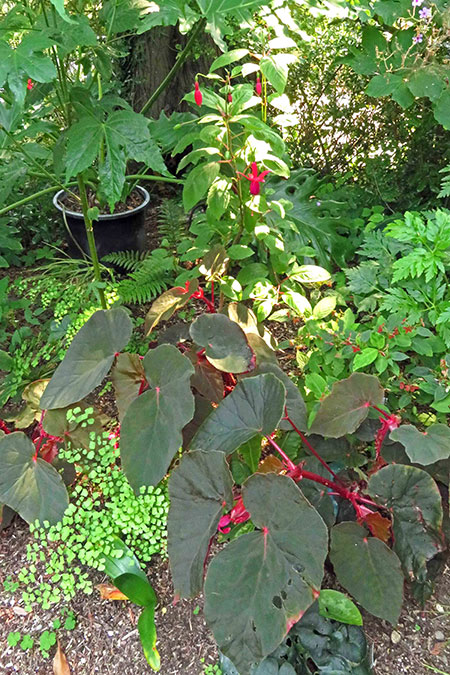
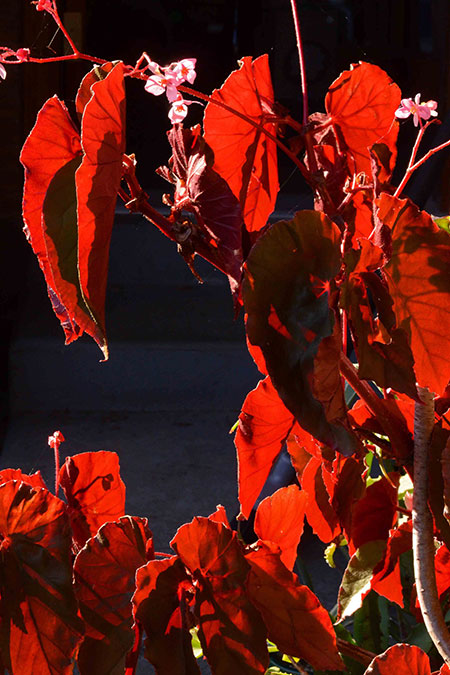
Begonia ‘Gene Daniels’—Tall, dark and handsome, this shrubby cultivar is an evergreen that develops semi-woody stems. Its angel-wing leaves, ebony green on top and deep red on the underside, glow like an illuminated fire engine when backlit. Canes can reach six feet in a couple of years but are easily kept shorter with judicious pruning. ‘Gene Daniels’, created in 1975 by the late California begonia guru and hybridizer Rudy Ziesenhenne, is surprisingly frost resistant. It’s also super easy to propagate: In late spring, simply insert a coterie of 4-to-6-inch cuttings in beds or borders for an instant tropical look. Lift and pot up in early winter, keep on the dry side and put them back in the spotlight come spring.
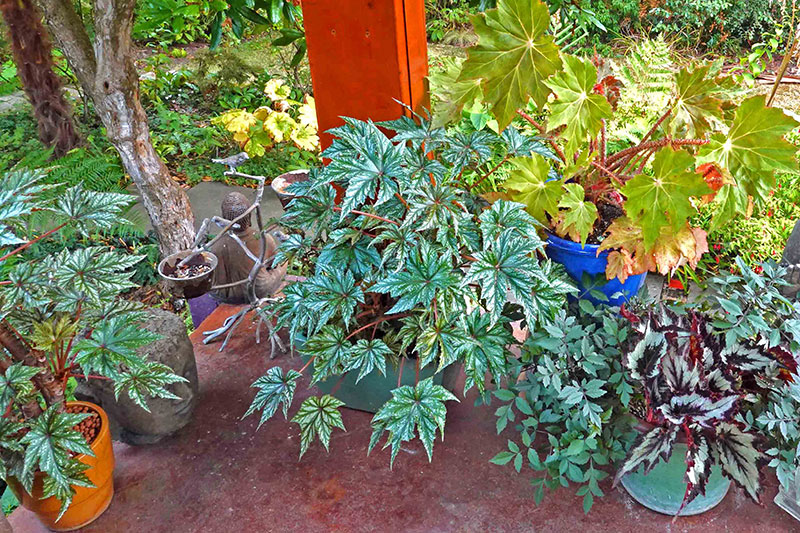
B. ‘Gryphon’—Introduced in 2009 by PanAmerican Seed, this cane-type cutie (also sold under the trademarked name ‘Pegasus®’) sports metallic-green palmate leaves with a silvery sheen and irregular gray splotches. In recent years it’s become widely available in nurseries and box stores, where it’s chiefly marketed as an annual for containers. However, even though it may succumb to mildew or stem rot in the cold, wet days of late autumn, with a modicum of care ‘Gryphon’ can live for years. If given a bit of shelter and kept nearly dry in winter, the bare, knobby canes engender delight the following spring with new flushes of foliage atop ever taller stems.
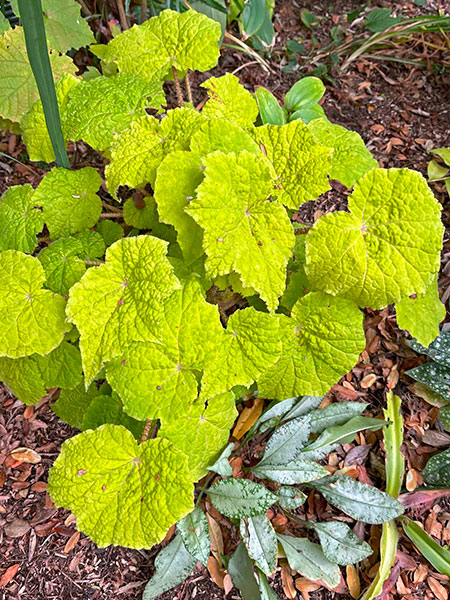
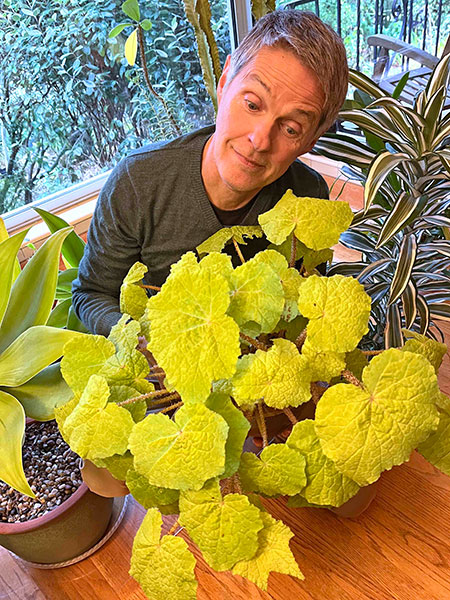
B. ‘Lime Marmalade’—This is one of my favorite finds of 2024. Among the more than 4000 named cultivars in the Rex-cultorum group of complex hybrids that share the shade-loving, rhizomatous South Asian species B. rex as an ancestor, ‘Lime Marmalade’ is a gleaming, solid chartreuse sport of the burgundy-speckled cultivar ‘Marmaduke’, discovered in 2010 at Dennis Schrader3 and Bill Smith’s Landcraft Environments on eastern Long Island in New York. Brightening shady corners both in the garden and in the house, it positively glows in winter, unphased by dry indoor air. I suspect it would also sail through nippy nights outdoors in a container on a covered porch.
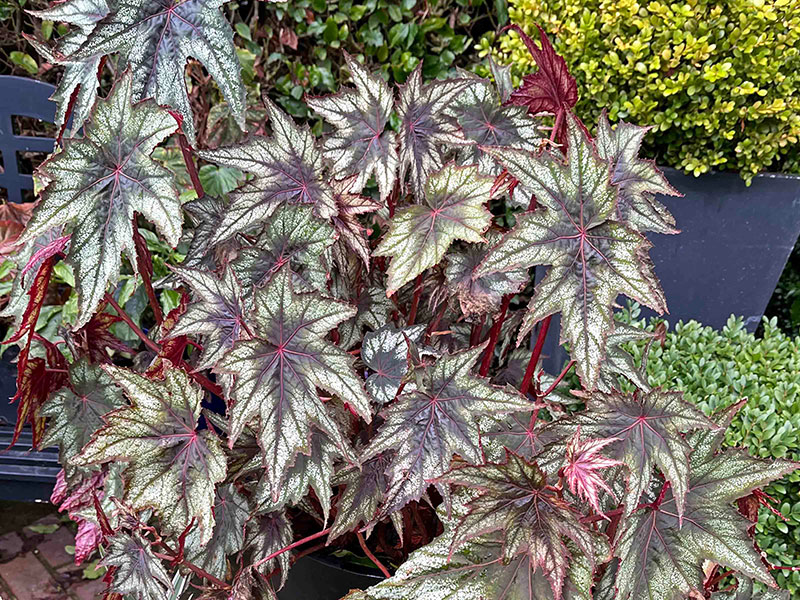
B. ‘Little Brother Montgomery’—Starburst leaves of dark sage sprinkled and splotched with silver and veined in hot magenta radiate upward and outward on red stems from vigorous rhizomes. ‘LBM’, hybridized by Martin Johnson in the Bay Area in the late 1970s, quickly fills its container and spills over the side. I started mine with a couple of shoots pinched (with permission!) from my friend Bonnie’s splashy specimen. ‘LBM’ holds its own outdoors in mild winters, maintaining its integrity through wind, rain and light frost.
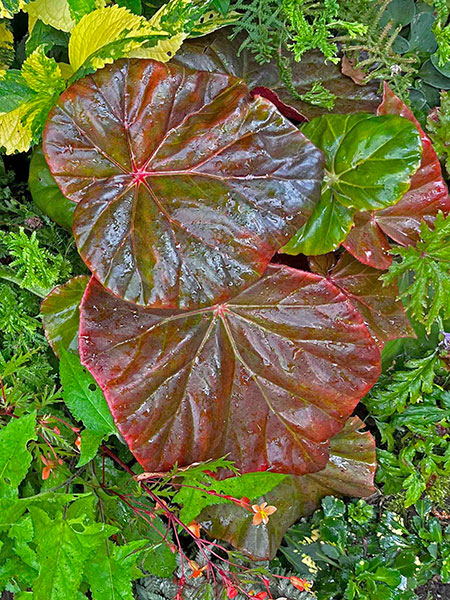
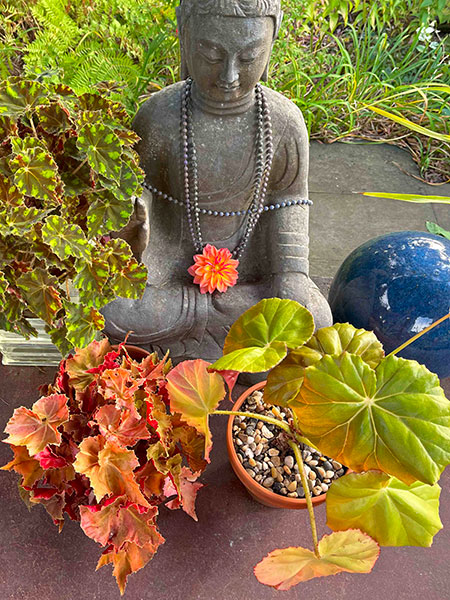
B. ‘Red Fred’— Southern California born and bred, ‘Red Fred’ is knockin’ ‘em dead. This summertime showstopper —selected in 2005 in Carpinteria’s Hi-Mark Nursery from a flat of seedlings of the cultivar ‘Freddie’— boasts oval, 8 x 10 glossy leaves that fade from deepest maroon in the heat of August afternoons to a golden olive in the soft focus of fall. Although I’ve tended this one only 18 months (a gift from my friend Bonnie, who grows it better than I), it has already proved its mettle.
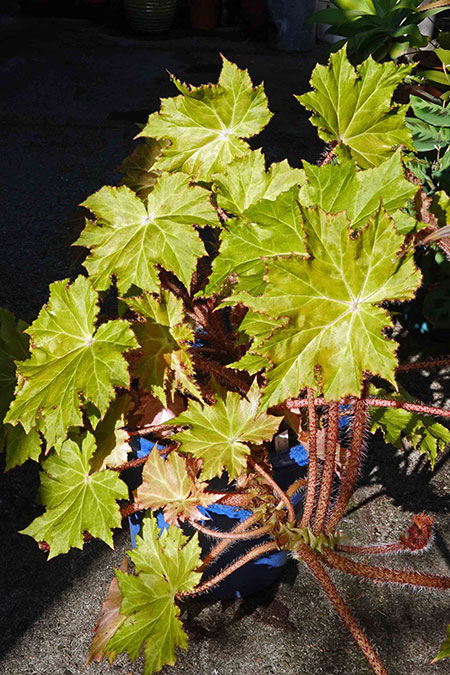
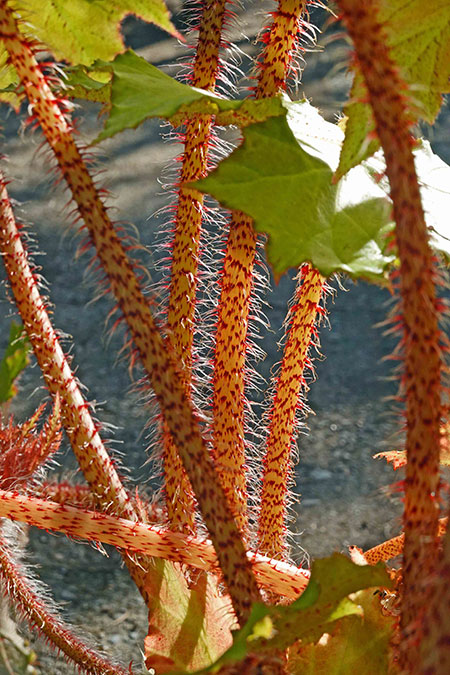
B. ‘Ricinifolia’—The Methusaleh of the bunch (dating from 1847), ‘Ricinifolia’ is likely the first begonia cultivar ever named.4 Curiously, this sprawling multigenerational giant, a cross of two Mexican species (B. heracleifolia and B. barkeri), is rarely offered on the market these days, although one sees it occasionally under the apt but incorrect moniker ‘Immense’. In March of 2021 I stumbled upon a massive stand in full bloom climbing up and over while also tumbling down a lava-rock wall behind a 100-year-old guest cottage on a defunct sugarcane estate near Hilo, Hawaii. A query to the property owner revealed little: She informed me that it had just “appeared” shortly after she cleared years of overgrown “jungle” vegetation from the wall. Evidently the begonia had long been biding its time among the boulders, awaiting its moment to return to the footlights. I brought home a tiny, leafless piece of rhizome (having thoroughly washed it to remove soil). Exploding in growth, within a few months it filled a 2-gallon container. Although its regal, pink blooms come only in March, the vivacious, palmate leaves and succulent stems (studded with soft, scarlet bristles) are the main attraction.

B. ‘Silver Point’—Wins my award for Most Resilient. One of around a dozen bright stars in the Jurassic™ series, the festive foliage of this compact new supernova in the Rex-cultorum group (see B. ‘Lime Marmalade’ above) radiates tones of pink, puce and celadon that shift slightly with each season. Astonishingly winter hardy if provided excellent drainage, my specimen survived the cruel Arctic blast of January 2024 in the ground with no protection other than a blanket of dried ‘Shishigashira’ maple leaves. As of mid-January 2025, it is still sitting pretty in full foliar flush, planted under the wispy branches of a sprawling Lomatia myricoides.
Ground Hog Day will be behind us when next we meet. With that in mind, it’s time to step out of the shadows, sharpen pencils and make wish lists of winter-be-gone begonias to help brighten the ever-lengthening days. I think Henry Mitchell would approve of doing that, don’t you?
Horticulturally yours,
Daniel
- From Page 140 of The Essential Earthman: Henry Mitchell on Gardening, (Bloomington, IN: Indiana University Press, 1981). The UW’s Miller Library has a lending copy.
- For those unfamiliar with the inimitable Ciscoe Morris, his catch phrase (and the title of his most recent book) is “Oh, La La!”.
- Dennis Schrader is author of two books that should be on the radar of all hortheads: Hot Plants for Cool Climates: Gardening with Tropical Plants in Temperate Zones (Boston: Houghton Mifflin, 2000) and Extraordinary Leaves (Richmond Hill, Canada: Firefly, 2008). The Miller Library has a lending copy of the former, and King County Library System offers both titles.
- See Page 147 of Mark C. Tebbitt’s indispensable Begonias: Cultivation, Identification and Natural History (Portland, OR: Timber Press, 2005). Published in association with Brooklyn Botanic Garden. The Miller Library has a copy.