
A Quintet of Quirks & Quandaries
October 2024
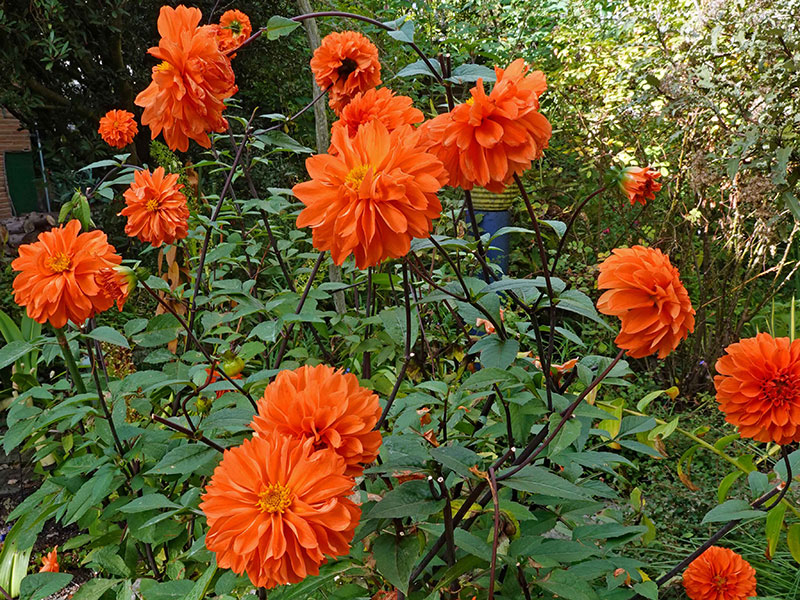
But what of the fall dahlias
—Didi Jackson1
that like bodiced planets float above
their roots and leaves? Surely they contain all
the colors of our universe.
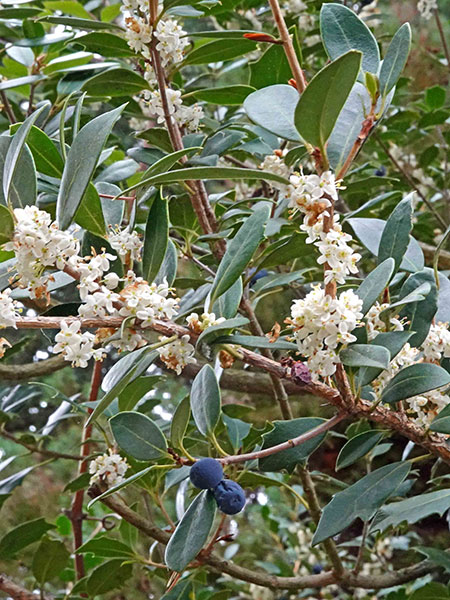
Ah, opalescent October! By day bedizened dahlias do a dizzy danse macabre before falling headlong into hibernation, while mild nights are nurtured by the heavily perfumed blanket of Osmanthus heterophyllus in full flower. Also looming in the fall darkness is the approaching pall of winter, and for Pacific Northwest gardeners this may call to mind the mayhem wrought by January’s deep freeze. Now, as the autumn planting season revs up and planning for next year slips into high gear, many of us are pondering which path to pursue, how to proceed given the vagaries of climate change. Yet gardening is an inherently optimistic venture. Yes, it’s a gamble, but I’ve found that calculated risk-taking2 yields far more delight than disappointment. After all, “Plunging into Plantlife” is my motto, if not my mantra.
Apropos botanical leaps, isn’t it hard to fathom that 48 months have transpired since the initial segment of Horticulturally Yours germinated and lifted its little cotyledon heavenward? With this 61st episode, we begin Season 5 by revisiting and ruminating over a fistful of fidgety flights and forays that have been our focus these last four years: In hand today are a pair of As —agaves and azaras, and another of Bs —bromeliads and brugmansias, rounded out with a green thumb of dahlias. Each of these entities has engendered unexpected complexities and conundrums of late, and this calls for another round of contemplation.
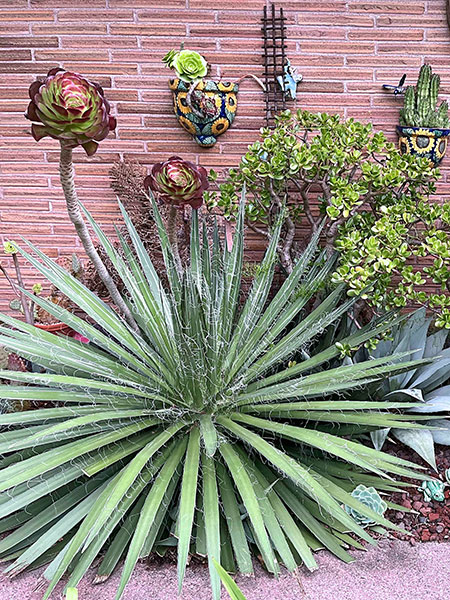
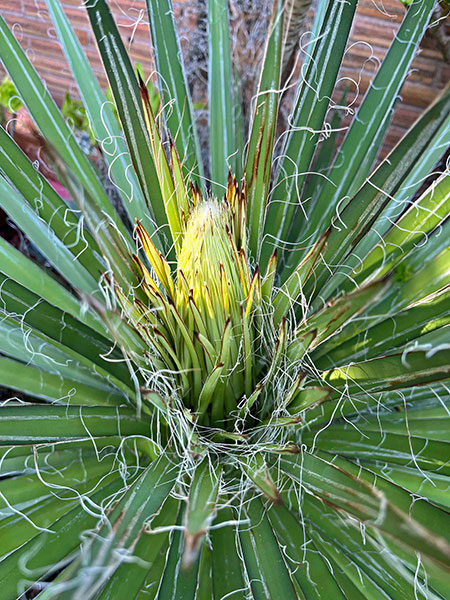
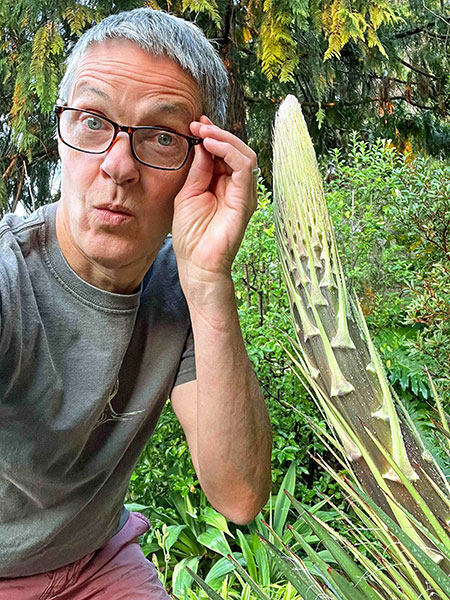
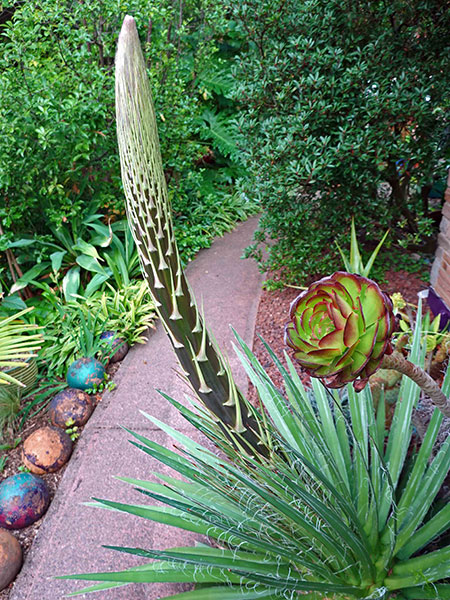
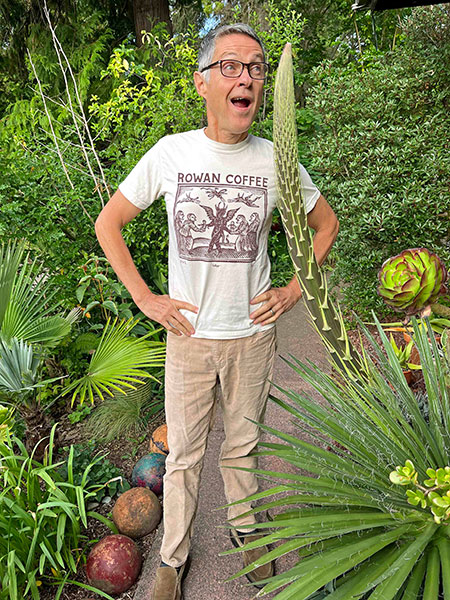
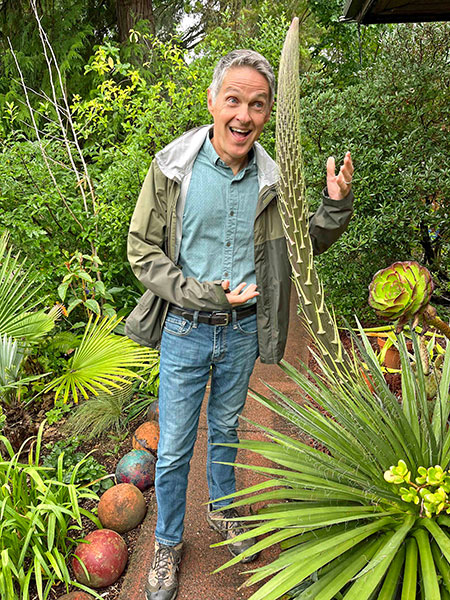
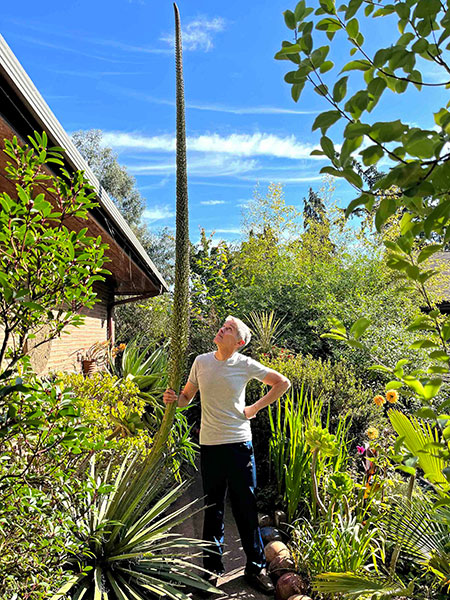
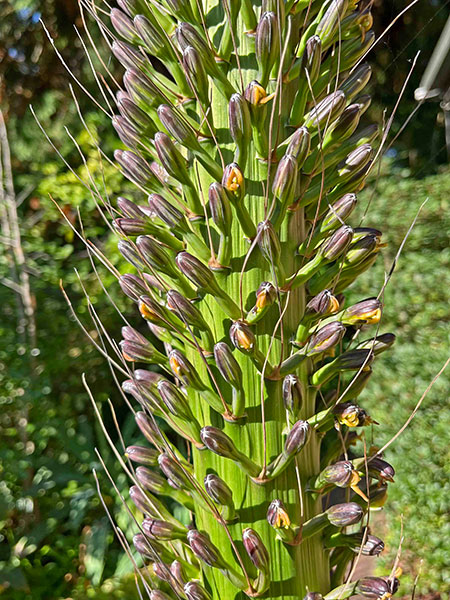
Agave—The stay-at-home pandemic summer afforded an unexpected treat, the bodacious inflorescence of my silvery-blue Agave havardiana, which I chronicled in “My August Agave” (Dec. 2020). After that bout of exuberance, all was quiet in Agaveville until six weeks ago, when on Labor Day my 21-year-old Agave multifilifera shouted out its intent to do a diva dive of its own. All part of nature’s plan, you may think, but here’s the rub: The older agave had the sense to begin its once-in-a-lifetime process in May, which provided ample time to complete its cycle and produce viable seed by early September. This younger upstart burst forth so late in the season that I doubt it will even have time to flower before winter sets in. In the first weeks its peduncle grew a startling six to eight inches a day. Now approaching 13 feet in height, it’s completely covered by swelling buds, but none has opened yet. If a frigid front descends, I may have to sever the stalk so that we can install our framed polycarbonate panels to protect the other residents of the xeriscape bed where it lives. What to do? Stay tuned.
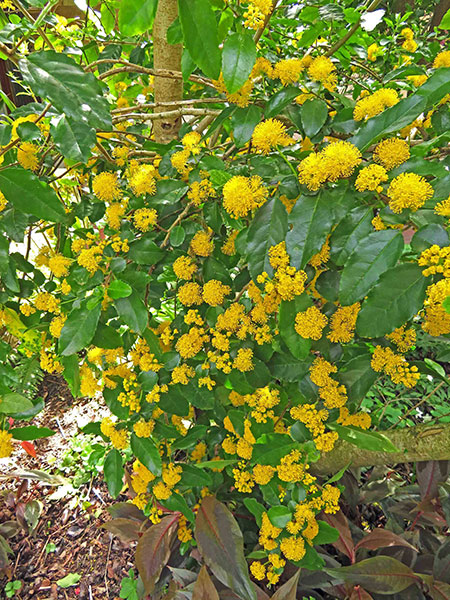
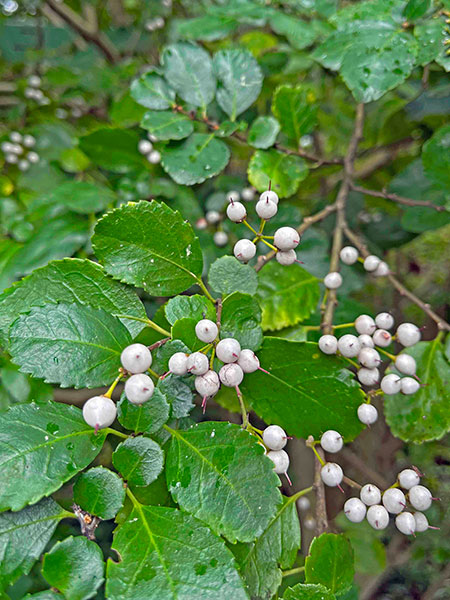
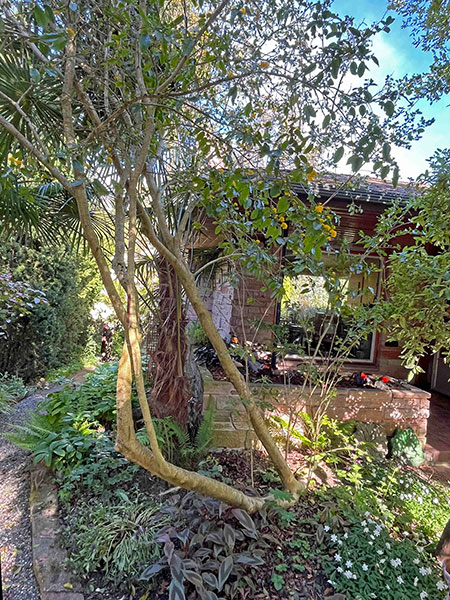
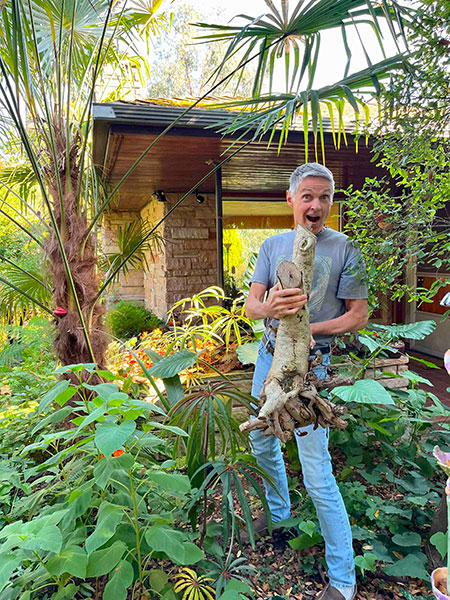
Azara—My ode to Chile’s evergreen, golden-flowering bundles of spring joy, “Azaras in Abundance” (Feb. 2021), caught the eye of Martin Gardner (such an apt surname!) a 30-year veteran of Royal Botanic Garden Edinburgh who has been charged with updating the Azara entry in the indispensable resource, Trees and Shrubs Online. He wrote seeking notes and photos on azara cultivation in North America. Since I had his attention, I picked his ample brain for help in relieving my confusion regarding the identity of several species whose names have been tangled and mangled in the trade. With grace and patience, he cleared my clot of doubts in a series of email exchanges. Here’s the gist of it: Specimens sold as A. dentata both here and in the UK are usually varieties of A. serrata. Martin reported that even the UK champion azara, labeled as A. dentata, is in fact A. serrata. The true A. dentata, in Martin’s words, “has dull glaucous green leaves which on the reverse are covered with dense hairs, and the margin is finely toothed, the flowers not very showy, the fruit orange”. This tells me that I’ve yet to see the real A. dentata, as the fruit of my (mislabeled) shrubs is pearly white, the leaves glossy and glabrous and flowers frilly and full. I feel compelled to report that in May I ripped out one of my two specimens, an undisciplined 13-year-old gangster, as it was running roughshod over its neighbors. Kudos to my long-suffering husband Jeffrey, who devoted hours to digging out the recalcitrant stump. The older, better behaved 19-year-old still holds pride of place in its spot.
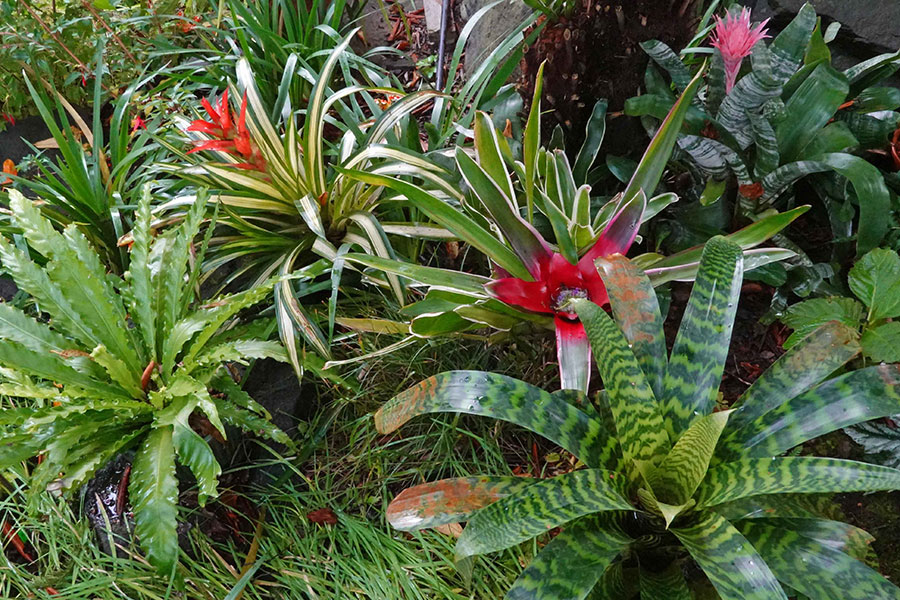
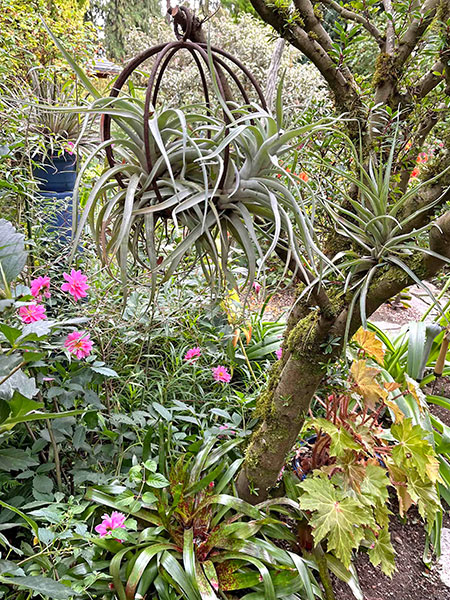
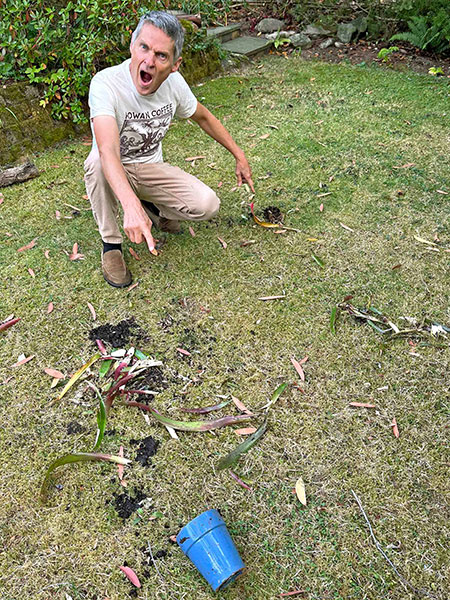
Bromeliads—This consummately flamboyant and architectural cohort of herbaceous perennials differs from the rest of the present bunch in that it encompasses an entire botanical family, Bromeliaceae, rather than an individual genus. Given my predilection for drama, it’s not a shock that I’ve staged them in four HY episodes, beginning with the eponymous early segment “Bromeliads” (Oct. 2020), continuing with “In the Pink of Early Winter” (Dec. 2021), “Dyckias: Sharp-Tongued Sweeties” (Mar. 2022) and perhaps most effusively in “Three Cheers for Hilo” (Dec. 2023). What’s not to admire? Bromeliads are easy going epiphytes, happy to hang out (in a literal sense) propped up in tree branches or plopped on the ground bare root, as they don’t require soil. They thrive living outside for half the year, constantly renew themselves, and brighten up dull shady corners. Current problem: Raccoons are ravaging some of the clumps, pulling them out of their pots, chewing, shredding and sometimes dragging them up to 100 feet from their homes. Apparently, the masked marauders are aiming for insects that make their homes in the water-soaked basal parts of the plants. Well-armed Dyckias and Puyas are immune to the scourge, but defenseless Billbergias, Guzmanias and Neoregelias are sitting ducks.
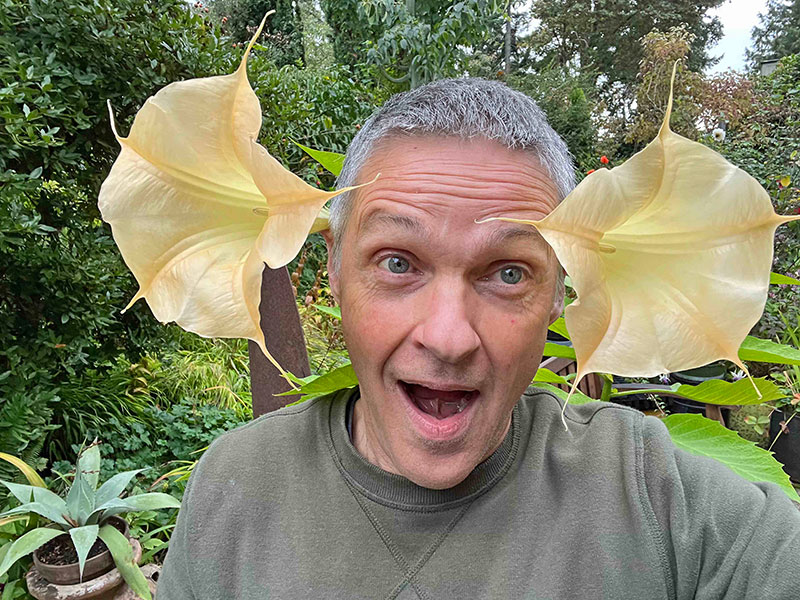
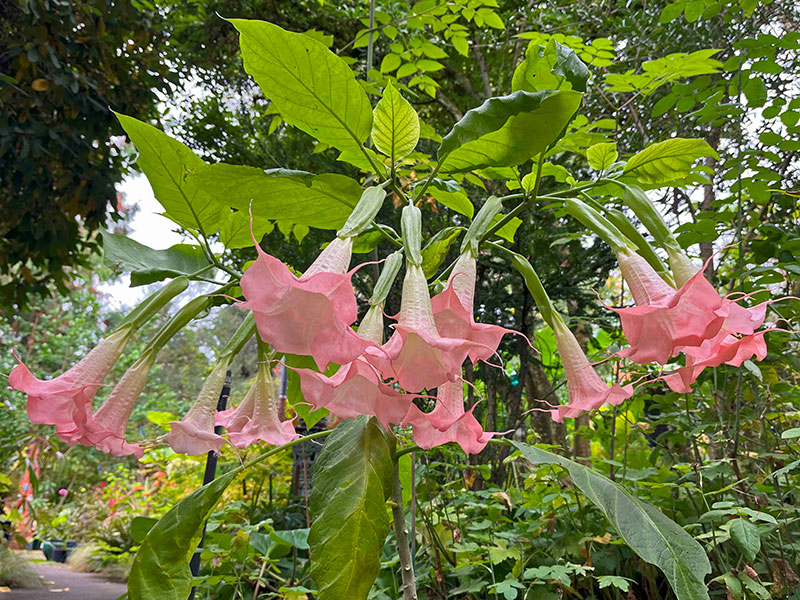
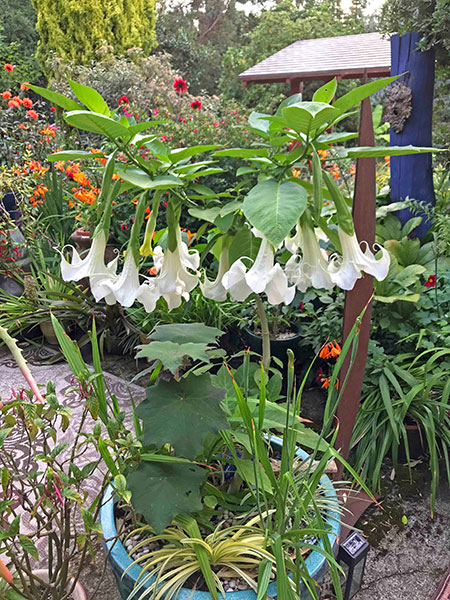
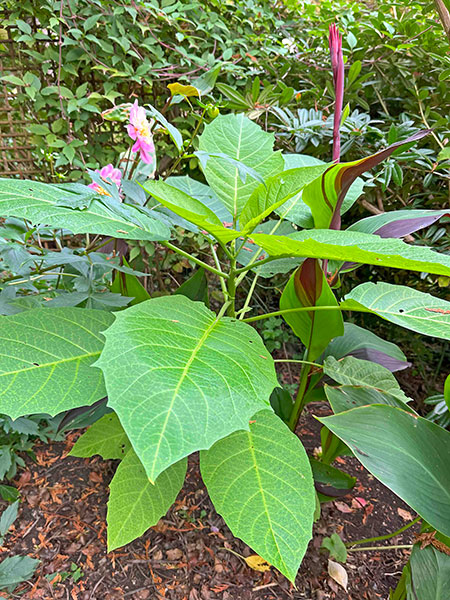
Brugmansia—Alright, you caught me. I haven’t yet produced a column devoted to these angelic but toxic nightshades, but I feel as if I have, if only by association with the other cards in this hand, all of which also hail from Latin America and hold up admirably before succumbing to the darkest, dankest depths of autumn. In the main originating in Andean cloud forests, all six woody species of Brugmansia are thought to be extinct in the wild. They and their dozens of hybrids and cultivars thrive, however, in gardens all over the world, where they are easily propagated from cuttings. Even though they’re usually grown in containers in our clime, they are (surprisingly) sometimes hardy in the ground if planted deeply. One of my bedded-out ‘Charles Grimaldi’ shrublets floored me by emerging Lazarus-like from its loamy tomb in early August, seven months after January’s arctic blast that I justifiably assumed had killed it. It’s now almost waist high. Should I lift and pot it prior to winter, or leave it once again to an uncertain fate in the ground? One I definitely will dig up is ‘Angel’s Pink Profusion’, a sporty new dwarf cultivar that currently illuminates the sidewalk leading to my front door.
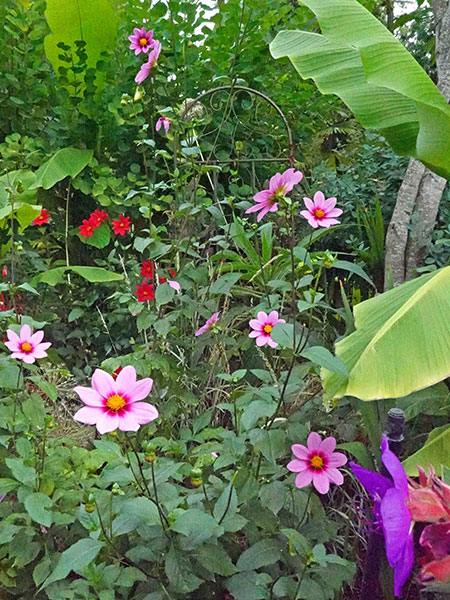
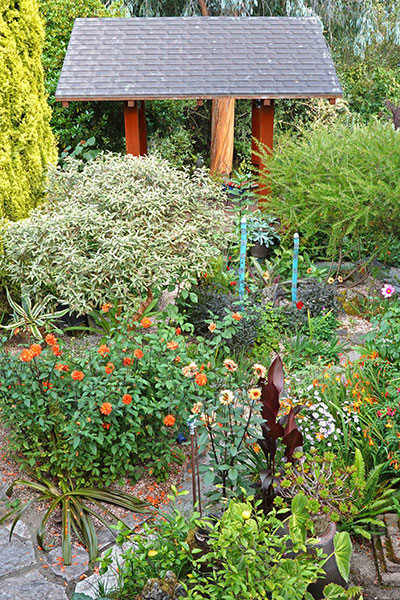
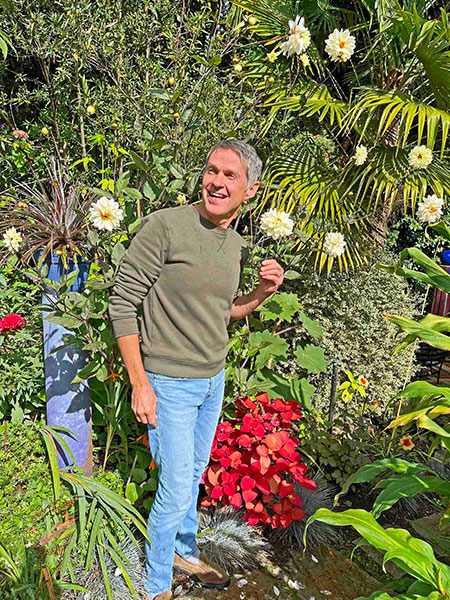
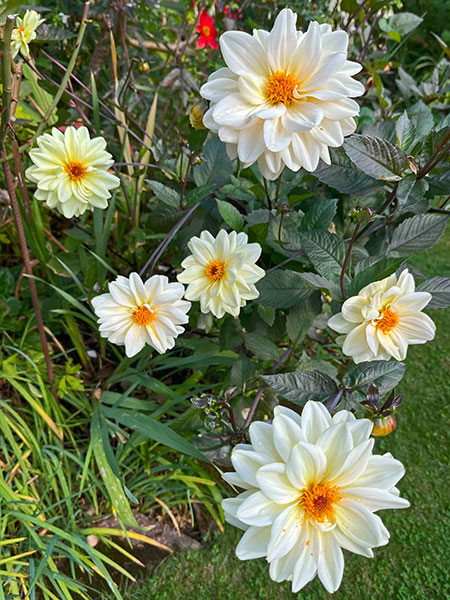
Dahlia—It’s no secret around these parts that I’m daffy for dahlias. See “October’s Paradoxical Opulence” and “Enveloped in Orange” (both from Oct. 2023). Over the last third of a century, I’ve grown more than 100 cultivars and several species, and I’m relieved to report that about half are still in the land of the living. The national flower of their homeland, Mexico, dahlias pepper my garden with pips of pleasure from June through November. In mild winters, Dahlia tenuicaulis may sail straight through to February. See “Dahlias in Excelsis” (Feb. 2021). In the wake of this past winter’s extreme cold, I feared I had lost many of the darlings, as I hadn’t had the chance to blanket their beds with protective mulch. (I don’t lift and store the tubers but leave them all in situ.) Indeed, spring cleanup revealed many clumps whose upper tubers had turned to mush. In almost every case, however, lower layers were intact and eventually pushed up strong stems, albeit a month or so later than usual.
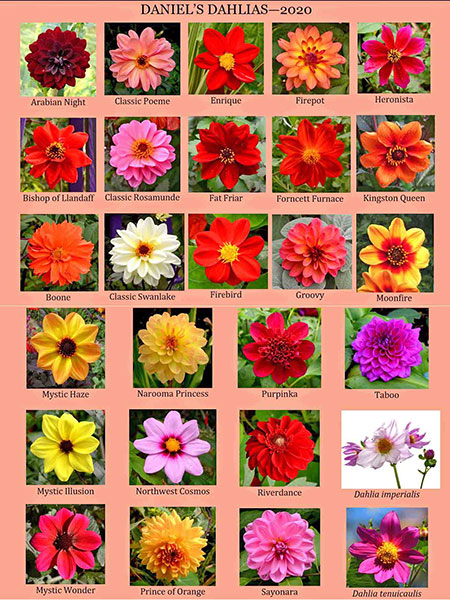
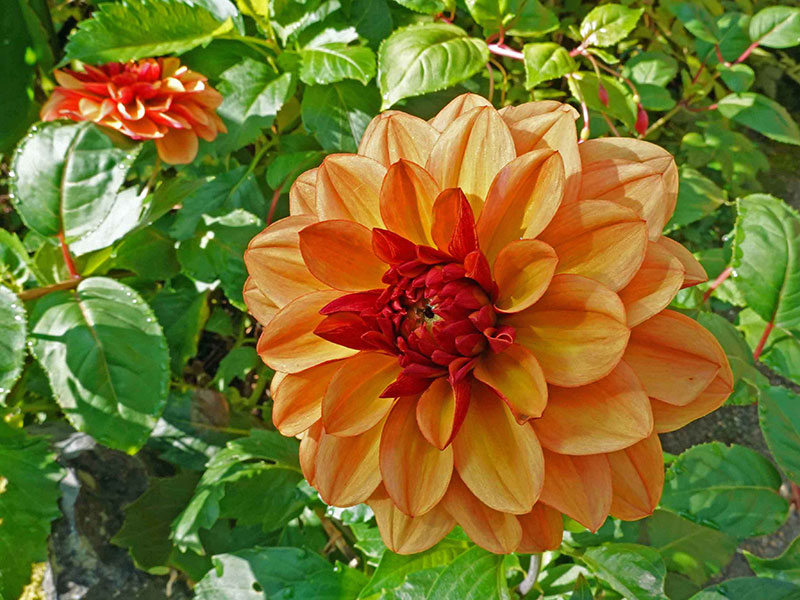
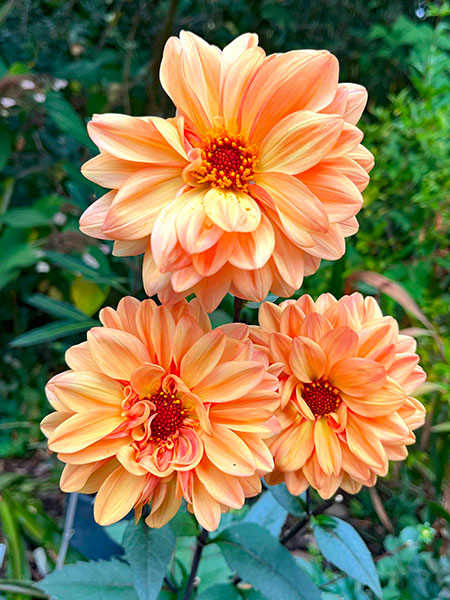
Spring cleaning also yielded an unexpected and unearned delight that produced the year’s most auspicious rediscovery for me: From a forlorn patch of border that had become increasingly shaded, I unearthed a withered cluster of unidentified tubers of a forgotten cultivar that hadn’t shown itself in years. Instead of tossing them I potted each of the six shriveled slips. They all sprouted, soon sporting handsome, bronze-tinged leaves and stems that rose four to five feet. On July 30 the first blossom showed its shades of sun-drenched peach, and the mystery was solved: Like a long-lost lamb, the sorely missed ‘Classic Elise’3 had returned to the fold. I presented one start to my friend Ciscoe and planted out the other five in rich soil and bright light, vowing never to neglect them again.
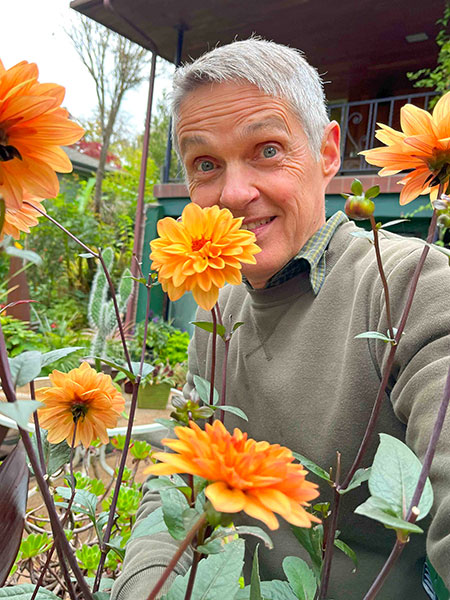
As with all consequential and stimulating ventures, success in any particular aspect of gardening is not a given: We win some and we lose some, but with perseverance we learn when to hold ‘em and when to fold ‘em, as Kenny Rogers sang in “The Gambler”4. Welcome to Year Five of HY. Let’s get growing!
Horticulturally yours,
Daniel
- From “The Dahlias”, published in the Sept. 9, 2024, issue of The New Yorker. Didi Jackson, author of the poetry collections My Infinity and Moon Jar, teaches at Vanderbilt University.
- I’m eager to read British statistician David Spiegelhalter’s new book, The Art of Uncertainty: How to Navigate Chance, Ignorance, Risk and Luck, when it’s published in the US next spring. You can listen to a BBC podcast interview with him on the topic here.
- Dutch grower Verwer Dahlias produced a marvelous line of bronze-stemmed beauties, of which I grow three in addition to ‘Classic Elise’. They are ‘Classic Swanlake’ (creamy white with sunny centers), ‘Classic Rosamunde’ (a regal lilac-pink with golden stamens) and ‘Classic Poème’, a shorter cultivar with salmon tones and a chocolate center. Verwer’s dahlia breeding program was acquired by Syngenta Flowers in 2018. It’s unclear if the ‘Classic’ line is still in production.
- “The Gambler” was created by Grammy-winning singer-songwriter Don Schlitz and recorded most notably by Kenny Rogers in 1978.