

My August Agave
December, 2020
Warmest December greetings to all NHS gardeners!

As the solstice approaches, gardeners of Pugetopolis often turn to evergreens for solace. From the tallest Thuja plicata (western red cedar) to the smallest Selaginella oregana (spikemoss), we revel in the verdure provided even in the depths of winter by these native sentinels of our maritime forests. Yet even as I embrace these old reliables, I find myself –dim and desperate from lack of sunlight– increasingly drawn to evergreens of a different temperament: succulents from the southwestern U.S. and Mexico. From Dasylirion to Yucca, Nolina to Beschorneria, these desert denizens –all members of the family Asparagaceae– have crept into my consciousness as well as my garden. Pride of place, however, must be granted to this giant botanical family’s most majestic genus, Agave.
Linnaeus was onto something in 1753 when he coined the term “Agave” from the Greek for “noble” or “illustrious” in recognition of its regal bearing, perfect symmetry, and towering flower spike. Doubtless he was unaware of or unconcerned with the vital importance of this genus’ myriad species –which range in size from tiny to huge– not only to sustenance of wildlife but also to human societies over thousands of years. (If you indulge in an occasional tipple of tequila, mezcal or pulque, you too have an agave to thank—or blame.) Linnaeus also named the official type species: Agave americana. This variable species, which boasts many gorgeous, variegated forms, is half hardy and will survive temperatures as low as 15 degrees Fahrenheit if provided sharp drainage in winter. In our climate this is easiest accomplished in containers, although I successfully grow the freely suckering A. americana var. marginata (gold leaf margins with green center) in the ground against a south-facing brick wall under a wide eave.
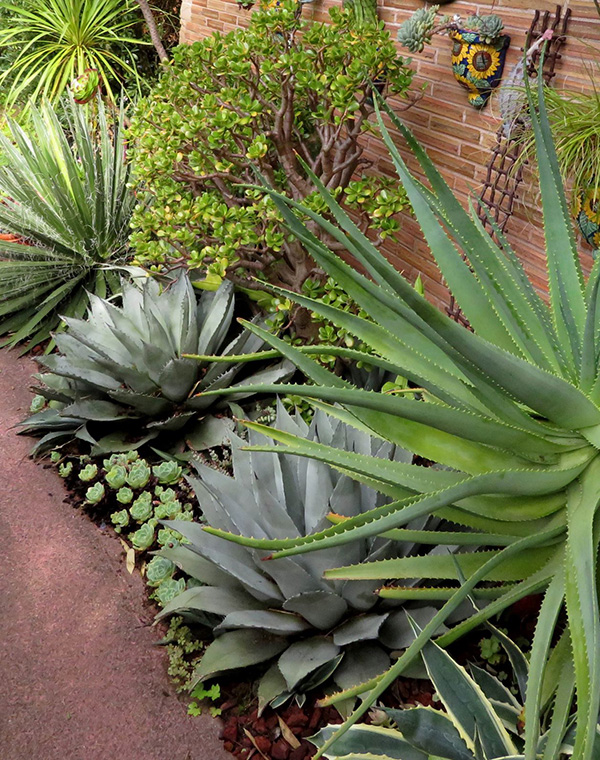
More reliably cold-hardy species abound, suitable for planting out with the caveat of providing excellent drainage. My personal favorites include three medium-sized (2 to 3 feet tall and wide) examples I have had in the ground for 15 to 20 years: A. multifilifera (hundreds of long, thin, slightly convex, pliable leaves adorned with curly white filaments), A. neomexicana (a spiky, blue-gray hemisphere of stunningly elegant geometric perfection) and its near lookalike, A. havardiana, the reigning champion of them all in my book.
Before launching into the glorious rise and fall in the year 2020 of my own Agave havardiana, let’s back up a bit. Agaves are commonly called “century plants” in reflection of their living for many decades before blooming, a process as spectacular as it is fatal: Agaves are monocarpic, fruiting only once and then dying. They rarely bloom in cultivation in these parts. Portland has seen a couple of prominent examples the last couple of years, but they enjoy much more prolonged and triggering summer heat than we do in the Puget Sound region. That said, in 2018 an Agave parryi bloomed near the Graham Visitor Center in Washington Park Arboretum, although its 15-foot tower of power fell over in midsummer while in full bloom.
My own specimen of A. havardiana I was given as a year-old seedling in 2001 by a Portland friend. In light of its cold tolerance, I planted it out in 2004 next to its little cousin, A. neomexicana. Over the ensuing years both blueish beauties grew handsome and healthy into robust middle age. In mid-May of this year, I got the surprise of my gardening life: My A. havardiana, now age 20, proceeded to rock my world.

The rumbling deep down in the plant must have begun, unseen and unheard, long before the prickly tip of the rosette, a perfect spiral of rigid, glaucous-gray leaves, separated to reveal a pointed orb. This was the apex of the inflorescence, the giant asparagus-like stalk that rocketed skyward at an astounding rate, rising from a basal height of 24 inches on May 13 (when I first noticed that activity was imminent) to 100 inches on June 13. It topped out mid-July at about 138 inches, just as its first glossy flower buds, pink-tipped and buttery yellow, were opening. The bloom cycle, beginning at the lowest of 11 tiers on the candelabra stalk, took around a month to work its way to the summit.
About a week after blooming began, I noticed that although honeybees in frenzied fashion burrowed into the blossoms’ nectar-rich, three-celled ovaries to claim their sweet reward, they couldn’t be bothered with the pollen hanging from the elevated stamens. I fretted and feared fertilization wasn’t in the cards. A. havardiana relies on a particular type of bat and hawkmoth for pollination, both of which are absent in our corner of the continent. Perhaps foolishly, I decided to tackle the task myself. For the next two weeks, each afternoon I perched at the edge of the precipice (the edge of my garage roof), extending my arm to each floral cluster within reach, covering the palm of my hand in golden pollen and then rubbing it on the sticky styles of neighboring clusters. Would it do the trick? I watched and waited through September as about half of the spent flowers and the attached ovaries fell to the ground, obvious failures. But the remaining half, more than 200 fruiting capsules, remained, swelling in size and gradually aging from glossy green to powdery black as they ripened and dried.

I began harvesting the pods in November. What elation (and relief) washed over me when I pried open the first three-chambered pod to find 42 iridescent, ebony (presumably fertile) wafer-like seeds scattered among a hundred papery bits of dun-colored chaff! In all, the harvest, which stretched into early December, yielded 221 mature fruit capsules containing 6300 seeds. I’m sharing them with regional botanical gardens and amateur enthusiasts alike, and you’d better believe I’ll try my hand at germinating some myself.
Given the inexorable progression of climate change, agaves are likely to play an ever-larger role in our horticultural pursuits. If you, too, have a mind to nurture one to the point of fruition, get started soon.
In recognition of Yuletide, we’ll take a break for the rest of December and meet again in the new year.
Horticulturally yours,
Daniel