
Striking A (Spinal) Chord With Cactus
July 2024
And her heart is full and hollow
—Joni Mitchell
Like a cactus tree.1
Filling my heart this last fortnight of uncharacteristically desert-like conditions in the Pacific Northwest2 is my ever-deepening respect for and appreciation of the botanical family Cactaceae. A couple of years ago I weighed in on the appeal for PNW gardeners of growing ornamental cactus in containers in the NHS’ Garden Notes newsletter. Present circumstances press me to return to the topic, and I’m not alone: Ross Bayton, director of the iconic Heronswood Garden, recently penned a column he called “A Prickly Truth” on Opuntia fragilis, the sole cactus native to western Washington. We’ll take a closer look at our “local” prickly pear in a moment, but first, let’s consider a bit of background.
Cactus is about as “All-American” (in the original, broader sense of the term) as plants can be: The core cacti, species in the subfamilies Opuntioideae and Cactoideae that have strongly succulent stems, are thought to have emerged in the central Andean region of South America about 25 million years ago. Around 10 million years later they began migrating north into what is now Mexico, and from there continued to trek all the way up to western Canada. The grandest of all —in terms of towering stature— are Arizona’s saguaro (Carnegiea gigantea) and Baja California’s giant cardón (Pachycereus pringlei). These slow-growing cactus “trees” may top out at more than 60 feet in height upon maturity. “Full” they are, but unlike in Joni Mitchell’s song, certainly not “hollow”: Their spiny and succulent trunks, when fully hydrated, hold more than two tons of water.
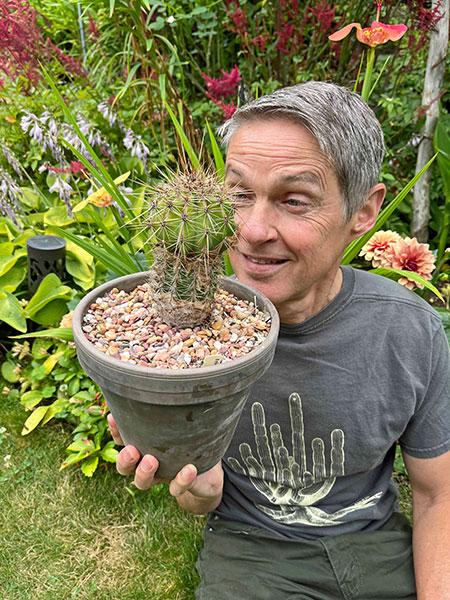
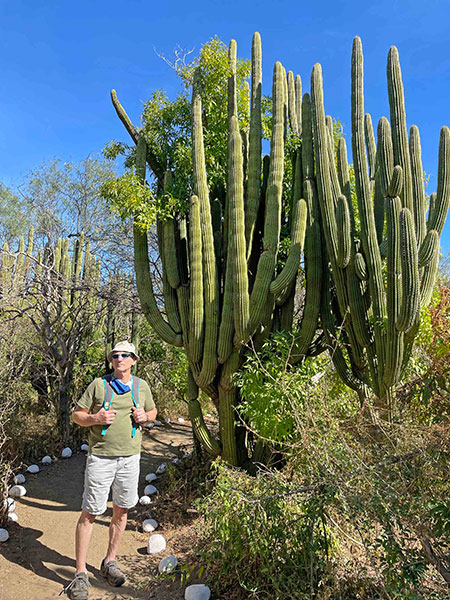
This camel-like self-sufficiency in hydration is among their main attractions for conservation-minded folks in the arid Southwest, but PNW gardeners intent on growing cactus in containers (fast-draining, unglazed terracotta is best) mustn’t neglect watering their spiky darlings in summer, which is their growing season. Their rest period, roughly October through March, is another story: A spot of water every six weeks or so should suffice. Other selling points are that cacti are nearly critter-proof (but can be plagued by mealy bugs or scale insects when kept indoors) and sport interesting and sometimes dazzling architectural structure. They also bear flowers that range from cute-as-a-button to gobsmackingly flamboyant.
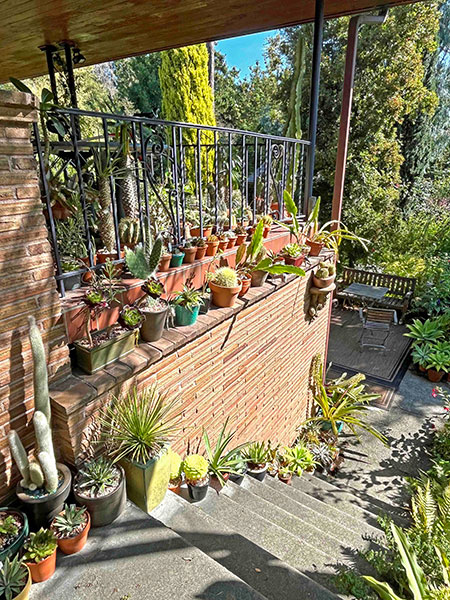
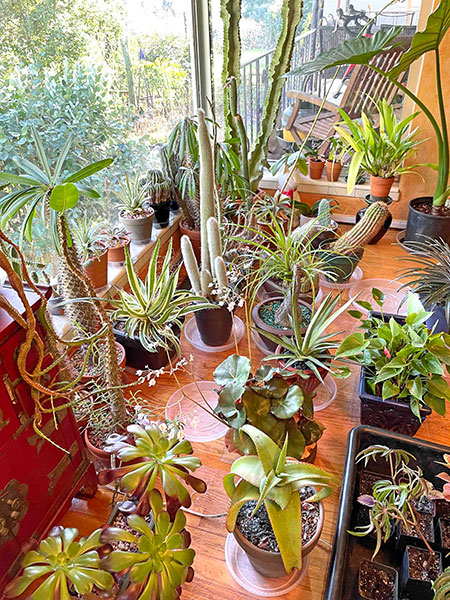
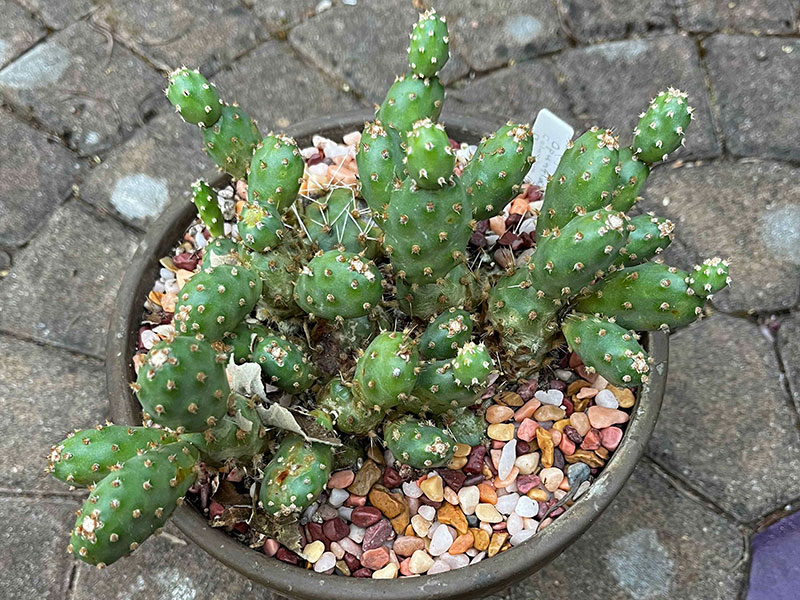
Back to the opuntias, commonly called prickly pears: The enormous genus of around 180 species is the most far-ranging and cold hardy of all cacti, endemic to most of the Western hemisphere from the interior of British Columbia down to the southern tip of Patagonia. The humble and unassuming Opuntia fragilis3 is the only cactus native to our wet, west side of the Cascades. It can be found on a few sandy bluffs of Whidbey Island, a couple of remote corners in the San Juan Islands and in several spots near Sequim. I’ve tried growing it and a few other cold-hardy opuntias in the ground on several occasions, but each time they’ve rotted due to winter wet even though I’d given them an elevated bed loaded with grit. Container culture is the surefire way to go.
Apropos my own cactus collection, over the last third of a century I’ve tried around 90 taxa. A census I conducted this week turned up 52 remaining specimens. Following are a few of my tried-and-true favorites.
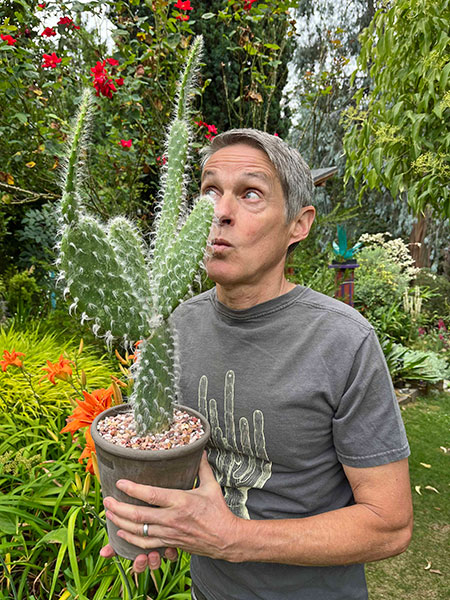
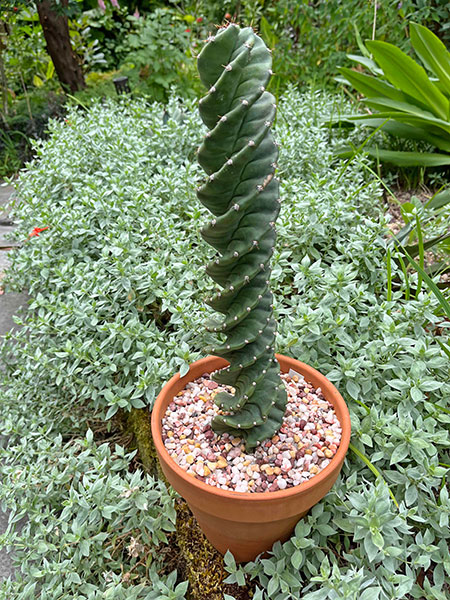
For architectural form, my preferred pair of pets are Opuntia ‘Woolly Jacket’ and Cereus forbesii ‘Spiralis’. Regarding this opuntia, whose origins are unknown, it’s the only example I know of in the cactaceous world that one can caress with impunity, as it has no spines and apparently no glochids, the minute and irritating barbed hairs that inflict grief on unaware passersby who venture too close to other opuntias. I found my almost cuddly ‘Woolly Jacket’ at a succulent nursery in Palm Desert, California; it’s been a fast, healthy grower for me over the last three years. Also mysterious in origin is the mesmerizing ‘Spiralis’ cereus, whose helical shape reminds me of a botanical auger with hints of Bruegel’s painting of the mythical Tower of Babel.
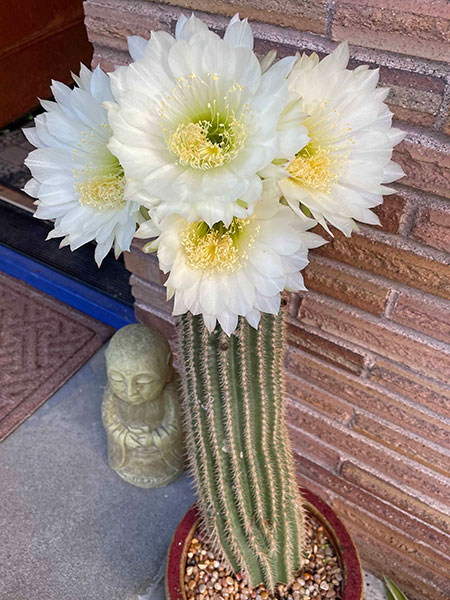
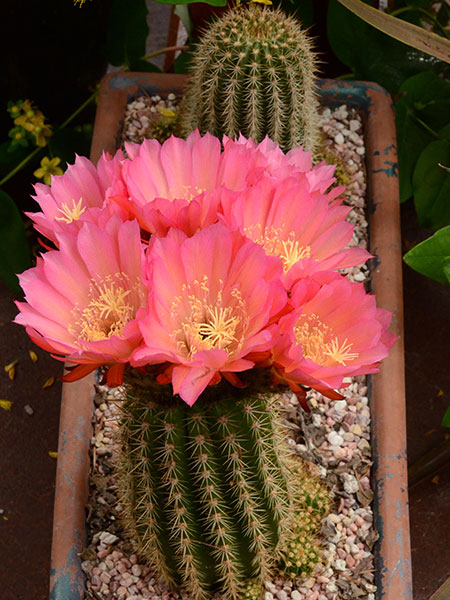
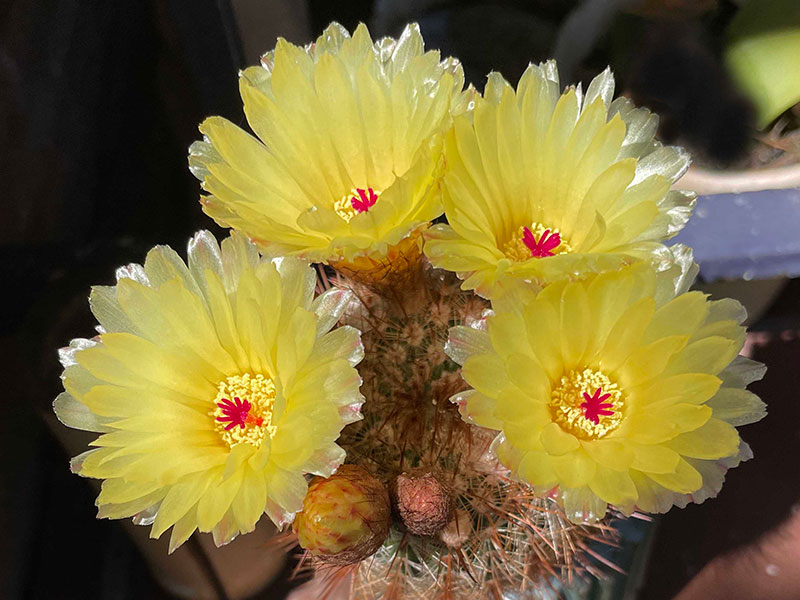
In the floral department, my most reliable bloomers are Soehrensia spachiana4, the golden torch cactus, which sometimes blesses me with up to five enormous ivory-hued frilly blossoms at once in July or August; the diminutive Soehrensia huascha, with its ample, neon-bright orange or pink flowers; Echinopsis oxygona, which boasts improbably large lavender-pink blossoms on long tubes; and the compact, globose Parodia erubescens, which pumps out demure but charming funnel-shaped, satiny yellow flowers that sport a tiny red button (the stigma) in the center.
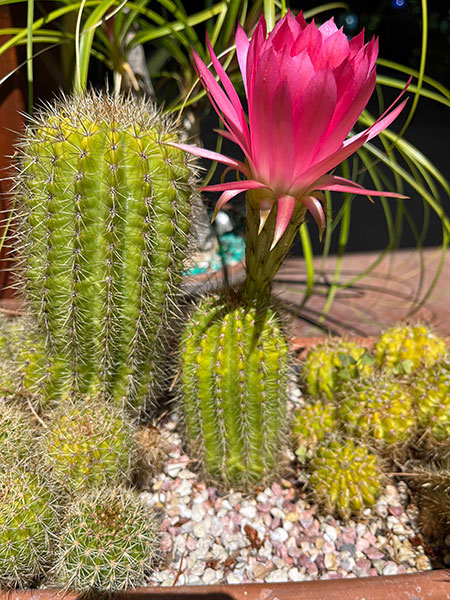
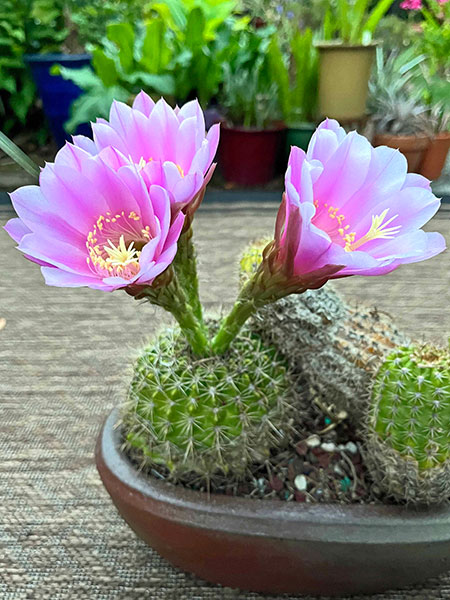
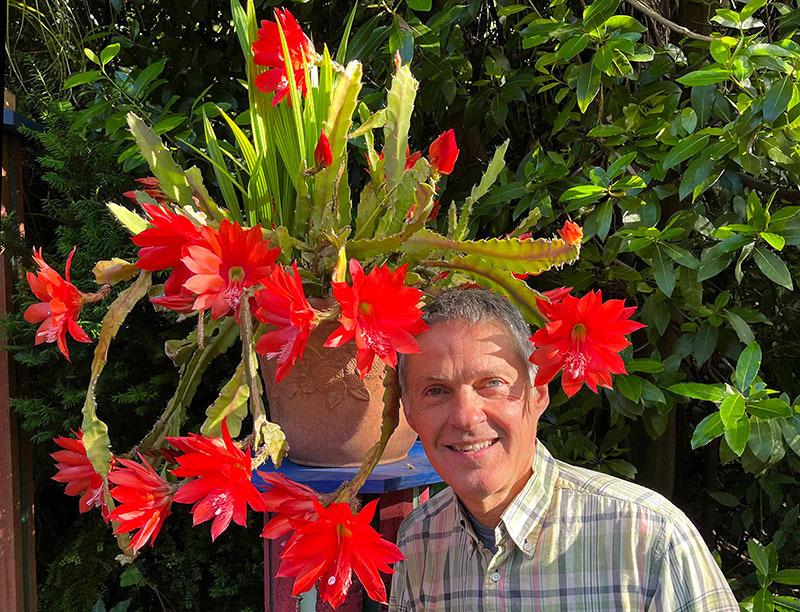
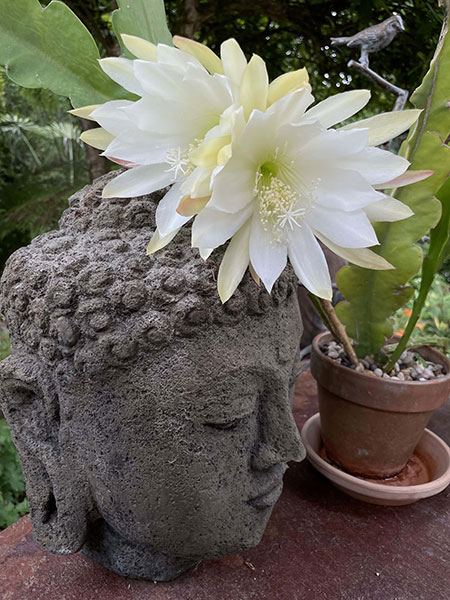
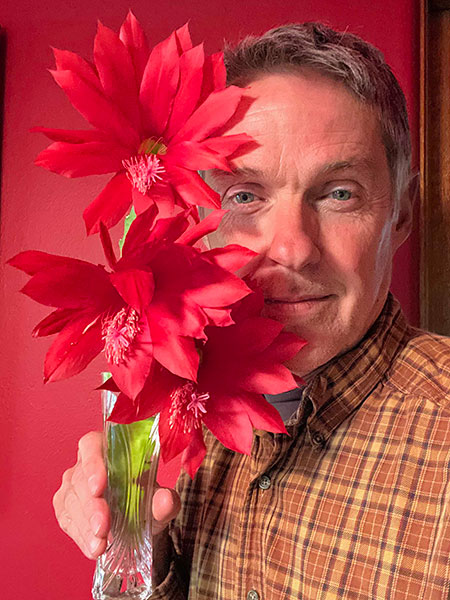
The veritable showstoppers, however, are the epiphytic orchid cacti, complex hybrids marketed as “epiphyllums”. Scores of named cultivars throw out gargantuan blossoms in a dizzying range of hues. Unlike other cactus types, these require regular water, rich soil that’s freely draining, and protection from scorching summer sun. Bright, indirect light is ideal. They overwinter without complaint in a cool, bright room. A mature plant may bear a dozen stems, each producing several flowers. A stem with three developed buds makes a stunning cut flower that will last for up to a week. When the spent blossoms fall, pot up the stem to make yourself a new plant.
As I’m being needled by my cacti’s siren song to nourish them on this warm afternoon, I’ll bid adieu until we meet again in mid-August.
Horticulturally yours,
Daniel
- Excerpted from the last verse of Joni Mitchell’s song, “Cactus Tree”, on the album Song to a Seagull, released in 1968 (Siquomb Publishing Corp).
- The average daily high temperature in the first half of July 2024 was about 85 degrees F.
- The “fragile” designation in the specific epithet reveals a clever survival strategy: Paddles break off easily, adhere to passing animals, eventually drop to the ground and root in a new location.
- Nomenclature is both confused and confusing: Many vendors designate Soehrensia as Trichocereus or Echinopsis, and Parodia as Notocactus or Wigginsia.