
Poppypalooza: When the Desert Blooms
March 2023
We have survived fires and floods, but it looks like the flowers are going to do us in!
—Steve Manos, mayor of Lake Elsinore 1
When a frosty February segues into a murky, morose March, many of us Pacific Northwest gardeners engage in a bout or two of California dreaming, visions of wildflowers dancing in our heads. Although late winter and early spring usually adorn the arid landscape of the Mojave and Colorado deserts with a chromatic sprinkling of flowering native annuals, about once a decade a complex set of climate variables converge to produce a staggering “super bloom” that carpets valleys and slopes alike with a technicolor tapestry of floral exuberance.
The last such event, in 2019, prompted a frenzy when out-of-control hordes from heavily populated coastal cities —irresponsibly stoked by social media— descended on the fragile terrain of Walker Canyon in the normally bucolic Riverside County town of Lake Elsinore. The consequential “Poppy Apocalypse” resulted in unhinged petal peepers clogging city streets, parking cars willy-nilly, then thrashing through pristine meadows and scurrying down precarious slopes to snap selfies while wallowing in the ethereally orange fields. The town’s current mayor, Natasha Johnson, remembers the chaos of 2019: “The flowers were beautiful; the scene was a nightmare.” To prevent a recurrence, Walker Canyon is closed to the public this spring. Johnson’s message for 2023: “Do not come. You could be arrested.”
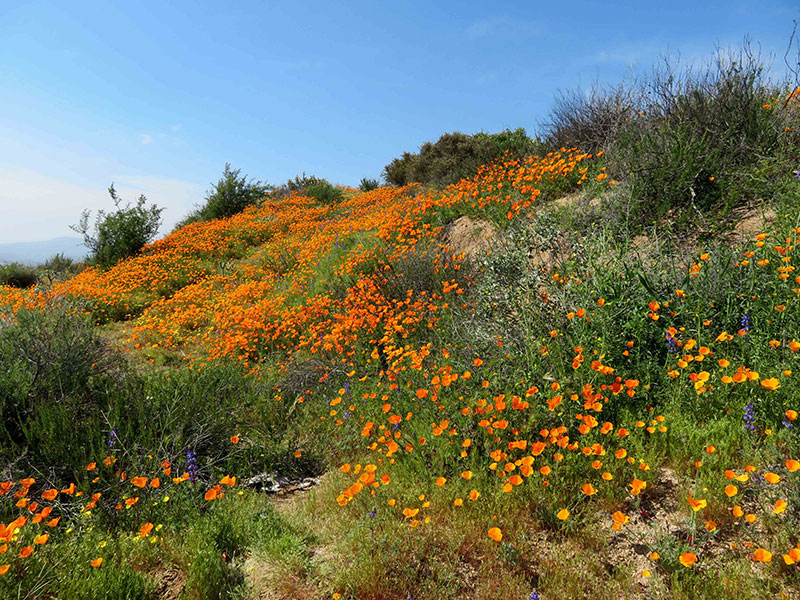
A much more suitable spot to view wide swaths of Eschscholzia californica 2, the state’s official flower, is the Antelope Valley California Poppy Reserve in a higher-altitude corner of the Mojave Desert near Lancaster in northern Los Angeles County. Given the frigid blanket that’s covered the whole West Coast this season —this reserve was covered in snow at the end of February— the poppies there are likely to peak in April and May, considerably later than usual. Of course, by that time, our local stands of these flowers (the native range of E. californica extends from Baja California north to Washington State) are likely to be blooming. Back down in the Golden State, of much greater botanical interest, not to mention peace of mind, are the more remote and arid Colorado Desert landscapes of the Coachella Valley and the iconic Anza-Borrego Desert State Park, which burst into myriad hues from a vast array of iridescent wildflowers and cactus blossoms.
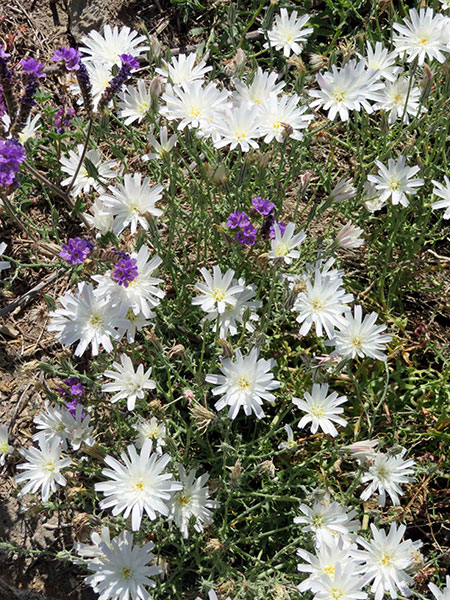
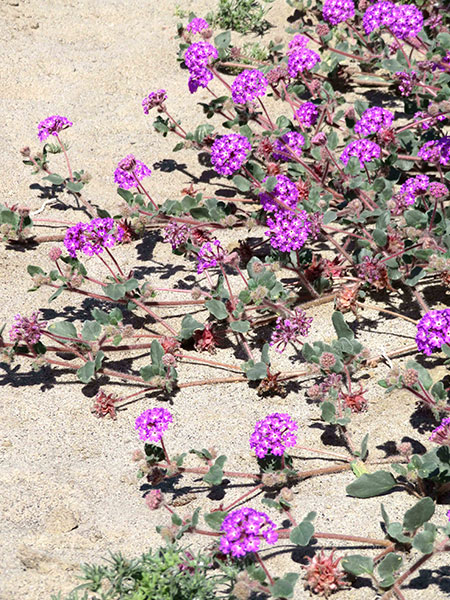
Rafinesquia neomexicana (L) & Abronia villosa (R)
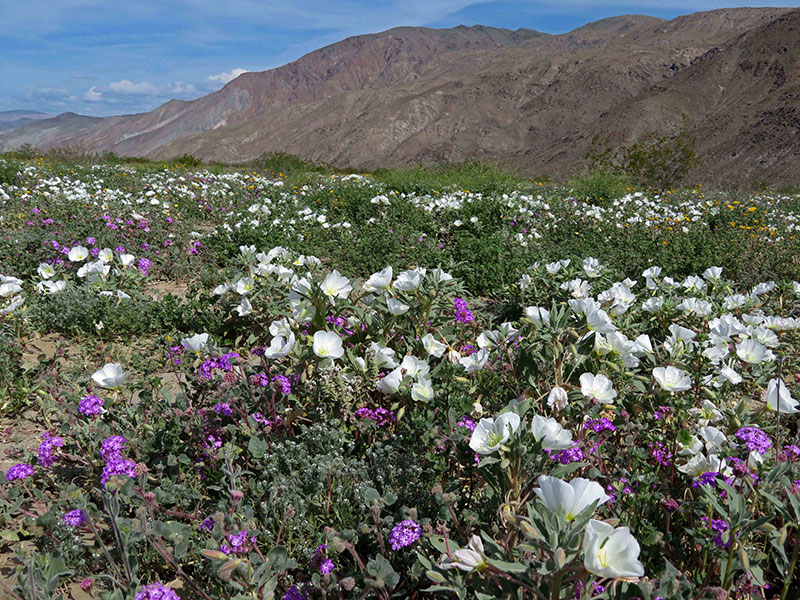
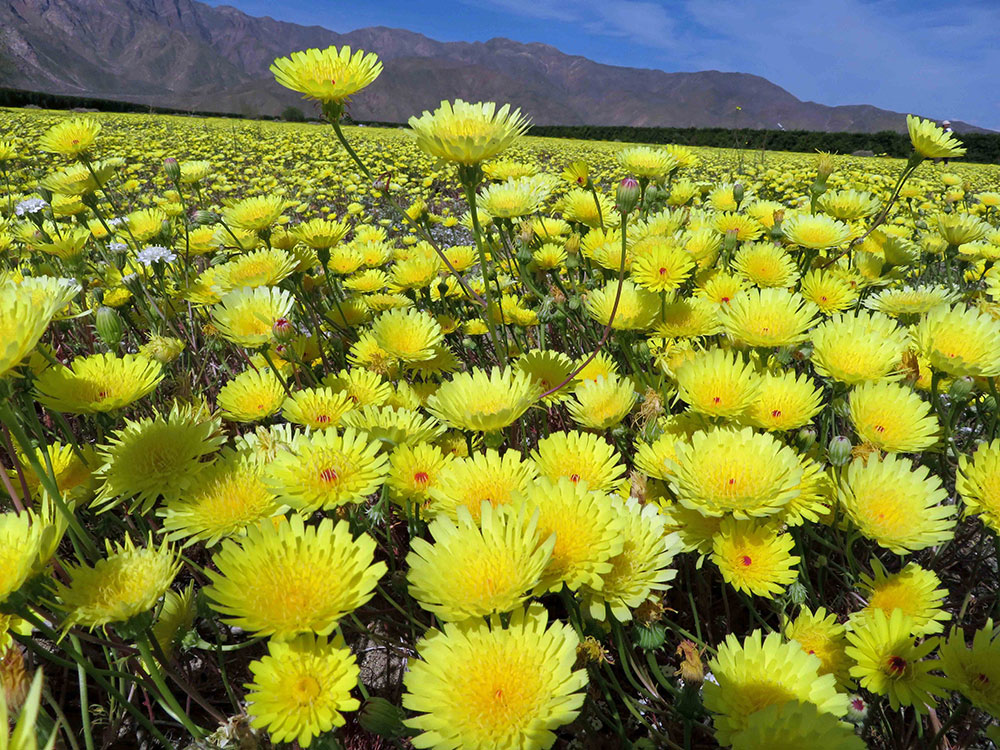
Determined to check out the blooming bonanza for myself, albeit in more sensitive and respectful fashion than the feverishly frenzied poppy zombies cited above, I popped down to Palm Springs in March of 2019. Rob, my local host, quickly whisked me to two nearby flower-viewing venues far from the madding crowd: The informal community of Sky Valley and the neighboring, idyllic Coachella Valley Preserve. A slow stroll along the unhurried lanes of the former and the placid pathways of the latter provided primo possibilities for taking in a plethora of Persian-carpet colors: Seemingly endless swaths of golden Malacothrix glabrata (desert dandelion) with their irresistible red eyes, interwoven with dazzling, snow-white Rafinesquia neomexicana (desert chicory) and mellow mauve drifts of Abronia villosa (sand verbena).
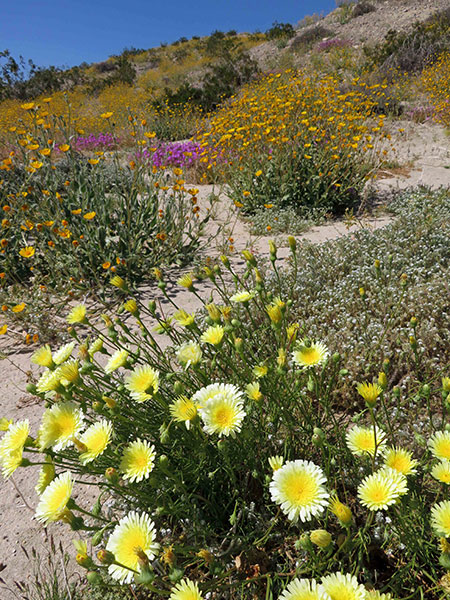
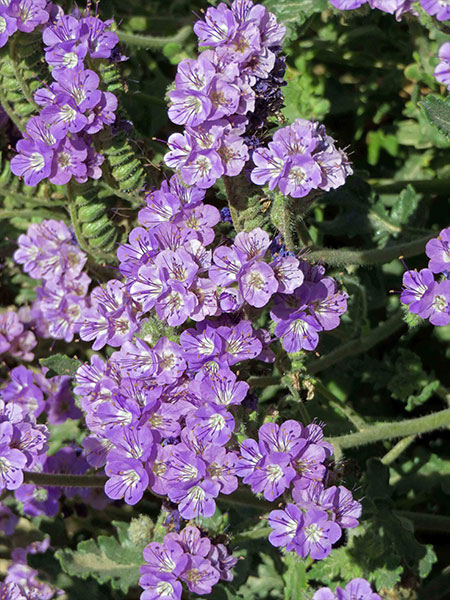
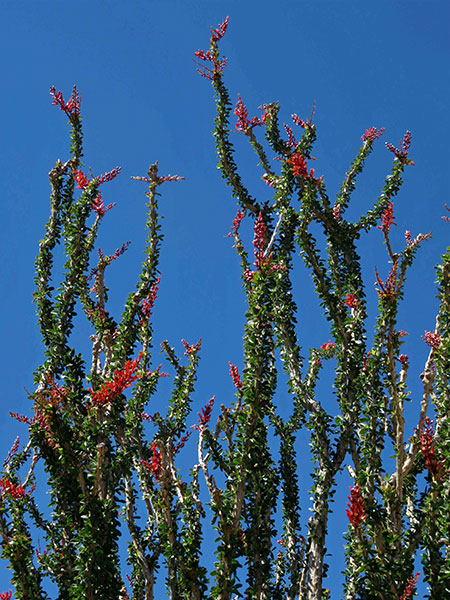
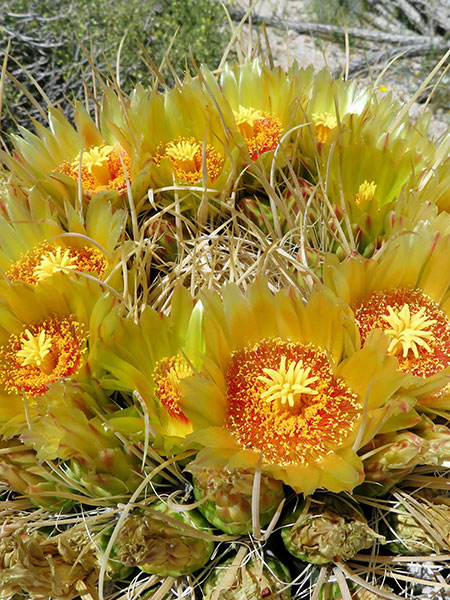
A bit further afield, a 90-minute drive brought me to the fabled floral mecca of Borrego Springs, headquarters of the desert state park mentioned above. Within the spacious boundaries of the park, which encompasses almost 1000 square miles, are a score of easily accessible meadows and hillsides home to loads of lavender and ivory Lupinus arizonicus (desert lupine), regal sky-blue Phacelia campanularia, P. crenulata and P. distans (sometimes called desert bellflower, desert bluebells and wild heliotrope), oceans of fragrant and dawn-white Oenothera deltoides (dune evening primrose), along with stately stands of Fouquiera splendens (ocotillo) with their incarnadine inflorescences, and prickly-proud clumps of chartreuse-blossomed Ferocactus cylindraceus (California barrel cactus).
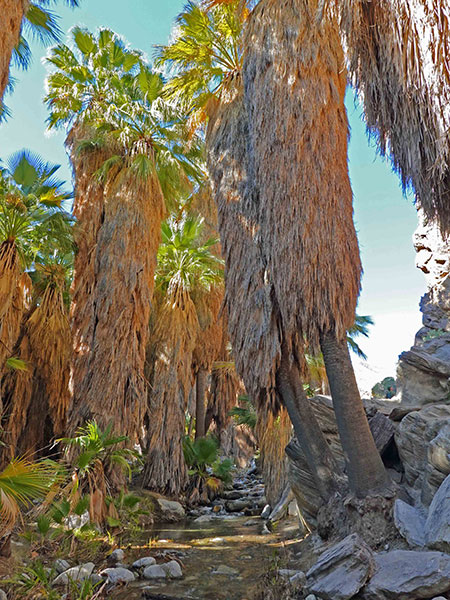
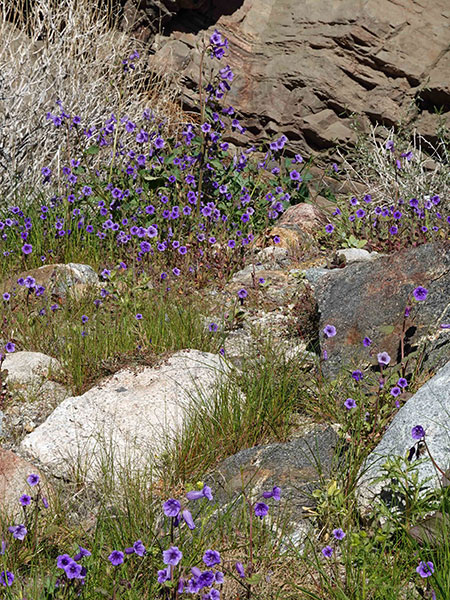
Despite the copious rounds of rain and snow that have pummeled Southern California the last few weeks, 2023 has not yet shown signs of producing a super bloom. However, a visit in the cool weather months of any year to the Anza-Borrego park or the palm-filled oases and nature reserves around Palm Springs is guaranteed to soothe the soul. In early February of this year, while wandering in the oasis of Andreas Canyon 3, its streambed lined with towering ranks of the handsome native palm, Washingtonia filifera, I marveled at the abundance of purple-belled Phacelia minor (commonly called California bluebells, wild Canterbury bells, or whitlavia) growing among granite boulders at the base of the mahogany-tinted metamorphic rocky slopes that form the canyon wall.
Should you choose to venture south this spring or next, don’t fail to contact the supremely helpful Anza-Borrego Desert Natural History Association in the town of Borrego Springs. Click here for a current account of what’s in bloom and how to view it responsibly.
When we meet again in a fortnight, just after the equinox, we’ll take a close look at two exemplary easy-to-access desert gardens within a few minutes’ drive of Palm Springs, one natural (Thousand Palms Oasis in the Coachella Valley Preserve), the other formal (Sunnylands Center and Gardens). Both are open to the public and are free of charge.
Horticulturally yours,
Daniel
- Steve Manos, a Lake Elsinore city council member since 2012, was mayor during the Super Bloom of 2019.
- The genus (pronounced “esh-HOLE-tsee-ah”) was named to honor Johann Friedrich von Eschscholtz (1793-1831), a Russian-Estonian physician and naturalist of Baltic German heritage who wrote the first scientific description of California’s flora.
- Andreas Canyon is part of the Indian Canyons complex belonging to the Agua Caliente Band of Cahuilla Indians. A nominal entrance fee is charged upon entering the canyon complex to access the trails.