

Autumn's Oddball Edibles
October, 2021

With November’s gloom looming just around the corner and my neighborhood farmers market shuttered for the season, I must rely on foraging the slim pickings in my own garden to satisfy my inner locavore. Let me take stock: Other than perennial herbs such as big-leaf culinary sage (Salvia officinalis ‘Berggarten’), a few rogue nasturtium blossoms (Tropaeolum majus) and fabulous but fickle figs (Ficus carica ‘Petite Negri’), which if they manage to ripen, rascally rodents usually nab before I can pluck, what else is there? As I mentioned in the last session, my yuzu tree (Citrus junos) is heavily laden with plump pods, but we’ll have a full report on that next time around.
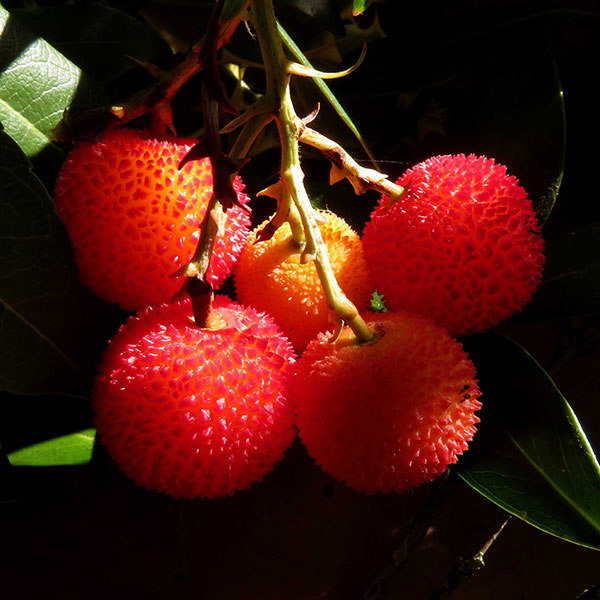
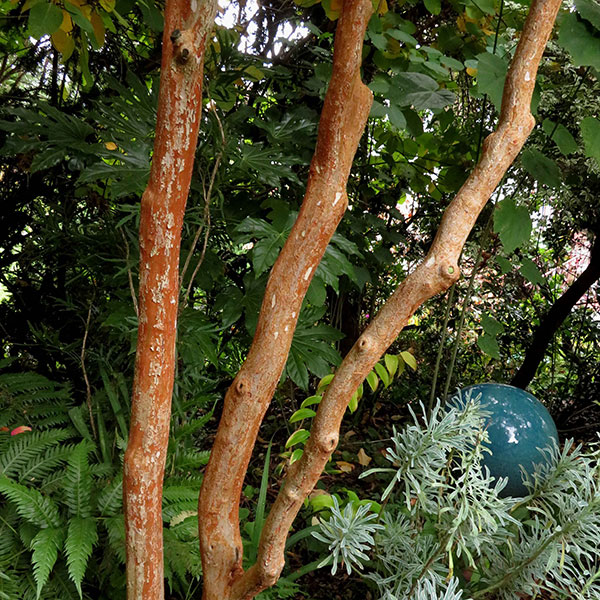
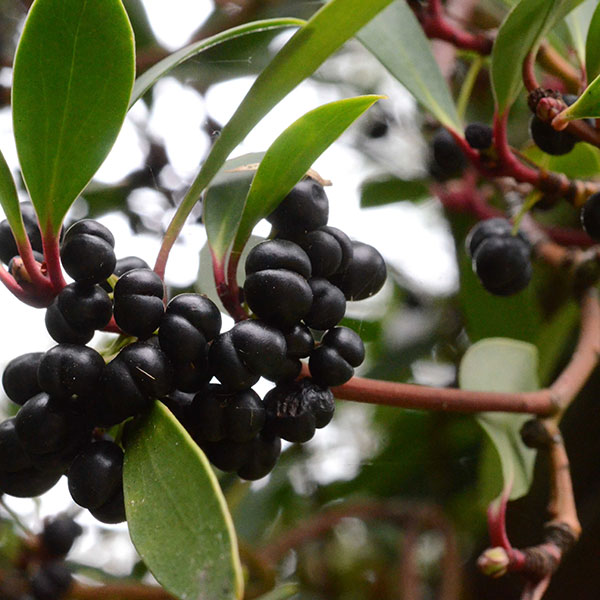
Today let’s look at a captivating trio of arboreal beauties that provide offbeat and highly nutritious, if not exactly luscious fodder for humans as well as our avian friends: Arbutus unedo, the strawberry tree, which sports ruby-red spheres of gumball-size, melt-in-the mouth fruit; Luma apiculata or Chilean myrtle, bedizened all fall with iridescent and juicy, purple-black clusters; and Tasmannia lanceolata, sometimes called mountain pepper or pepper tree, now cloaked in lustrous, double-barreled ebony orbs of piquant power.
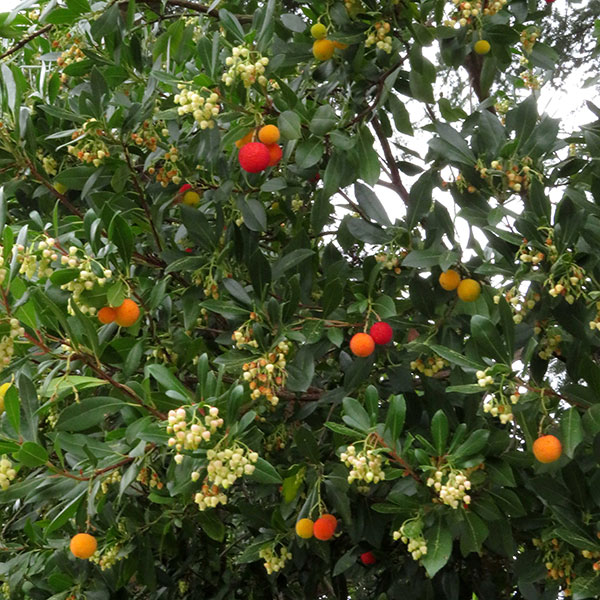
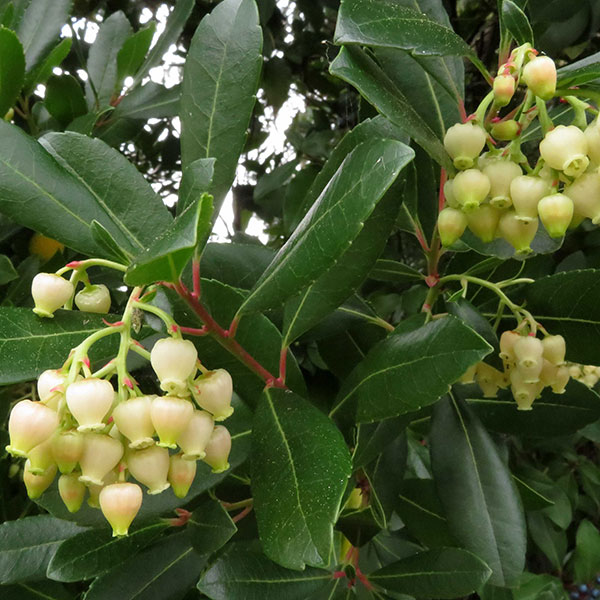
Although I have grown Arbutus unedo ‘Compacta’ for 25 years, I hadn’t given it much notice until this year. This is wholly due to my own dizziness and not to any shortcoming of this most worthy shrub, a smaller and much less fussy relative of our own beloved madrona, Arbutus menziesii. Native to the Mediterranean, the illustrious A. unedo has figured in the historical record for more than two millennia 1. Among its many appealing features (evergreen foliage, attractive bark) is the utility of its understated but elegant flowers in providing late season pollen for bumblebees and nectar for honeybees. Once pollinated, the fruit takes a full year to mature; this results in the fascinating spectacle of fresh blossoms surrounding clusters of yellow, orange and red berries. Recently I munched a handful of fully ripe, dark red “strawberries” just before they fell from the tree. I’ll be going back for more.
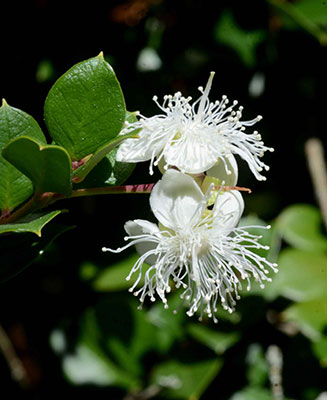
The cosmopolitan family Myrtaceae, which basks in the glow of its highly aromatic and flavorful members eucalyptus, clove, allspice, guava and pineapple guava, also features Luma apiculata, sometimes called Chilean myrtle 2, a fetching small tree I have grown for 20 years. Although its exfoliating, velvety-soft orange bark may be its most distinctive feature, the compact and glossy evergreen foliage, dazzlingly white and fragrant jewel-box flowers in summer, and succulent autumn fruit (best sampled when fully ripe to avoid the puckering astringency of immature berries) are also noteworthy. The fruits can be made into jam or used as a cheesecake topping, although I have not done this, and their medicinal value is now being recognized. A caveat: Mature plants may produce a battalion of seedlings where the fruit drops to the ground, but these are easily removed.
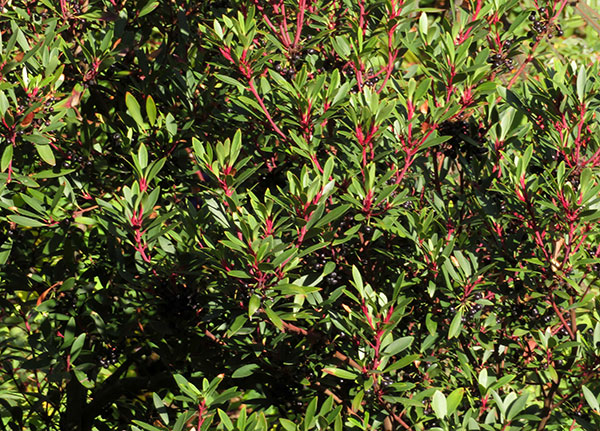
Who could guess, when admiring the rich, glossy, aromatic foliage and showy red stems of Tasmannia lanceolata 3 or mountain pepper, that this member of the botanical family Winteraceae is among the most primitive of angiosperms, related to magnolias and having emerged around 100 million years ago? I became so enamored of these handsome, versatile bushes (my first I planted 25 years ago) that my garden now boasts five, all of which bear fruit, a fact I’m at a loss to fully comprehend, as authoritative sources state that this species is dioecious, with male and female flowers on separate plants. My original specimen, limbed up to expose its comely trunks and create a canopy, is now a happy host in summer to visiting bromeliads. Of the trio featured in this column, mountain pepper has the brightest presence as a culinary and medicinal plant. Pop a pepper in your mouth and savor the initial sweetness before it gives way to a wasabi-like flavor bomb of spice that lingers on the palate.
Horticulturally Yours,
Daniel
1. Writing in the 1st Century of the Common Era, Roman polymath Pliny the Elder commented at length on the plant’s features in Volume XV of his encyclopedic Naturalis historia. Taxonomic note: Linnaeus assigned the Latin term Arbutus to the genus, as this is exactly what the Romans called this tree. For the specific epithet he chose unedo, a contraction of the Latin unum tantum edo (or “I only eat one”) apparently quoting Pliny, who was commenting on the often insipid taste of the fruit.
2. To call this plant “Chilean myrtle” is a slight to Argentina, which boasts the oldest (600 years or more) and largest groves of these stalwarts in their own national park, Los Arrayanes. “Arrayán”, although of Arabic origin, is the Spanish name for this tree, first applied to the true myrtle, Myrtus communis, the Mediterranean plant that gave its name to the botanical family. The generic name Luma comes from the Patagonian indigenous (Mapudungun) name; the specific epithet acuminata indicates that the leaves terminate in a sharp point.
3. Formerly included in the genus Drimys (and usually still marketed as Drimys lanceolata), this and a few other Australian species are now properly placed in the genus Tasmannia, with Drimys reserved for species originating in Latin America. Although the generic name is an obvious reference to Tasmania, the plant is also native to mountains of nearby portions of the Australian mainland in Victoria and New South Wales. The specific epithet refers to its lance-shaped leaves.