

Some Liked it Hot
October, 2021
Given the recent, welcome showers and pronounced plunge in temperatures, memories of the unprecedented heat dome of 100 days ago may be receding as fast as fleeting summer sunlight in our collective consciousness. We’d best keep in mind, however, that with climate change, increasingly erratic and extreme conditions may be the new normal. Most of our maritime Pacific Northwest days may drone on as drably as ever, but to quote New York Times journalist Sam Anderson, we should steel ourselves for periods of “deep normalcy inflected by sharp stabs of strangeness,” or in our situation, of meteorological terror.
That said, now a bit distanced from the inferno, we can reflect on the silver lining emanating from the cloud-of-heat doom: A few of our botanical charges not only survived, but also thrived after the early summer sauna. Did you note, as I did, that blooms on abutilons were more abundant, the fatsias fuller, the salvias more sumptuous and the roses, well, rosier in the wake of the withering warmth? Last time around we highlighted a cluster of plants (mainly trees) that sailed through unscathed. The same is true of a heat-loving clan of perennials and shrubs we’ll examine today.
May I present a resplendent and resurgent octet of opulence from my own garden? —That’s one exemplar for each day the ambient temperature exceeded 90 degrees F. at the National Weather Service’s Sea-Tac station this summer. Except for the agave, all are planted in the ground and stay there year-round, save for the canna, which I yank out in December and toss in the garage until spring. Four hail from Latin America, two from East Asia and the remaining pair from Australia and New Zealand. These botanical regions are likely to figure ever more prominently in our plant palette.
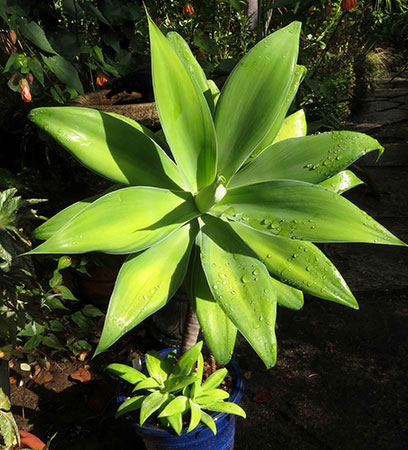
Agave attenuata ‘Kara’s Stripes’: This most huggable of all century plants is also one of the loveliest. Entirely devoid of spines, its fleshy leaves are almost cuddly soft. As it ages the old leaves fall away, revealing a smooth, trunk-like stem, at the base of which arise cute little pups that can be teased off to increase one’s collection. My 14-year-old specimen, whose rosette now peers out atop a 20-inch stem, more than doubled in size this summer. Native to central Mexico, it’s among the least cold hardy agaves; best kept in a container and moved under cover when frost looms.

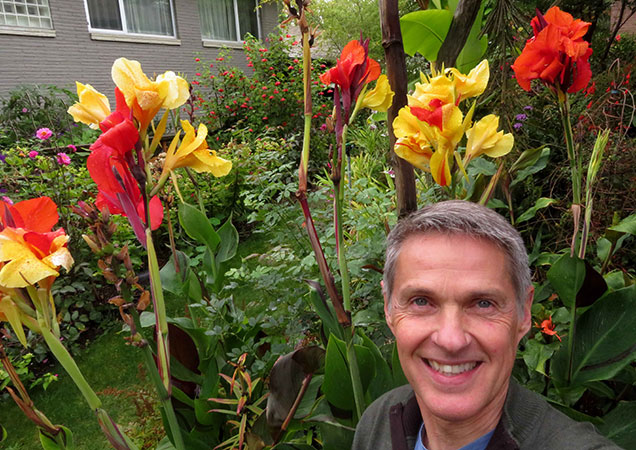
Canna ‘Cleopatra’: Although related to bananas and gingers, the genus Canna (which sports 10 species —all from the Caribbean Basin and South America— along with hundreds of named cultivars) is the sole member of its botanical family, Cannaceae. The mesmerizing and quixotic ‘Cleopatra’, technically a “periclinal chimera,” is among the weirdest and gaudiest, which means it has pride of place in my garden. Wild and unstable striations of green and bronze leaf tissue give rise to yellow, orange and red flowers atop 6-foot stems. Easy to propagate.
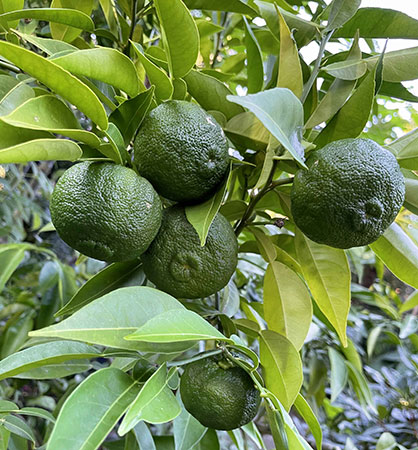
Citrus junos: A cold-hardy evergreen, this citrus produces yuzu, an edible fruit. Yes, its zest is practically the holy grail for hipster tipplers, but its unclassifiable, intensely aromatic juice has also been prized for centuries in Japan, Korea and its native China. I planted my specimen in 2015; at seven feet tall, this year it’s bearing its heaviest load yet of 70 or more fruit (like large mandarin oranges), now nearing maturity.
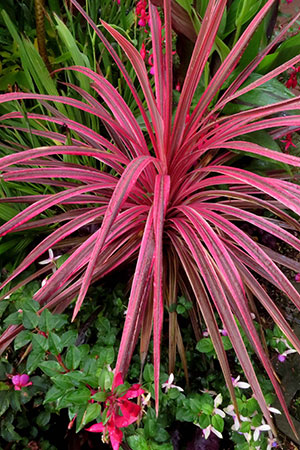
Cordyline australis ‘Cherry Sensation’: Known as tī kōuka or cabbage tree in its native New Zealand, every part of this agave relative is useful, from its edible stems and roots to the enduring fibers of its strap-like leaves. Oblivious to this greater truth, we grow it only for its looks, usually as an annual. Now in its sixth year for me, this shockingly electric-pink cultivar calls to mind a bucket of radioactive fuchsia blossoms suspended in mid-air nanoseconds after exploding.
Grevillea robusta: Was it hubris, naivete, or garden-variety ignorance that led me to plant this improbable Proteaceae species in a sunny garden bed 12 years ago? After dying to the ground its first several winters, it has now developed a trio of slender but sturdy, frost-resistant trunks. This year it doubled in height and now waves its filigreed fingers eight feet in the air. Known as silky oak in its native Australia, this grevillea, the largest in the giant genus, may reach 100 feet in prime locations. I’d be over the moon if it just produced a blossom for me, but for now I’ll stay in my place, contentedly admiring the foliage.
Iochroma ‘Princess’: The economically vital nightshade family, Solanaceae, produces a host of multicolored, trumpet-blossomed, shrubby beauties in the Latin-American genera Acnistus, Brugmansia, Cestrum, Dunalia, and Iochroma, among others. With rare exception, these are container plants for us, but this pretty-in-pink ‘Princess’ promises to tolerate mild winters if planted in a sheltered spot. This I did two years ago, and my 4-inch twiggy slip of a thing is now a 12-foot-tall behemoth and nearly as wide. It’s been puzzlingly parsimonious with blooms, however.

Musa basjoo: Although it’s been a quarter century since my husband Jeff and I first planted the hardy Japanese fiber banana (now understood to have originated in Sichuan, China), our main grove still engenders oohs and aahs from garden visitors. At this writing, a record six stalks are simultaneously producing blossoms and fruit. Anyone have a troop of monkeys for hire to harvest them for us?
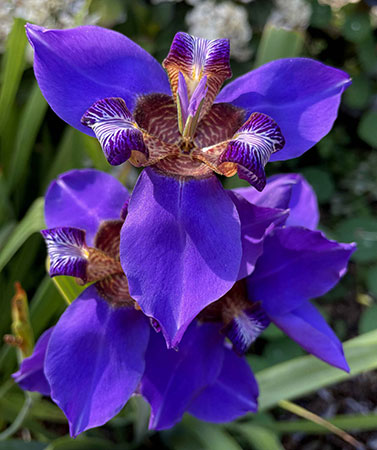
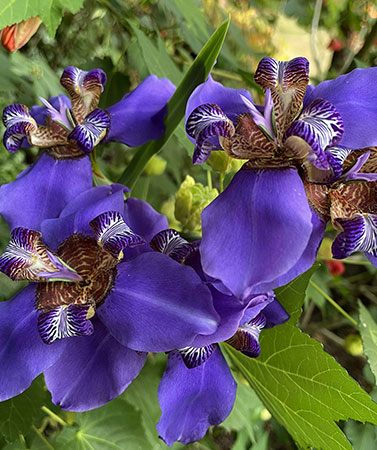
Neomarica caerulea: This Brazilian diva is the Greta Garbo of the iris world. When the mood strikes it, from tall, elegant lance-shaped foliage emerges a blossom stalk with a dozen or so coy buds that suddenly burst forth one fine morning with the most captivating purple-blue flags and falls that open to reveal intricate, internal ivory and chocolate striations. Although individual flowers last only a few hours before swooning, up to six may open at once on the same stalk.