
Kudos to Kiwiland: NZ Plants for PNW Gardens (Part II)
March 2025
Gardens are never completely ‘right’,
—Helen Dillon1
and perhaps the allure of the garden is
that it’s never, ever ‘right’.
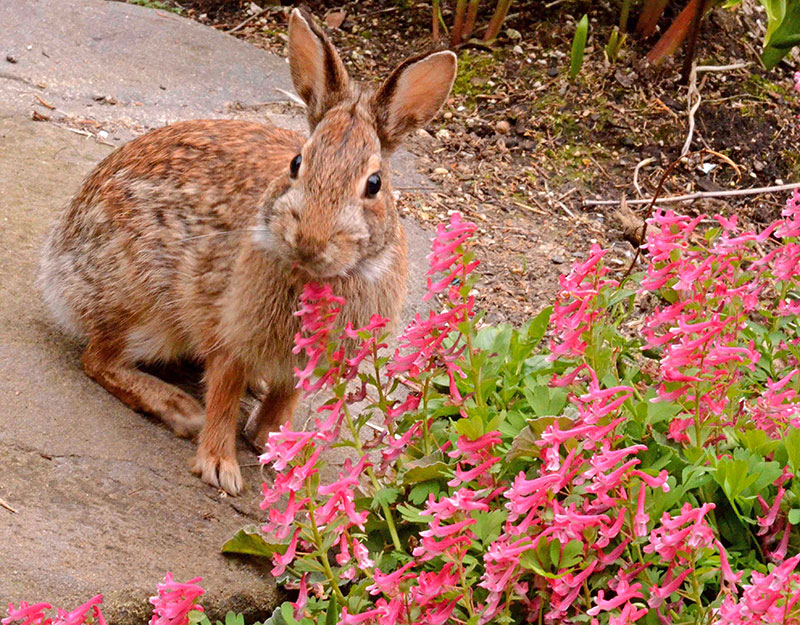
Happy Vernal Equinox! At solar noon today (1:16 p.m. PDT, March 20) the Seattle sun will rise to a shade shy of 43o above the horizon, a most welcome contrast with its gloomy zenith of 19o at the winter solstice three months ago. Waxing daylight coupled with waning chill usually manage to coax even the more reluctant gardeners among us to head outside and take stock of the season’s survivors and casualties. It just hit me that I’ve been conducting this census for a third of a century (which is to say, half of my life) in the Garden of Exuberant Refuge. There are a few perks to growing old in one’s garden —I’m not sure if much wisdom has seeped in, but I do find myself (despite my habitual, knee-jerk complaints) increasingly at peace with winter’s losses. Predation by rabbits, however, still gets my proverbial goat: A few days ago, a belligerent band of bad bunnies devoured a flat of foot-tall seedlings of my beloved Pseudopanax crassifolius.
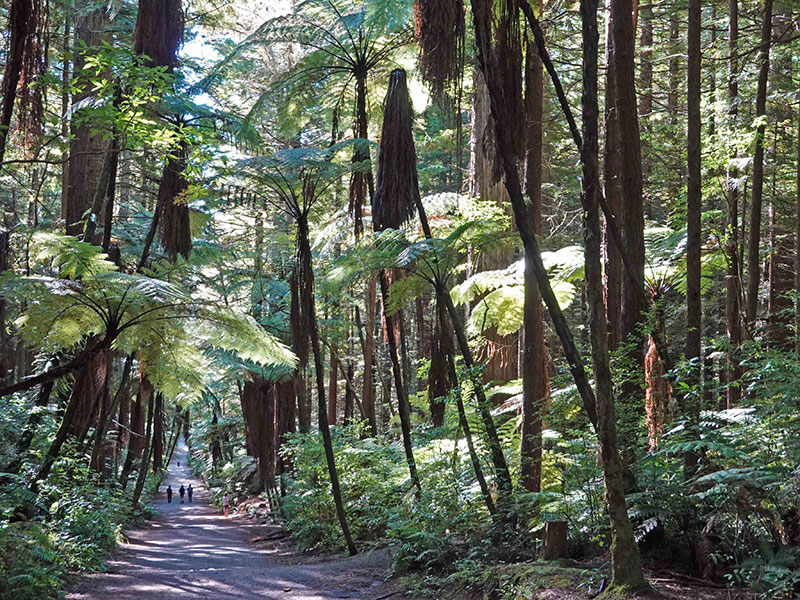
Last month our report on embracing New Zealand plants in the PNW commenced with a few shrubs and trees, including the weird and wacky lancewood (Pseudopanax) noted above. Today we’ll shine the light on more Kiwi cuties, starting with a final set of woody wonders before moving on to grassy perennials and a couple of evergreen ferns.
Cordyline—Of the 20 or so species of these strappy southern-hemisphere, asparagus-family shrubs, six are New Zealand natives. The rest originate in warmer parts of Oceania, except for C. sellowiana, which true to its common name of “Brazilian palm lily” hails from South America. Although closely related to spiky yuccas and needle-sharp agaves, cordylines are unarmed, sweet-natured softies. Over the past 33 years, I’ve attempted about 20 taxa drawn from five species. While none is truly hardy, the most frost resistant is C. australis (australis = “of the south”, New Zealand representing the southernmost part of the genus’s range). Often called “cabbage tree” (“tī kōuka” in Māori), it makes an imposing presence over time. In sheltered spots of older gardens around town one can spot decades-old multi-trunked specimens. Although the straight species is a rather drab green, flashy cultivars and hybrids of C. australis and adjacent species are a different story.
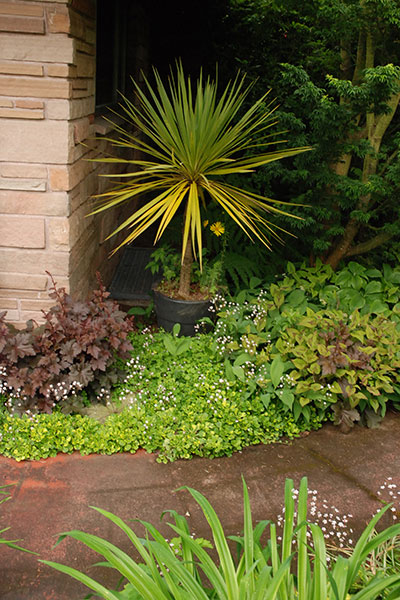
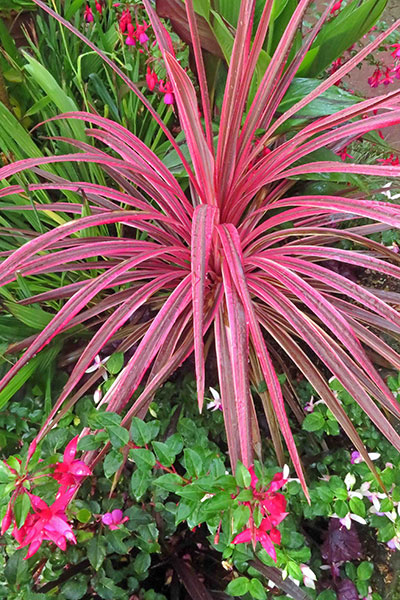
Fuchsia-pink, ruby-red and golden-striped selections are now widely available, even in big box stores, where they’re usually marketed as fancy annuals. Easy to overwinter in containers, some may survive in the ground if given adequate protection. Among the most reliable are the gorgeous ‘Torbay Dazzler’ and aptly named ‘Cherry Sensation’. Another dynamic duo to look out for are ‘Renegade’ (US Plant Patent 18,605), a compact purple wonder that is probably a hybrid of C. australis and C. banksii, and ‘Electric Flash’ (USPP 26,267), an appealingly clumping, cream-and-chocolate-striped cultivar of C. banksii. A species of a different order entirely is C. indivisa, sometimes called “mountain cabbage tree”, whose brash and broad leaves make it a knock-‘em-dead diva in that oversized container you’ve been flummoxed over what to grow in it.
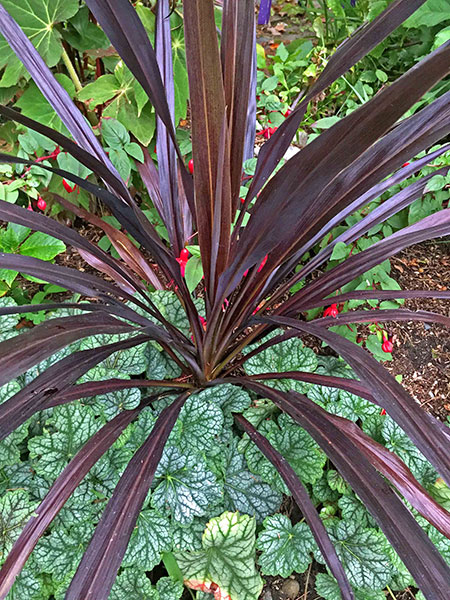
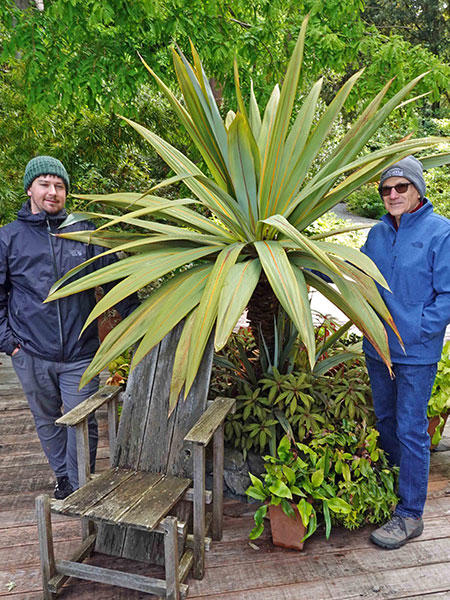
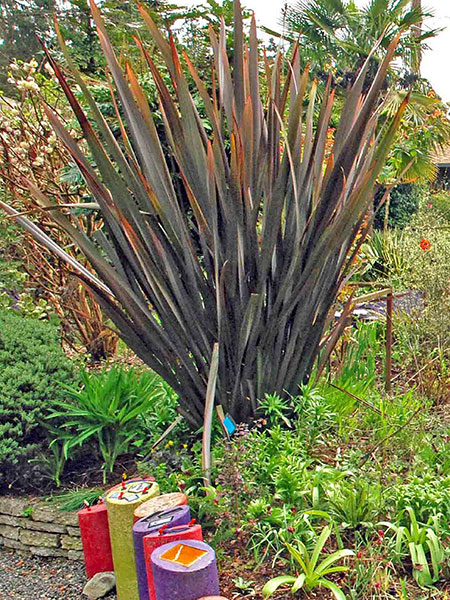
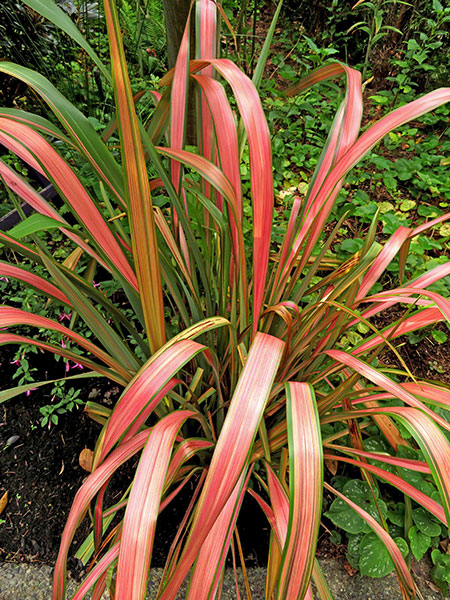
Phormium—Remember when New Zealand flax was de rigueur in our gardens? Dan Hinkley waxed poetic on their sterling qualities in his catalogs 20 years ago (the legendary Heronswood Nursery carried about a dozen taxa). Taking the bait, I ended up on the hook for a couple of dozen specimens of seven cultivars, from the juggernaut of P. tenax ‘Atropurpureum’ (tenax = tough), with its pliable but strong-as-steel dusky bronze spears thrusting skyward, to the more human-scale, audaciously pink, lime and gold-striped cultivar ‘Jester’. Successive waves of freezes delivered the behemoth P. tenax specimens to the tomb, while the spunky, sprightly ‘Jester’ continues to charm, but only in pots that can be dragged into the garage if an arctic blast looms. Curiously, the ‘Jester’ divisions I’ve retained in containers lose over the winter much of the pink hue that their in-ground (and now dead) clones flaunted, although the potted ones recoup their color in the bright light of summer. We’ll take a closer look at phormiums in their home context next month when we recap our recent tour of Aotearoa New Zealand’s flora.
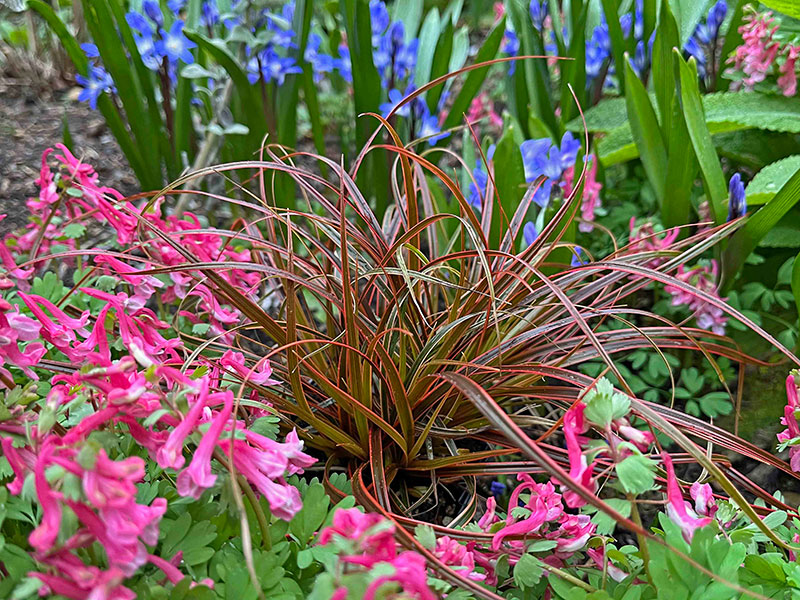
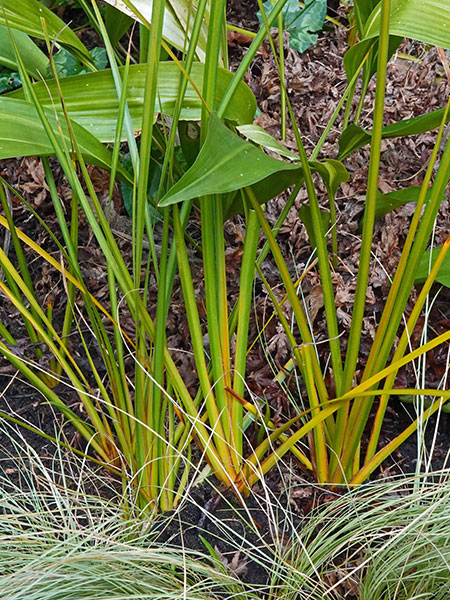
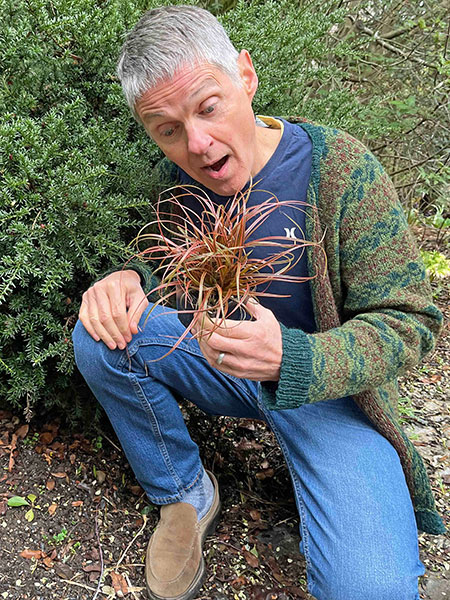
The “Rights” Stuff (Astelia, Carex, Libertia, Uncinia)—Seriously, Folks, there’s no political subtext here. I innocently alphabetized this like-minded quartet of grass-adjacent, mounding, evergreen perennial New Zealand natives in my garden and was startled by the acronym that arose. Let’s meet them: (A) Aristocratic astelias have their own botanical family, Asteliaceae, and further distinguish themselves with their striking, silky foliage. The handsome cultivars ‘Silver Spear’ and ‘Silver Shadow’ have faded into oblivion at my place over the last few cold winters, but ‘Red Devil’ keeps plugging impishly along. (C) Unlike the other genera in this ACLU group, which are endemic to Oceania and South America, the cosmopolitan Carex comprises nearly 2000 species. Of the 15 I’ve grown, roughly half (mop-haired bronze sedges such as C. buchananii and C. testacea) emerged in New Zealand. Reliable self-sowers, they pop up all over, although I limit them to the margins of borders and pathways. (L) The dapper genus Libertia (Iris family) stands out from the others with small but showy tri-petaled white flowers, yet the cutest species, L. peregrinans, is most noted for its dainty fans of stiffly upright, narrow glossy foliage that weave delicately around neighboring plants (peregrinans = wandering). Glowing orange leaves fade to green in winter. (U) Uncinea is a genus of hook sedges closely related to Carex 2. Its most garden-worthy member, U. rubra, flaunts a tidy, titillating tuft of bronze to mahogany-red foliage that darkens beautifully in summer, but also looks smashing when paired with spring ephemerals. Both its botanical 3 and common names point to the sharply spiked black seeds, which in late summer do their darnedest to dig into my ankles as I walk past.
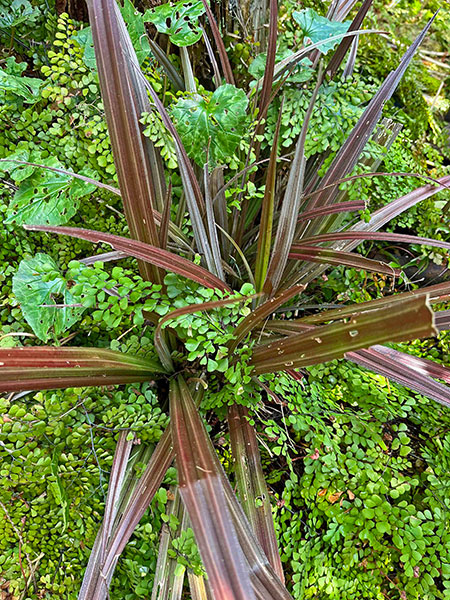
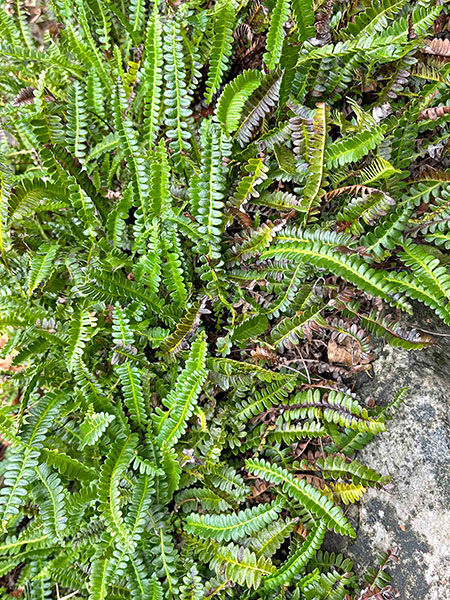
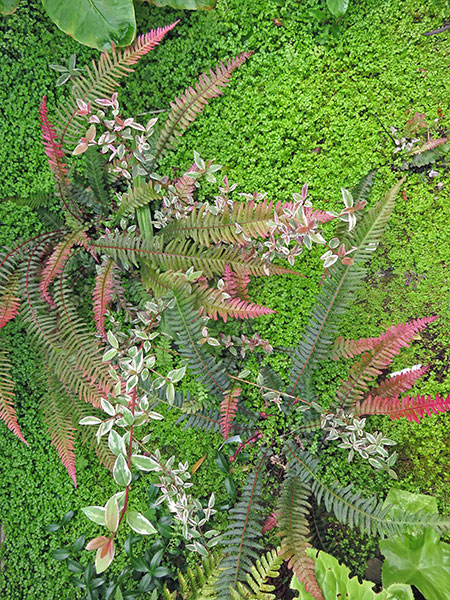
Ferns—Aotearoa New Zealand boasts 200 species of ferns, from the world’s tallest to the world’s smallest, but I’ve successfully grown only two, and from the wee end of the spectrum: Blechnum penna-marina and Doodia media. The former, recently reassigned to the new genus Austroblechnum (Austro = southern), is a close relative of our native deer fern. Where happy —in a sheltered spot under a large evergreen, for example— it makes a neat and elegant groundcover. The latter, commonly called rasp fern, or by its native Māori name, the delightful pukupuku, sports pretty, pinkish-red new growth and appreciates a similar level of protection.
The most comprehensive venue for inspecting native Kiwi plants in the Seattle area is the 2.5 acre New Zealand Forest, a key component of the Pacific Connections Garden in the UW Botanic Gardens’ Washington Park Arboretum. Late last month I asked my friend Ray Larson, the arboretum’s associate director and Curator of Living Collections, how the garden had fared over the recent cold seasons. Here is a synopsis of his report: “Last winter really did a number on many plants. Our clay soils certainly haven’t helped, but we got down to 13 degrees F with no snow cover to insulate. Many, but not all phormiums did poorly, as did many of the astelias. Cordyline australis was killed to ground but has started to resprout. Podocarpus nivalis and P. hallii did fine and showed no damage. Corokias also did remarkably well. Pittosporum patulum did well, as did P. tenuifolium ‘Irene Paterson’. We have found that most species that were winter killed when young fared better if given a few years to get established. Olearia × haastii did fine, but O. avecinniifolia suffered. O. ilicifolia did ok. Hebes mostly did ok and have been suffering more from heavy soils and rabbit predation than anything else.”
“Wascally wabbits” notwithstanding, next month we’ll commence an inspection of Kiwi flora in several of its native habitats, plunging into the plantlife of Aotearoa New Zealand’s North Island in a virtual circuit that encompasses nature reserves and cultivated gardens alike. In the meantime, I’ll be at ease putzing around my ever-so-slightly shambolic garden as it springs into rebirth.
Horticulturally yours,
Daniel
- From page 39 of Helen Dillon’s Garden Book (London: Frances Lincoln Ltd, 2007). The Miller Library at the UW’s Center for Urban Horticulture carries this and four other titles by the noted Irish garden writer.
- Kew’s Plants of the World Online has folded the genus Uncinia into Carex, but other sources maintain the difference.
- A most descriptive botanical name: Uncinia = much hooked; rubra = red.