
Three Cheers for Hilo
December 2023

Almost any garden, if you see it at just the right
—Henry Mitchell1
moment, can be confused with paradise.
As we slide ever closer to the somber winter solstice, when the slumbering Seattle sun seems scarcely able to poke its feeble head above the horizon, my light-deprived thoughts turn to evergreens for solace. Over the last 30 years I’ve been packing them into my garden to help ward off the winter blues. Nevertheless, whether familiar (Woodwardia, Euphorbia, Taxus) or fetched from afar (Weinmannia, Eucalyptus, Tasmannia) when I step outside in December to admire them, I’m bound to get W.E.T., especially given the recent spate of “pineapple express” atmospheric rivers that have us drenched. Steeped in this sopping situation, every year about this time it occurs to me, why not go straight to the source? Recently my long-suffering husband Jeffrey and I did just that and once again headed for Hilo on the Big Island of Hawai‘i to ogle a tropical trio of evergreens: palm, cycad and the pineapple papa itself, bromeliad2.

For those unfamiliar with Hilo, it’s the down-to-earth county seat of Hawaiʻi County, one of the state’s major cultural centers and the wettest city in the United States, with an average annual rainfall of 120 to 160 inches, depending on neighborhood. Copious precipitation, combined with refreshing trade winds and porous, nutrient-rich volcanic soil make Hilo and environs one of the planet’s lushest and most fruitful places to cultivate plants. The flashiest horticultural showcase of the Hilo region is the must-see Hawaiʻi Tropical Bioreserve and Garden a few miles north of town, but that’s a topic for another time. Our focus today is on the unsung but alluring botanical jewel-boxes on the campus of the University of Hawaiʻi at Hilo.

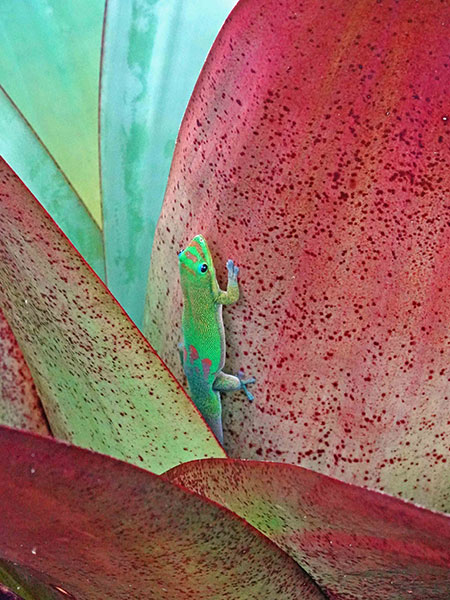
The unassuming gardens were begun about 35 years ago by UH biology professor Don Hemmes to demonstrate plants from other parts of the world for his students. Over the years Dr. Hemmes refined the garden’s focus: Its two parcels, separated by about 120 meters, now feature cycads and bromeliads in the upper portion and moisture-loving palms in a nearby gulch that is subject to periodic flooding. Although the university provides the land, maintenance is carried out exclusively by volunteers and donors. Admission is free and public access is unfettered, although there is a small fee to park on campus when classes are in session.


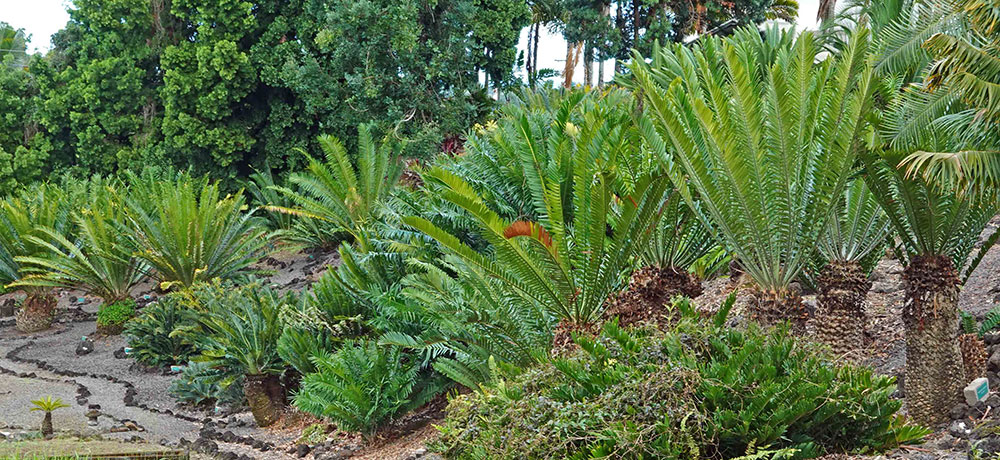
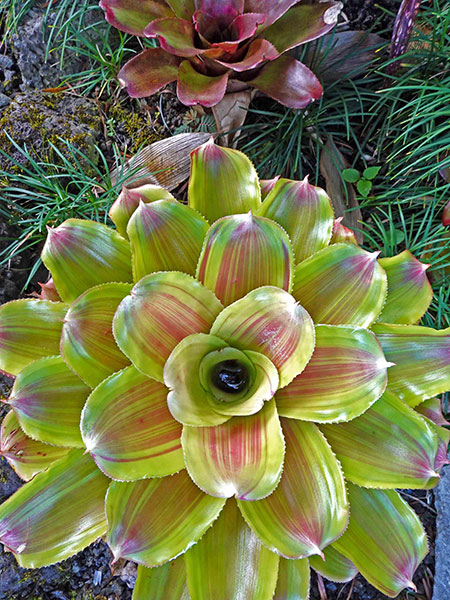
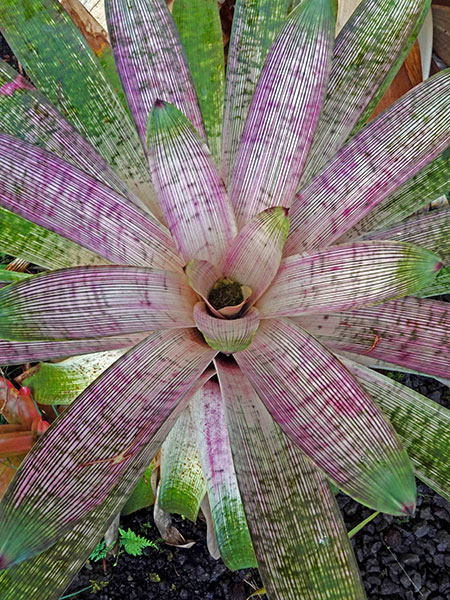
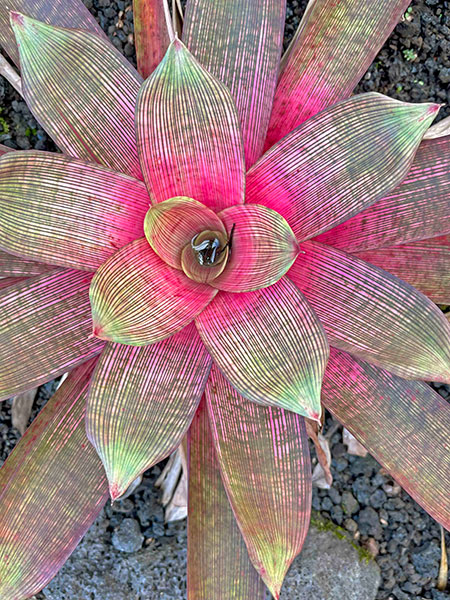
Peering into the upper garden, one’s eye is drawn to a short stela of black lava rock topped by a plaque that bears Henry Mitchell’s pithy epigram quoted at the top of this column. However, there’s no confusion here, as this veritable slice of plant paradise has no need of a “right moment”. What a sumptuous, sensational theater Hemmes and friends have crafted! Protected by an overstory of towering solitaire palms (Ptychosperma elegans), large cycad specimens (of the Latin American genera Dioon and Zamia) take center stage, but the scene (if not the whole show) is stolen by hundreds of swirling, twirling, radiant and shimmering Brazilian bromeliads, the Carmen Mirandas of the plant world. Most of the showiest specimens (mainly cultivars of the epiphytic genera Vriesea, Neoregelia and Alcantarea) were donated by accomplished Hilo hybridizer David Shiigi.

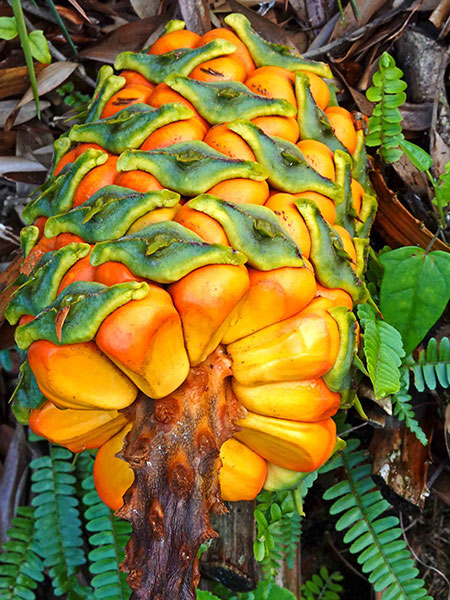
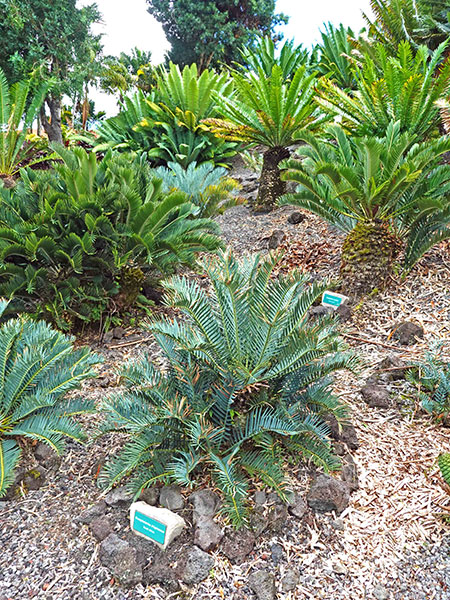
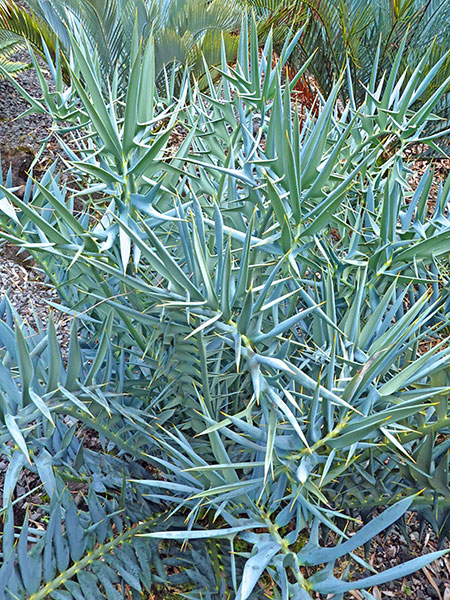
Behind the bedazzling bromeliads, the bulk of the garden is devoted to clusters of cycads from other regions of the world: East Asia, Australia and central and southern Africa. Of the 375 recognized cycad species, this garden boasts 554 specimens from 115 species representing all 10 accepted genera. Three of the most photogenic include Macrozamia lucida (sometimes called “pineapple cycad” due to the appearance of its fruiting cone), Encephalartos ferox (whose bright red, mature female cones look decidedly Christmassy against the glossy green foliage), and the beguiling but aptly named Encephalartos horridus, whose steely blue, spiny leaflets mean business: Their belligerent bristles brook no argument.

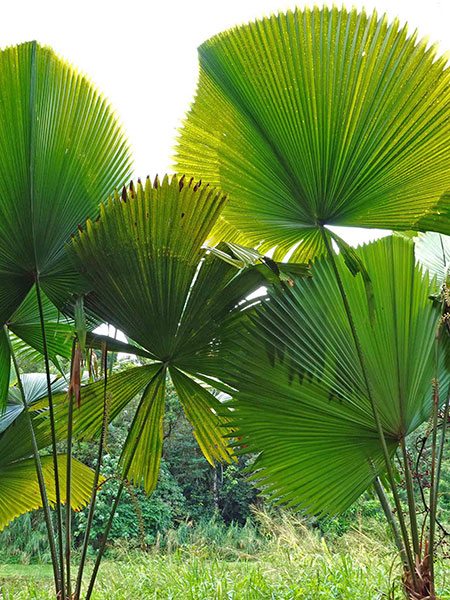
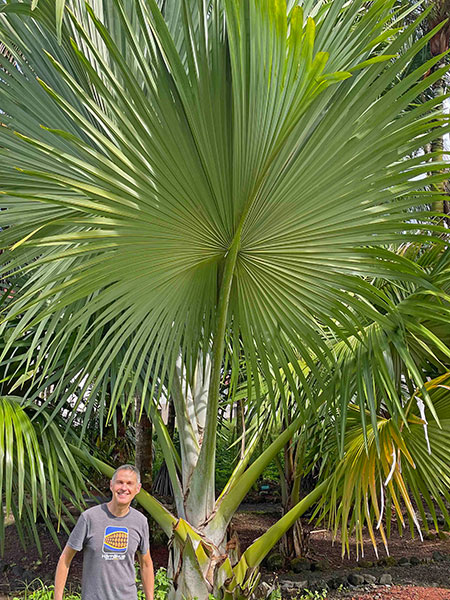
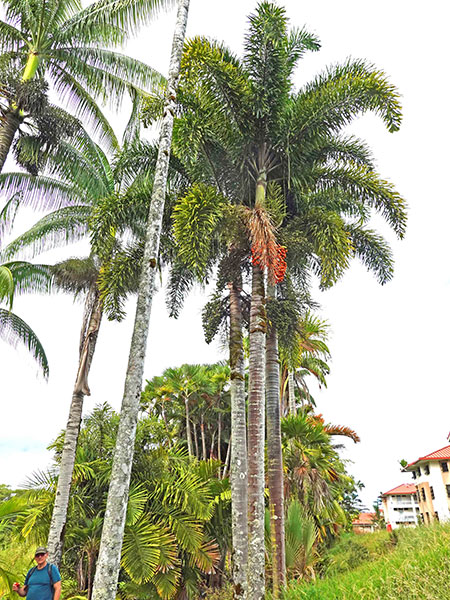
Through a large field, across a courtyard and down a short slope lies the compact palm garden. As there are more than 2600 species of palms worldwide, this portion of the garden can’t hope to be as comprehensive as the cycad section. Yet its 75 species boast a winning combination of the native palms (endemic Hawaiian “loulus” in the genus Pritchardia), the wonderfully weird (such as the gargantuan-leaved duo Kerriodoxa elegans and Licuala peltata var. sumawongii), and the recently discovered. This latter category includes Tahina spectabilis, named for Tahina, a 12-year old girl who is said to have “discovered” the tree on her family farm in Madagascar in 2006, and Wodyetia bifurcata (the foxtail palm), named for an Australian aboriginal man who in 1978 brought this handsome —and now widely grown— tree to botanists’ attention.

Let’s return before signing off to the preface of the book quoted above and cited below. In advocating an embrace of “leisure, slowness and contemplation” Mitchell reminds us that “in an age of presumed efficiencies and professionalism, these amateur virtues are perhaps despised, but they may underlie the greatest joys in gardening, and of life. It is not enough to grow the most beautiful things. It is even better to explore them, to identify with them, and to grow into a rather new consciousness of them.”
On that note, I wish you all peaceful dreams and dreams of peace. See you in the new year.
Horticulturally yours,
Daniel
- From “On the Defiance of Gardeners,” Chapter 1 of The Essential Earthman: Henry Mitchell on Gardening (Bloomington: Indiana U Press, 1981). The UW’s Elisabeth Miller Library has a lending copy.
- Among the most ancient of plants, cycads (divided between two botanical families, Cycadaceae and Zamiaceae), bear a superficial resemblance to palms, to which they are unrelated. Cycads are in fact kin to coniferous trees, but their closest extant relative is another “living fossil”, the ginkgo (Ginkgo biloba). Bromeliads (botanical family Bromeliaceae) are related to grasses, rushes and sedges, and more distantly connected to palms (family Arecaceae).