

Enveloped in Orange
October 2023
Partly because in your orange shirt
—Frank O’Hara1
you look like a better happier St. Sebastian
Depicted in art lashed to a tree and shot through with arrows, Saint Sebastian, it could be argued, is an apt metaphor for the resilience of nature, which perseveres despite the merciless attacks inflicted upon it by witless humanity. However, it’s the orange shirt in the poet’s verse that more firmly captures my attention. Oddly (to my eyes), orange as a concept isn’t afforded due respect. Even the word itself as a reference to color entered the English language only in the 1500s, centuries later than names of all other tones on the optical spectrum. In “refined” gardening circles, orange has often been marginalized, if not reviled. As garden-design guru Penelope Hobhouse writes: “The craving for bright color is like that of a child reaching for a scarlet crayon. Impulsive and primitive, advancing and positive, distorting distance and reducing dimension, vermilion-reds, oranges and the harshest egg-yolk yellows can produce a confused glare on the retina.”2
Call me impulsive and primitive if you want, but I’m a sucker for that saturated, sun-drenched hue. And I’m in good company: Here’s the perspective of my NHS Board of Directors colleague and overall horticultural luminary Lorene Edwards Forkner. “Sometimes, the colors you choose for your garden can act as a kind of spirit guide: Orange is mine—energetic, optimistic, and a little bit tart.”3 Brava, Lorene! I’ll gladly embrace your assessment, especially in the context of providing beacons of light in the gloom of late October’s ashen skies. And let’s not forget the general acceptance of orange as the most emblematic shade of the spirit-filled season leading up to All Saints’ Eve and the Día de los Muertos. Let’s do a timely survey in terms of a gardener’s holy trinity: Flowers! Foliage! Fruit!
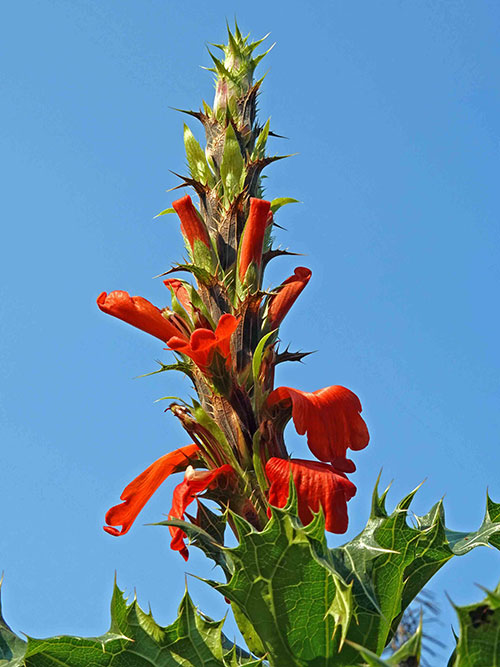
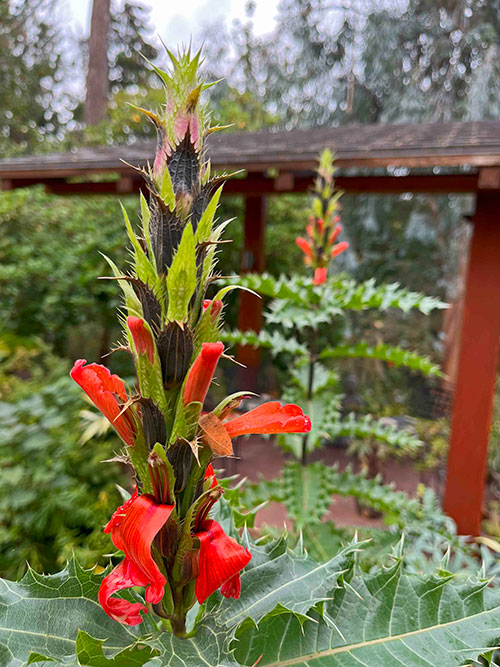
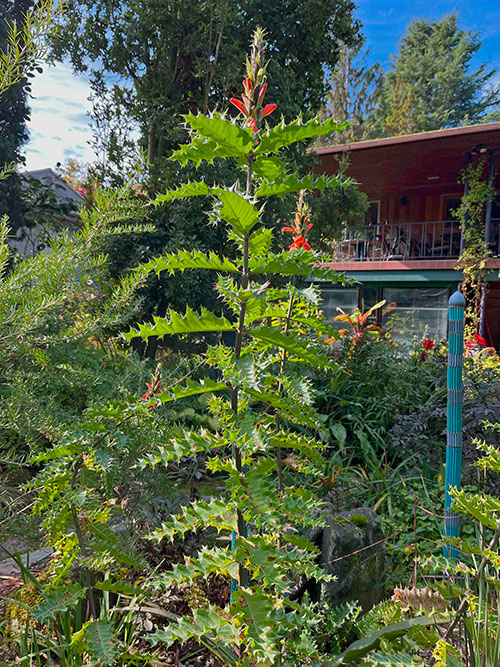
In the floral category, come Halloween only one plant in my garden hits the trifecta that combines orange, black and scary: Acanthus sennii,4 a shrub native to the highlands of Ethiopia that I’ve grown as a herbaceous perennial for 13 years. In mid to late autumn, lurid and glossy vermilion-orange petals emerge like taunting tongues from alternating black and chartreuse bracts atop tall, tawny stems wickedly armed with super spiky —if not spooky— silver-veined opposite leaves that may conjure up a holly from hell. For best results in our climate, it’s advisable to grow it in a container for several years (overwintering it under shelter) so it has time to develop a hefty underground rhizome. Treated thusly, when planted out and frost kills the top growth, fast-growing bronze-tinted shoots will emerge phoenix-like in late spring and grow to six feet or more by early autumn.
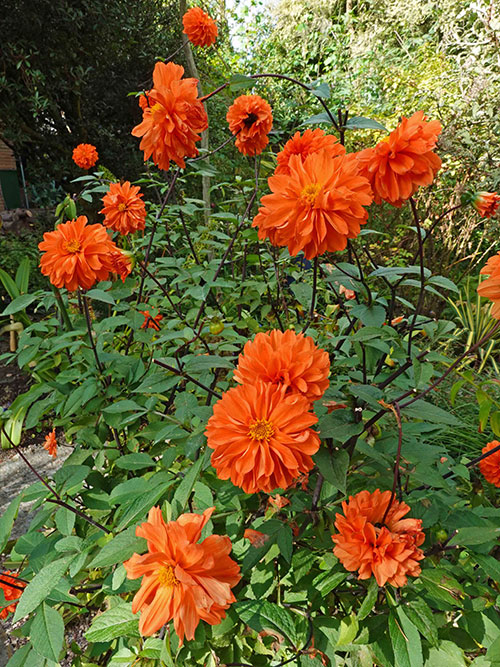

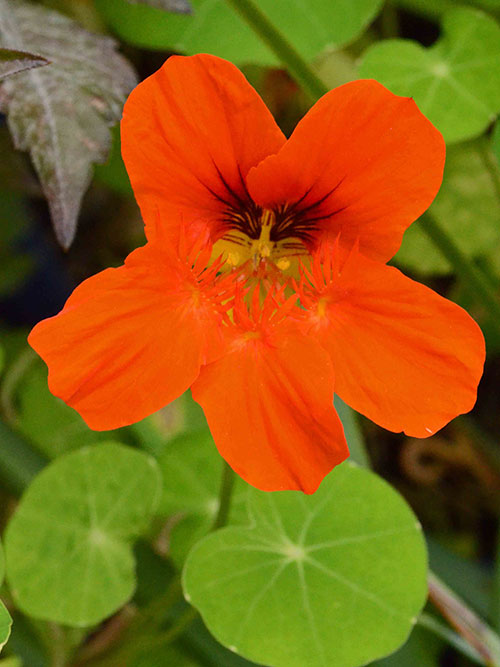
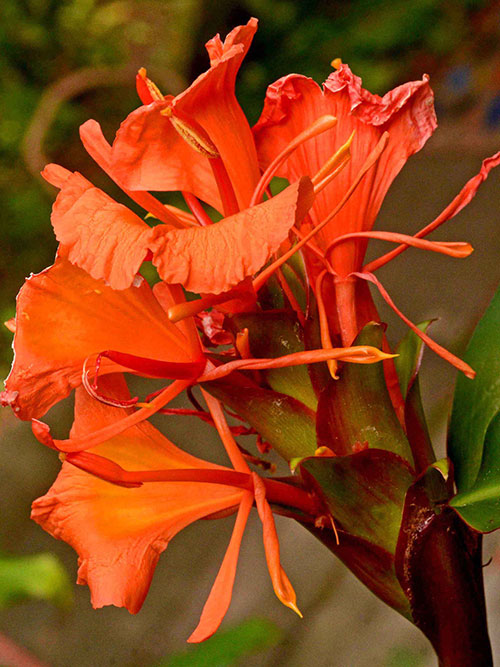
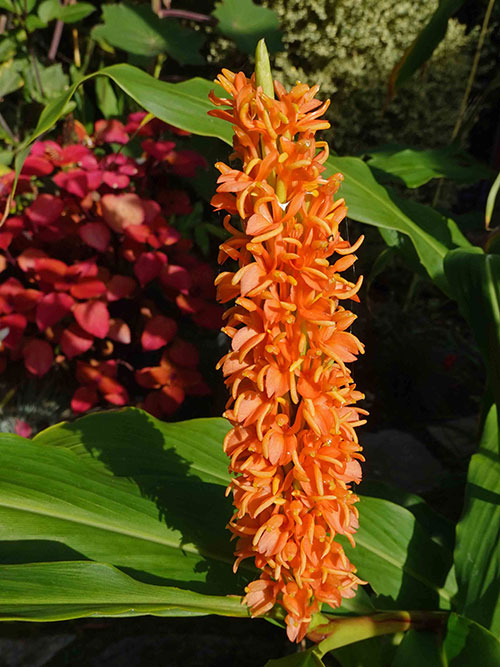
Other orangey blossoms that adorn my late-October garden include a couple of industrious dahlias, the dark-stemmed, peony-flowered ‘Boone’ and the lanky, elegantly single-petaled ‘Forncett Furnace’. Both of these cultivars are much beloved of bees. Also shining on are two hardy gingers: Hedychium greenii, sometimes called butterfly ginger, and a surprisingly remontant clump of Hedychium densiflorum ‘Assam Orange’, whose main bloom time is late summer. The sterile H. greenii, essentially evergreen until knocked down by a hard freeze, sports the added attractions of red stems and leaf backs as well as detachable plantlets that form atop each stalk after flowering. Winding up the floral field, I’d be ungrateful if I overlooked hard-working Tropaeolum majus, the common nasturtium, who keeps on cheerfully pumping out edible blossoms until nipped by frost.
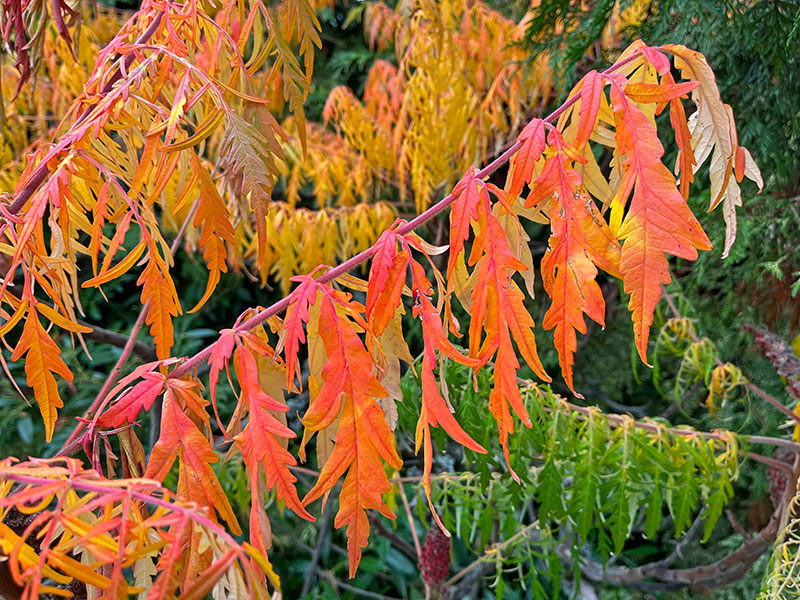
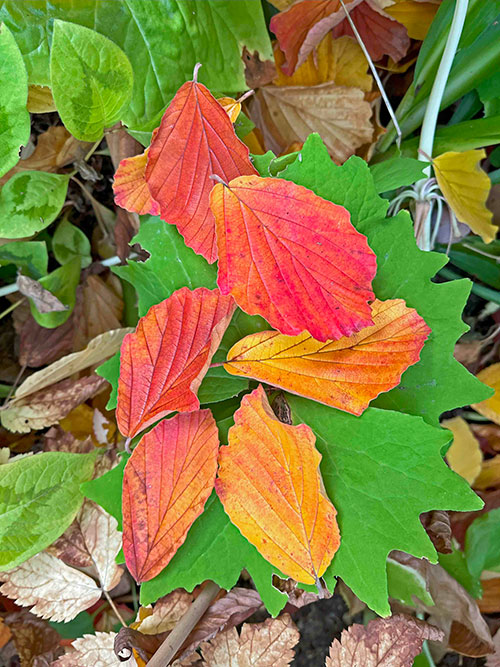
As for foliage, although the biggest color bonanza, that of hot-hued maple leaves, comes on later in my neck of the woods, taking center stage now are the sprawling, fiery and feathery limbs of the North American native staghorn sumac, Rhus typhina ‘Dissecta’. I confess that the sumac photo at the top of this column I shot in a neighbor’s garden, as I foolishly removed and gave away my own plant a few years ago. Also coloring up the Halloween scene are the incandescent leaves of a witch hazel, Hamamelis × intermedia ‘Arnold Promise’. Oddly, my other Hamamelis, ‘Jelena’, is resolutely retaining its summerish green.
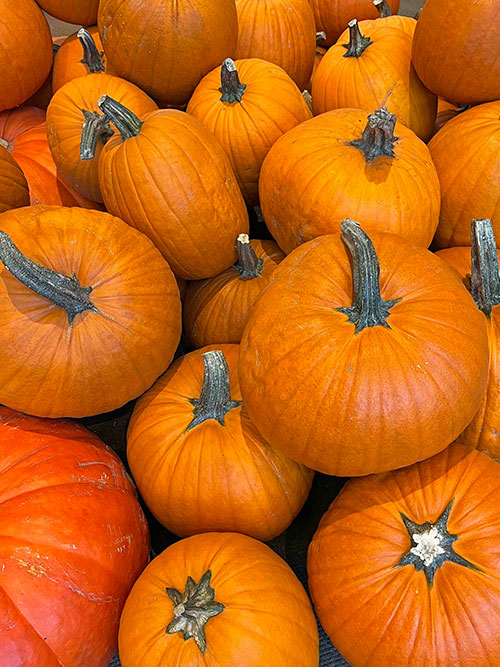
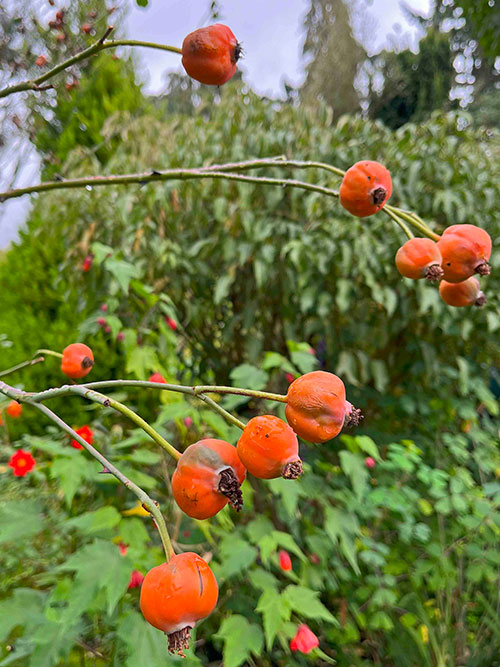
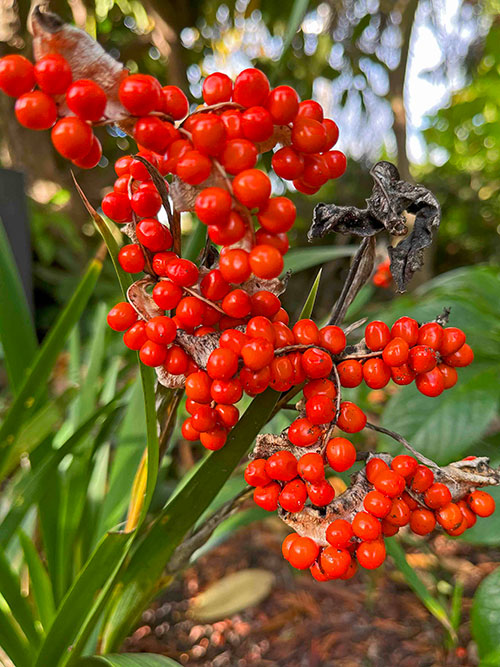
Orbs of orange fruit —especially on shrubs such as cotoneaster and pyracantha— practically beg to be eaten by birds, but the veritable symbol of the season is the incredible edible pumpkin, our all-American Cucurbita pepo subsp. pepo. Due to space limitations, I don’t grow this, but I admire the ubiquitous piles of “pepos” at local markets and farm stands. Other chromatically rich globular fruit strutting around my garden now are the oversized, overhead hips of Rosa ‘Altissimo’ and at ground level, brightly beaded and iridescent seed clusters of the evergreen Iris foetidissima. Let’s round out this ode to orange with an “Olé” for the unabashedly gleeful clumps of Alkekengi officinarum (aka Physalis alkekengi), commonly called Chinese lantern plant, whose 2-inch inflated husks will brighten anyone’s gray day.
Wishing you all avoid (with apologies to Shakespeare) this season’s “slings and arrows”, we’ll meet again mid-November to offer our thanks to —let us hope— a “better happier” Mother Nature.
Horticulturally yours,
Daniel
- Excerpted from O’Hara’s poem, “Having a Coke with You”. Published in The Collected Poems of Frank O’Hara (New York: Knopf, 1971).
- From page 174 of Hobhouse’s Color in Your Garden (Boston: Little, Brown & Co., 1996). First published in 1985 by Frances Lincoln Limited, London. The UW’s Miller Library has a copy.
- From page 56 of Edwards Forkner’s Color In and Out of the Garden (New York: Abrams, 2022). The Miller Library has a copy.
- Acanthus derives from Greek “akanthos”, for thorn, as do Acacia and Pyracantha (“fire thorn”, in reference to its orange fruit).
