

With a Little Help From My Friends (Part II)
February 2023
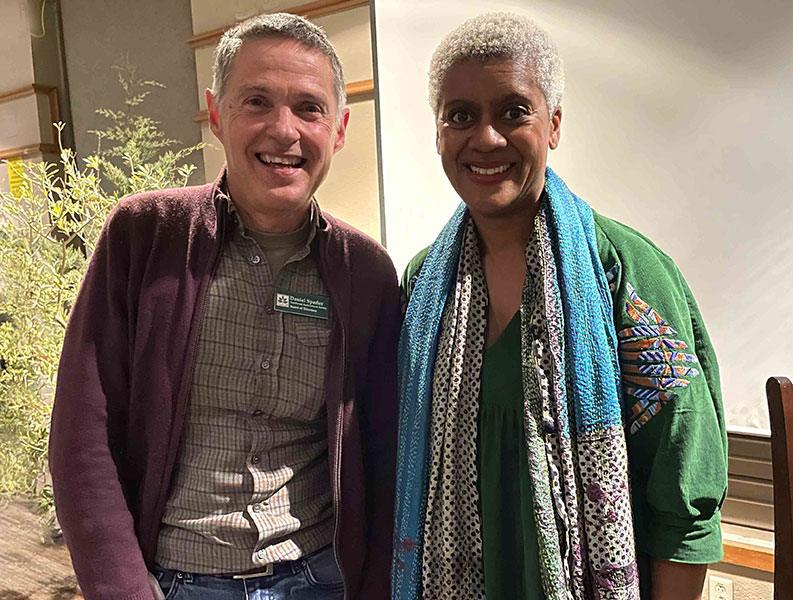
Empowerment entails helping others succeed. …
—Arit Anderson 1
Can you remember being a baby gardener?
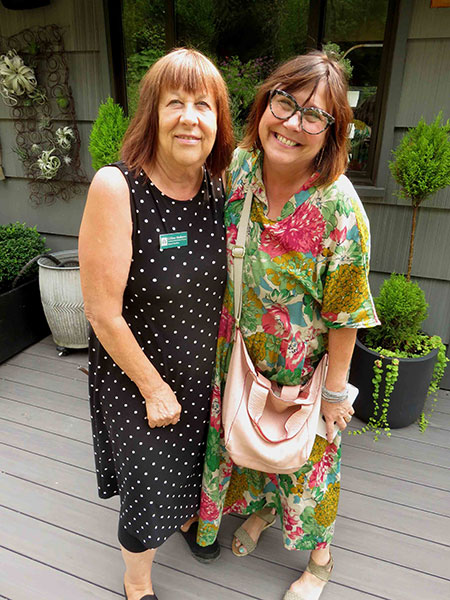
As promised in the last segment of this column, today we’ll hear from four more of my congenial colleagues on the board of NHS (I relish thinking of them as “co-horts”) as they share their assessments of 2022 and prospects for 2023: Lorene Edwards Forkner (author of Color In and Out of the Garden), Ray Larson (UW Botanic Gardens Curator of Living Collections), Barbara Lycett (Barbara Lycett Landscape Designs) and Delaney (Del) Brummet (head gardener at Elisabeth C. Miller Botanical Garden). (Their bios are here).

Before yielding the podium to this quartet of quality, I will note that all five of us exuberated in the effervescent wit and wisdom of Arit Anderson a few days ago (see footnote). Among the many take-away pearls she bestowed was this: “Maintenance is a strange concept when you think of it, as a garden should not be static. It should evolve, not be maintained. … Better we employ the terms care and development.” She also urged us to get out of our individual silos, to converse and collaborate with others all along the gardening spectrum. In that spirit, off we go!
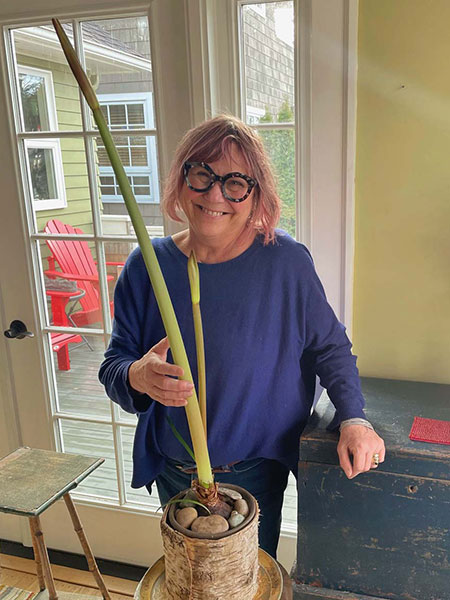
1. Lorene: This was a fun thought experiment. Of course, my list of garden failures was front of mind — I had to “dig” to come up with a solid win. It showed up with only a few weeks left in 2022 when it became evident that the Cybister ‘La Paz’ amaryllis (Hippeastrum) bulbs I kept going through summer were going to rebloom. The stalks grew to nearly 4-feet in the low light of winter and sent out a cluster of beautiful blooms. Surely the most disappointing part of the growing season was discovering that my newly established raspberries, in their first productive crop, had Bushy Dwarf Virus, a condition that causes the fruits to crumble when picked. Hats off to Raintree Nursery for diagnosing my plant. Said raspberries have now been dug up and safely disposed of. Fortunately, the plants were growing in a large stock tank, so the garden soil escaped contamination. So disappointing—I really love raspberries. I’ll start the process over and replant in spring (*sigh*). Plans for 2023 include finishing out and decorating my new potting shed that one of my neighbors, along with my husband, generously built along an exterior wall of the house. I’ll be counting my blessings!
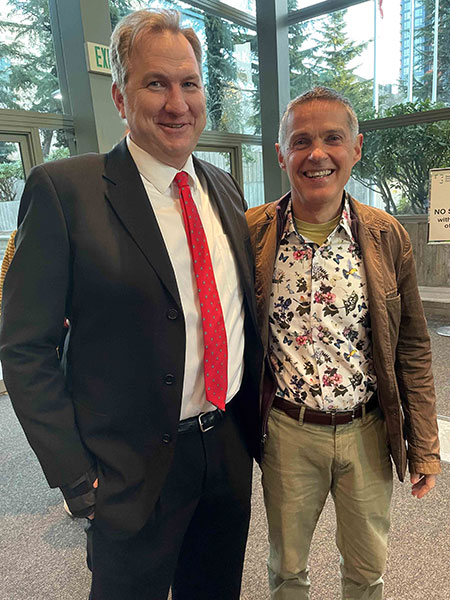

2. Ray: Two cold-induced losses last year in the Arboretum were Daphne bholua and Pittosporum eugenioides. At home it wasn’t as bad, just minor damage to some broadleaf evergreens that mainly recovered; even Tasmannia lanceolata ‘Suzette’ showed new growth by summer’s end. As for joy, one was the excellent flowering of the evergreen Magnolia maudiae at the Arboretum, a fragrant delight for several weeks in spring. Also, the long and prolific flowering of rhododendrons was the best in recent memory. Of special magnificence were R. macabeanum in the Dan Hinkley Asian Maple Collection and the huge R. auriculatum, planted in 1938. This year I’m planning a redo of my lower back garden at home. I’m debating just spreading the contents of my daughter’s former sandbox over what is already well drained soil. A couple of favored trees still in pots might go there: an Acer japonicum ‘Aconitifolium’ and a Magnolia wilsonii. Hydrangea heteromalla also needs to get in the ground this year, as will Rhododendron sinogrande, although it is pickier and requires a suitably shady and protected spot, not too close to thirsty conifers. No concrete design plans yet, but it’s nice to have a blank slate to work with.
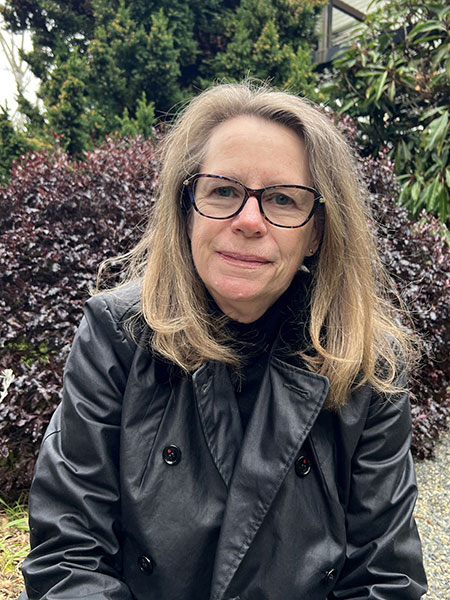
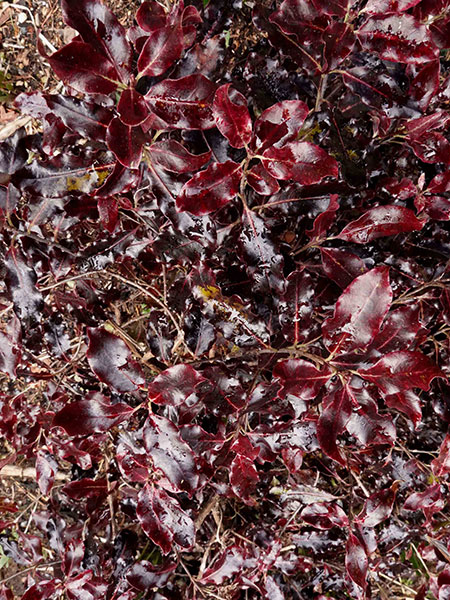
3. Barbara: After the extreme cold we endured last winter, I was delighted that some of my favorite plants survived, including a Leptospermum grandiflorum ‘Eugene Hardy’ and both of my Pittosporum tenuifolium ‘County Park Dwarf’ shrubs. As to loss, much of it was caused by critters: Did you know that a group of rabbits is called a fluffle? A very hungry fluffle descended on my garden three weeks before it was to be on the NHS Meet the Board tour in June. They devoured every grass plant in a key part of the garden. I had to rush out and buy replacements. In the coming year I hope to be able to better control the rabbits, rats and mountain beavers that eat my plants. In the meantime, I will distract myself with a visit to Singapore, The Garden City. They have added a giant park, Gardens by the Bay, that is over-the-top amazing. In addition to the wonderful botanic garden (founded in 1859) there are many other parks and wild spaces connected by a series of six garden loops. Also, I started following @BotanyGeek on Instagram and now I have an even longer list of gardens, parks, buildings and rooftop gardens to see.
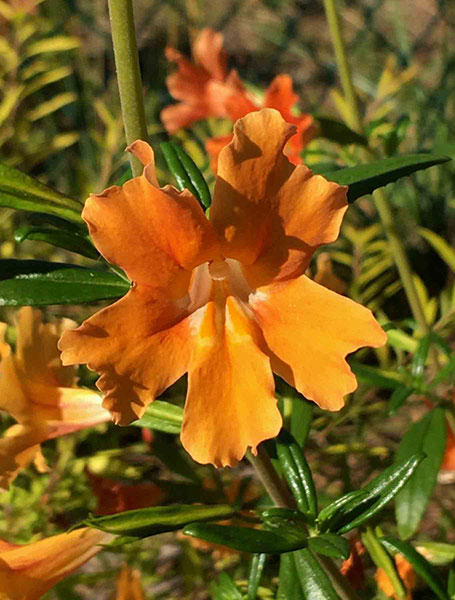
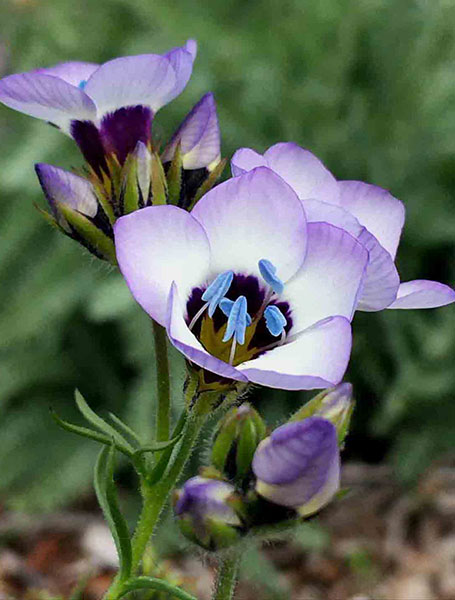
4. Del: My favorite plant of 2022 in my home garden was the bush monkey flower, Diplacus aurianticus, which bloomed from June until late October! It died to the ground in the winter cold but sprouted back in spring and proved itself a tough cookie, needing little supplemental irrigation in our arid summer. At the Miller Garden, one of our great successes was sprouting several Wollemia nobilis from seed. Only about 1 in 300 seeds of this endangered Australian conifer is viable. On the negative side of the ledger, in our home garden we planted a fuzzy-stemmed evergreen shrub, the filo dough tree Polylepis lanata, a high-elevation Andean native, and admired its shaggy bark, but winter’s repeated cold snaps did it in. For 2023 we are sowing large quantities of Pacific Coast native annuals that are both drought tolerant and long blooming. They also outcompete many weeds! Included on this roster are the exceptionally pretty Gilia tricolor, along with Collomia grandiflora, Collinsia grandiflora, Clarkia purpurea, and Limnanthes douglasii.
This wraps up our recap of 2022. We’ll meet again in mid-March, just before the equinox.
Horticulturally yours,
Daniel
- From “A Conversation with Arit Anderson,” a Northwest Horticultural Society event held Feb. 16 at the Center for Urban Horticulture. Arit’s Growing Greener podcast series is on the BBC’s Gardeners’ World Magazine website. She served as Show Judge for the just-concluded NW Flower & Garden Festival.