

Reflections on a Scorching Summer
September, 2021

Roasted rhodies, blistered begonias, desiccated dahlias, fricasseed ferns… Although my garden has largely recovered from the trauma, visions of damage wrought by late June’s unprecedented heat dome still dance in my head. Since we last communed in these lines at the end of May most of us have slogged through a sizzling season struggling to stay cool and keep ourselves and our parched gardens properly hydrated. As we commence Season Two of Horticulturally Yours, let’s pause to ponder this parable. What can it teach us about gardening on a rapidly warming planet?
Lest we seem frivolous or callous, let us first acknowledge the horrible loss of human life caused by this summer’s treacherous conditions. According to the Washington Department of Health there were 100 heat-related deaths from June 26 to July 2, 2021 in our state, a staggering increase over last year, which saw only seven over the entire summer. Our neighbors to the north fared much worse: British Columbia’s chief coroner confirms that the province suffered 570 deaths directly attributable to June’s hellish heat. The town of Lytton, BC shattered Canada’s all-time record for hottest temperature on three consecutive days, culminating at 121 degrees Fahrenheit (49.6 Celsius) on June 29.
An international benchmark of hot weather is temperatures in excess of 30 degrees C, or 86 F. This year Seattle reached or exceeded that threshold on 14 days (On 20 days in Olympia). Near the relative cool of the Salish Sea, we got off lightly: Our friends in Portland have suffered through 53 such days this season, 20 of them in July alone. June 28 saw Portland hit an unfathomable 116 degrees.
Given that government seems unwilling or incapable of enacting meaningful policies to mitigate the devastating impact of climate change, it falls on us to do whatever we can to protect ourselves and those around us. An appropriate place to start is in our gardens and shared greenspaces: As banners in the Royal Sydney Botanic Garden attest, “No plants, no planet.”
Studies show that deadly urban heat islands can be cooled dramatically by planting trees, vines and shrubs. There’s no better time to do this than now, as autumn begins. Shade-creating vegetation on southern and western sides of target areas will cool residences and garden spaces alike, providing shelter and other benefits to humans as well as wildlife and pollinators.
Before we peruse a plant palette that may fare better in heat spikes than many natives, we must also consider the other face of the two-headed beast of climate change: Protracted drought. In the three-month period from June 15-Sept. 14, 2021, Seattle saw only a fraction of an inch of precipitation (0.13 to be exact). Among the 50 largest U.S. cities, only Portland (at 0.08) and a few spots in California got less (although Los Angeles and San Diego, at 0.25 and 0.24, nearly doubled Seattle’s total.) Compare this with New York’s 30.11 inches, Atlanta’s 17.38 and even desert-embracing Tucson’s 12.41.
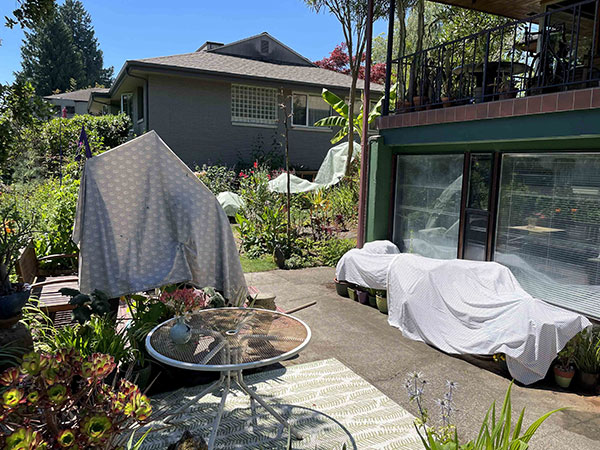
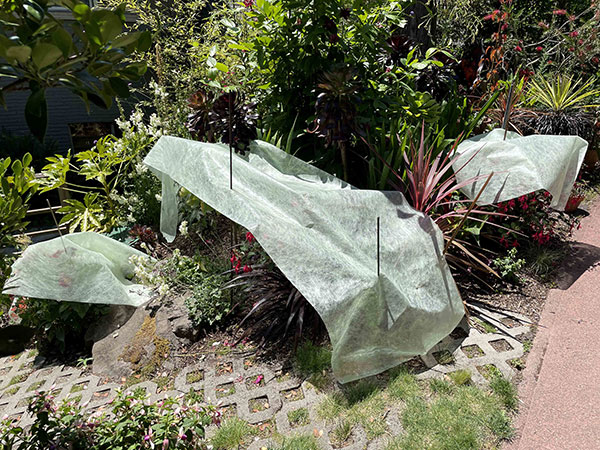
Three months have passed since the searing heat of early summer maimed or destroyed several of my botanical treasures – despite my having shrouded and wrapped large swaths of the garden in shade cloth. What can be learned from this, and how can we apply this knowledge while embarking on a new planting season? Following is an assessment from my own garden of a few sun-loving and heat-tolerant, but shade- and habitat-providing shrubs and trees (evergreen unless otherwise noted) that not only emerged unscathed from June’s furnace but also are modest in summer water requirements. Attentive readers will note that several were featured in Season One of Horticulturally Yours.
Daniel’s Defiant Dozen


Acca sellowiana (pineapple guava). Elegant, leathery, ovate leaves and deliciously edible flowers. Fast grower, tolerant of hard pruning.
Calycanthus ‘Aphrodite’ [Plant Patent 24,014]. Fast growing, lush foliage. Blooms for months. Wine-hued, magnolia-like flowers smell strongly of merlot, or maybe malbec. Deciduous.
Chamaerops humilis (Mediterranean fan palm). Good drainage is about its only requirement. Slow growing at first, it makes an excellent screen and refuge for birds.
Choisya ternata ‘Sundance’ (Mexican mock orange). Glossy, fragrant, chartreuse foliage and frequent blossoms. Fast growing.
Cupressus sempervirens ‘Swane’s Golden’ (Italian cypress). Stays a bright gold all year. Maintains a neat and narrow, columnar shape. Birds love it for nesting.
Eucryphia (various cultivars). Shiny, smallish leaves yield dappled shade. Columnar. Flowers in July and August, its fragrant blossoms bewitching bees and gardeners alike.
Ficus carica ‘Petite Negri’ (hardy fig). Wider than tall, grows rapidly; large leaves provide ample shade. Bears two crops per season of dark, edible fruit. Deciduous.
Lomatia myricoides (hardy Australian protea). Light shade from long, feathery, lightly toothed leaves. Curlicue white blossoms in July prove irresistible to pollinators. Handsome, spreading, multitrunked tree with age.
Tasmannia lanceolata (syn. Drimys: Tasmanian pepper bush). Elliptical, aromatic leaves, gorgeous red stems, edible black peppercorns in autumn.
Taxus baccata ‘Fastigiata’ (columnar Irish yew). Strongly upright, narrow growth. Glossy, dark green foliage with red berries much loved by birds and squirrels.
Trachycarpus fortunei (windmill palm). Easiest palm for the Pacific Northwest. Foolproof.
Thaumatophyllum bipinnatifidum ‘Hope’. OK, you caught me. I had to slip in this heat-relishing Brazilian philodendron that might, just might make it through a mild winter if given adequate overhead shelter. Create your own Jurassic Park in the shade: Each hypnotic, exotic, deeply cut, lustrous leaf grows quickly to three feet. If kept in a large plastic liner, you can pull it into the garage before a freeze.
Happy to be back for another year of botanical musings, I invite your comments on these topics as we ease into autumn.