

Euphorbia: An Admirable Adversary
April, 2021
Although a single consonant separates “euphorbia” from “euphoria,” these terms could scarcely be further apart in the minds of most gardeners. Just ask my friend John, who recently spent several hours in the emergency room due to impaired vision and shortness of breath after a nasty encounter with a vindictive clump of the stuff (probably E. characias subsp. wulfenii) he was attempting to eliminate. Yes, euphorbias know how to defend themselves: When cut, crushed or chomped on, the caustic, sticky latex that emerges quickly teaches the unprotected perpetrator a vivid lesson. Gloves, long sleeves and goggles are de rigueur if you intend to work on them. As some people, like John, report lung irritation simply from breathing in fumes from the latex, a KN95 mask might also be in order.

Given the peril they can pose, it may seem puzzling that euphorbias, also known as spurges, abound in our gardens. Clearly, they must possess redeeming qualities. What is it that renders them appealing? In brief, it’s their easy adaptability to harsh conditions and multi-season visual interest. I have grown more than 30 taxa over the same number of years. After a few explanatory comments, I will spotlight two of my favorite euphorbias, which happen to be the mightiest (E. mellifera) and the most miniscule (E. obesa) of my collection. Both of these relatively benign species were given the Royal Horticultural Society’s Award of Garden Merit in 2002.
As with many toxic plants, euphorbias have been used selectively and sparingly for medicinal purposes since time immemorial. The term euphorbia dates back at least to the Roman polymath Pliny the Elder in the 1st century of the Common Era, who described several North African varieties and attributed the name as an encomium to Euphorbus, physician to King Juba II of Mauritania. The English common name “spurge” appeared around the year 1400 via Old French from the Latin expurgare (“purge,” “cleanse,” “purify”) in recognition of the extreme laxative properties of euphorbia extracts.
The mammoth and cosmopolitan genus Euphorbia comprises nearly 2,000 species, a sum exceeded by only three other genera of flowering plants. Diverse to a mind-blowing degree, the genus runs the gamut from the lovely, if hackneyed poinsettia (E. pulcherrima – the specific epithet is Latin for “most beautiful”) to the highly annoying, mat-forming weed E. maculata (Latin for “spotted”), where “spurge” and “scourge” merge. Filling the chasm between these two are a host of towering, columnar cactus doppelgängers native to Africa —many of which happily adapt to container culture— and the stoloniferous perennials from the Mediterranean that are old standbys in our Pacific Northwest gardens.

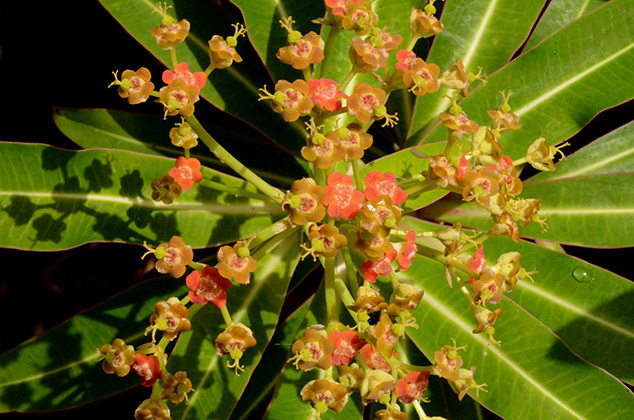
On to today’s features: In 1999 my friend Javier gave me a tiny seedling of E. mellifera, commonly called Canary spurge or honey spurge. Endemic to the Macaronesian islands of the Canaries (Spain) and Madeira (Portugal) in the North Atlantic, this potentially tree-like titan can reach 50 feet in its native habitat, although in our climate it grows into a handsome, multi-trunked, six-to-eight-foot evergreen shrub if planted in a well-drained, somewhat sheltered site. That my original specimen has not only thrived, but also produced a few offspring over the last two decades is a testament to its hardiness. As its name indicates (mellifera = “honey bearing”) the complex blossoms, produced in abundance in April and May, smell like warm honey. Pay close attention to the monthlong evolution of the fascinating inflorescence as it develops into a cyathium, a process unique to euphorbias. After a few years, some trunks may end up looking a bit bedraggled. When this happens, simply lop them down individually or collectively (wearing proper protection, of course) to a foot-high framework, then stand back and watch the new growth emerge. Flowering should resume on second-year growth.
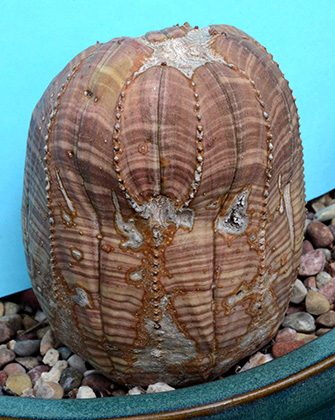
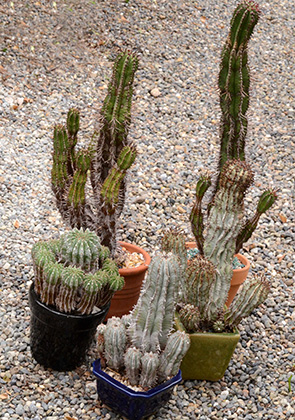
In stark contrast, E. obesa is to E. mellifera as a Chihuahua is to a Great Dane. The source of its specific epithet, “obesa” is transparent: This diminutive, rotund oddity, endemic to South Africa, is sometimes called baseball plant, although when young it is nearly a dead ringer for a green tennis ball. In old age it elongates, adding a second story so to speak, and changes in color from green to a striated, pinkish brown, adorned with vertical ribbing reminiscent of stitches on a baseball. Mine has lived contentedly in a broad but shallow ceramic tray for 18 years and now measures 95 millimeters, or just shy of 4 inches in height. In early summer, its tonsured pate sports minute chartreuse blossoms. Although frost tolerant if kept dry in winter, it’s best to bring it inside if a deep freeze looms.

Want to know more? Check out Euphorbias: A Gardener’s Guide by Roger Turner, published by Timber Press in 1995. Although no longer in print, it’s still available from some book purveyors, and the Miller Library at the Center for Urban Horticulture in Seattle has two copies.
Horticulturally yours,
Daniel