

Alluring Illiciums
March, 2021
With this 10th episode of Horticulturally Yours we begin our sixth month of ruminating on plants that bring us joy. Thus far we’ve covered a mix of tender to half-hardy perennials and flower-forward evergreen shrubs and trees. The common denominator has been their origins in the Western Hemisphere, mainly the swath from Mexico and points south all the way to Patagonia. Today we continue down this trail while also opening a path across the Pacific to East Asia as we aim our sights on two shiny species of star-anise shrubs in the genus Illicium.
We should stress at the outset that despite the appetizing moniker, only one species, Illicium verum, the “true” star anise, bears edible seed or essential oil. All others, including the two that star in this column, are highly toxic if ingested, although several species are used medicinally and show significant potential in combating cancer and viral diseases in humans. Nevertheless, the fragrant foliage and flowers of most species explain the term that the godfather of binomial nomenclature, Carolus Linnaeus, applied to the genus in 1759. “Illicium” in Latin means “that which entices.”
Among the most ancient of all angiosperms (flowering plants), Illiciums have been around for nearly 150 million years, since the late Jurassic or early Cretaceous era. These shade-loving evergreens are thought to have evolved as understory plants in the gloomy environs of long extinct giant conifers. They emerged in two widely separated spots: More than 30 species are found in Asia (centered in China) while the other half-dozen species arose in North America, from the Caribbean to the southeastern United States and westward to Mexico’s Gulf Coast. I have successfully grown two species, one Asian, one American: I. simonsii from China’s Sichuan province, and I. mexicanum from moist forests of the Sierra Madre Oriental in the state of Veracruz.

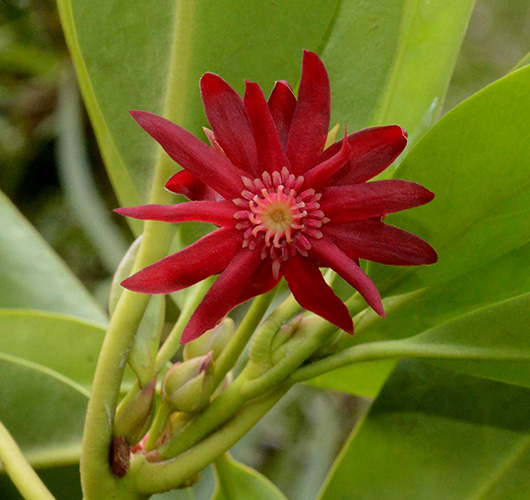
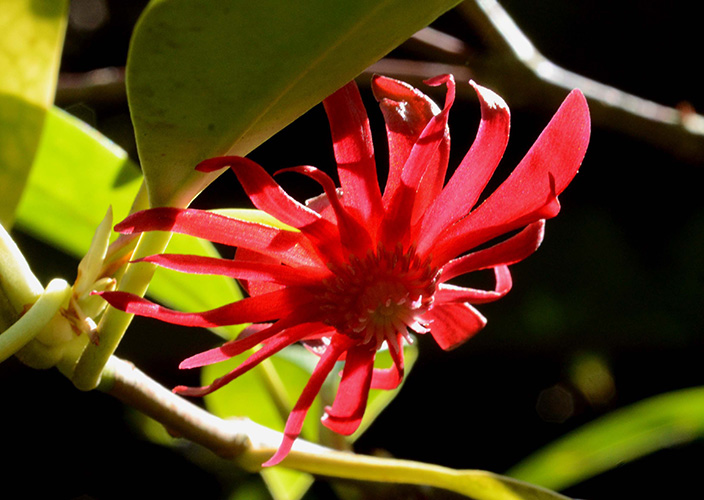
Let’s begin with the latter, which I obtained 20 years ago at Cistus Nursery near Portland and ignorantly planted in my garden in full sun. This was my first experience with an anise tree; I think its appeal must have been the enticingly fragrant foliage coupled with Sean Hogan’s warning on the plant’s nursery label that the blossoms of Illicium mexicanum were fetid, like “St. Bernard breath”. I was hooked by this paradox. The shrub was slow to establish, undoubtedly due to my having tortured it in a dry, sunny bed, but within a couple of years a trio of fast-growing neighbors —a Taxus, a Lomatia and an Edgeworthia— were providing the shade it craved. Later came the solitary, multi-tentacled, primordial blossoms that remind me of ruby-red sea anemones suspended at the end of each slender branch. Over the years my specimen has grown to eight feet in height, with multiple trunks and a floor-to-ceiling skirt of glossy, olive-green acuminate leaves that vary in length from as few as two inches to as many as seven. Main bloom time is April and May, and only on warm days do I detect an odor (which I find oddly appealing). This year buds formed early; a few opened fully in late February with many more now on the way.
In March of 2015 I obtained from Windcliff a specimen of Illicium simonsii that Dan Hinkley originally collected in Sichuan in November, 1999. In his 2009 tome The Explorer’s Garden Hinkley describes the blossoms of his first crop of seedlings in 2005 as “primarily ivory white”; however, mine puts out a profusion of buttermilk yellow flowers. In six short years my plant, more tree-like than its Mexican cousin, has shot up to 10 feet in height. Its leaves are more evenly sized, at a nearly uniform 4 inches, and peak bloom comes in February and March. This year it was unphased by a 12-inch snowfall and a full week of subfreezing nights. As charming as the clustered creamy blossoms are when fully developed, in bud they are just as cute, with distinct pink blush marks adorning the calyx prior to opening.
These days around a dozen cultivars and hybrids of star-anise shrubs are on the market, sporting names such as ‘Grey Ghost,’ ‘Florida Sunshine’ and ‘Halley’s Comet’. Most are crosses or selections of I. floridanum and I. parviflorum, both natives of the Southeastern United States. As such, bewitching and beautiful as they may be, they’re probably better suited to the heat and humidity of that region than to our relatively cool summer habitat. On the other hand, my two decades of hassle-free experience with the pair of species we have spotlighted today have made me their staunch advocate.
We’ll next meet on the brighter side of the approaching equinox.
Horticulturally yours,
Daniel